
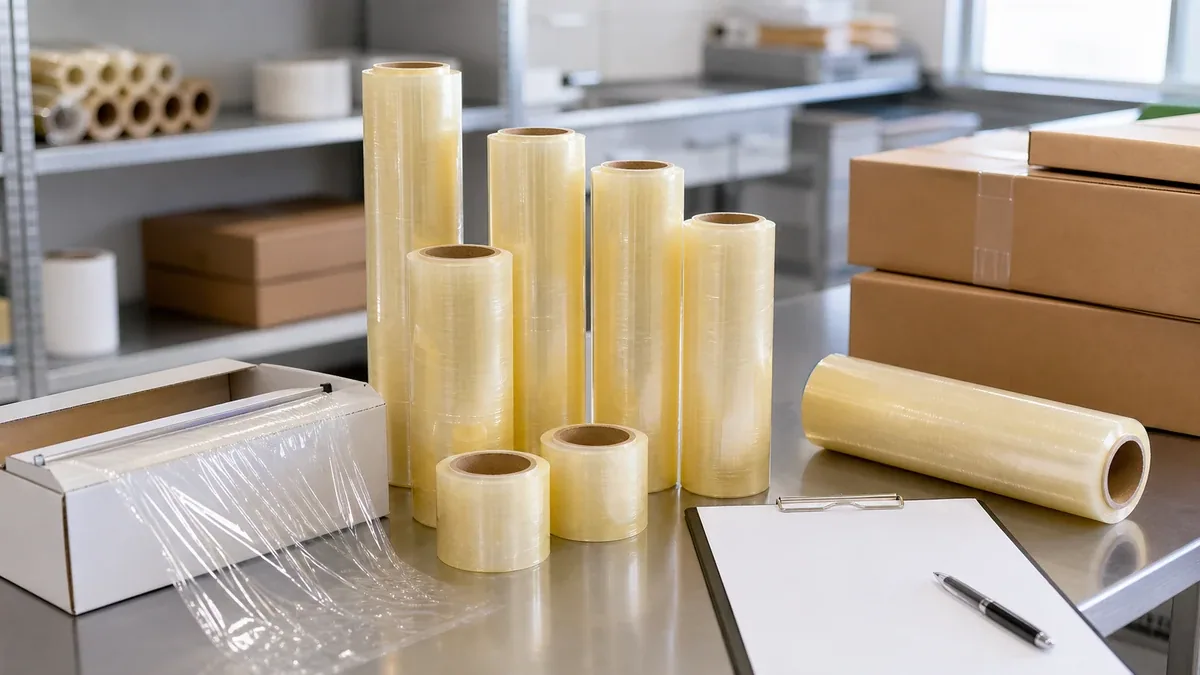
Questions about whether PVC cling film is “phthalate free” quickly lead to the formulation: which plasticizer is used, which market rules apply, what the test covered, and whether production can change. A yes-or-no supplier statement cannot carry that entire review.
Identify the Exact Product First
Record supplier, manufacturing site, SKU, film structure, formulation or controlled formulation reference, thickness range, intended foods, contact time and temperature, and destination market. A statement for “PVC film” generally is too broad to connect to a shipped roll.
Questions that a generic compliance letter cannot settle
Does FDA authorization mean a substance is suitable for every PVC film? No. Regulatory basis, restrictions, food type, contact conditions, formulation, and finished-product evidence still have to match.
Can the public PE report support a PVC order? No. It identifies a submitted PE sample, not PVC. YIYUAN’s commercial roll page lists PE or PVC as order-specific options; a PVC order needs its own formulation and market review.
Ask What Plasticizer Is Used
- What is the chemical identity or suitable controlled identifier?
- Is it intentionally used in this exact formulation?
- What supplier and raw-material controls prevent unapproved substitution?
- What destination-market basis and restrictions are being relied on?
- Do declarations and test reports identify the same product and formulation?
- What change-notification rule applies to the plasticizer or resin source?
Read Current U.S. Information Carefully
FDA’s phthalates in food-contact applications page, current as of June 24, 2026 when this article was prepared, states that nine phthalates remain allowed in food-contact applications under specific regulatory contexts and describes an ongoing post-market evaluation. It also explains that 23 authorizations were revoked in 2022 because uses were abandoned. This does not mean every allowed substance is suitable for every film or condition, and it does not establish the composition of a supplied roll.
Do not convert “authorized somewhere” into “approved for this product”: Match the substance, applicable authorization or regulation, limitations, food type, use condition, and formulation evidence.
Build an EU Review Around the Article and Use
The European Commission’s food-contact materials overview points to general, good-manufacturing-practice, plastic-specific, and other applicable requirements. The buyer’s reviewer should determine which measures and national rules apply to the finished film, its substances, documentation, testing, traceability, and intended use. A U.S. document is not a substitute for the EU review, or vice versa.
Check Reports for Scope and Method
For each report, verify laboratory, issue date, sample description, material, color, thickness, report holder, test method, simulants or analytical scope, contact conditions, results, units, limits, and conclusion. Confirm whether the submitted sample represents current production. A “phthalate test” may cover only a named analyte list; it does not reveal every formulation component.
Control Changes After Approval
Require written notice before changes to resin, plasticizer, additive package, color, recycled content, manufacturing site, thickness range, or relevant raw-material source. Decide which changes need document review, testing, and a new approved sample. Store current declarations and reports by SKU and revision in the buyer file or document request process.