
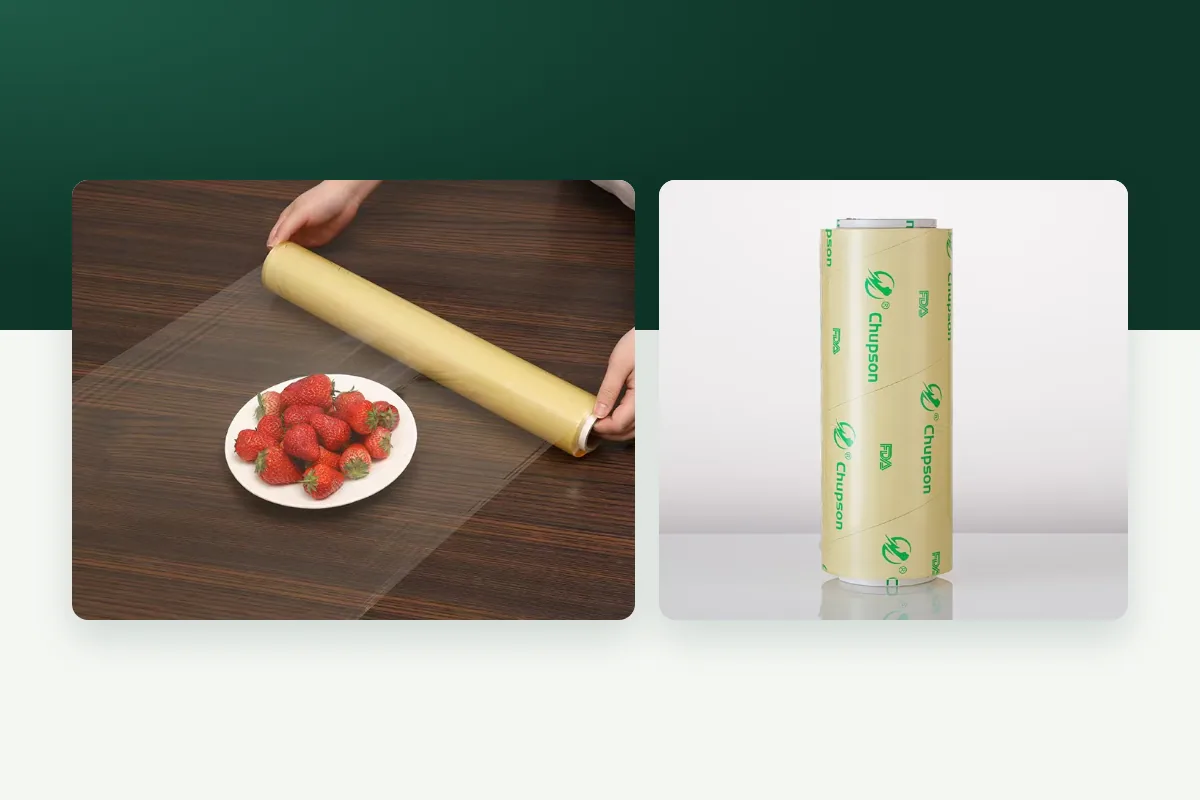
At a cheese counter, cling film does one job well: it seals the cut face of a piece that will be sold within days. Press the film flat against the cut surface with no trapped air, use a fresh sheet every time the piece is cut again, and label the wrap with the cheese and the cut date. For whole wheels and longer storage, many cheesemongers prefer cheese paper, which lets the rind breathe. Use the film where it works best, and size the roll from your largest piece, not your average one.
Where film works and where it does not
| Cheese or task | Film? | Why |
|---|---|---|
| Cut pieces of hard and semi-hard cheese for sale | Yes | Tight wrap slows drying of the cut face and shows the cheese clearly |
| Cut face of a wheel in the display | Yes, on the cut face | Covers the exposed paste; the rind can stay uncovered |
| Sliced or grated cheese on trays | Yes, as a tray overwrap | Standard tray wrapping; the film does not touch every slice |
| Soft, bloomy-rind cheeses | Gently, or in a box | Film pressed hard onto the rind can stick and tear it on opening |
| Whole wheels in storage | Usually not | Cheese paper or the original packaging lets the rind breathe |
Wrapping a cut piece
- Pull a sheet a little longer than the distance around the piece.
- Lay the cut face down on the film and smooth the film onto it first, pushing air to the edges.
- Fold the long sides up and over so they overlap on the rind side, then fold the ends like a parcel.
- Label the wrap with the cheese, weight, price and cut date.
- When the piece is cut again, discard the old film and wrap with a new sheet.
Thin film, 8–10 μm, conforms to the cut face more easily than thick film. If wrapped pieces stick to each other in the display or the film tears on rind edges, sample a thicker film. Our guide to why cling film tears or does not stick lists the usual causes.
Choosing the roll width
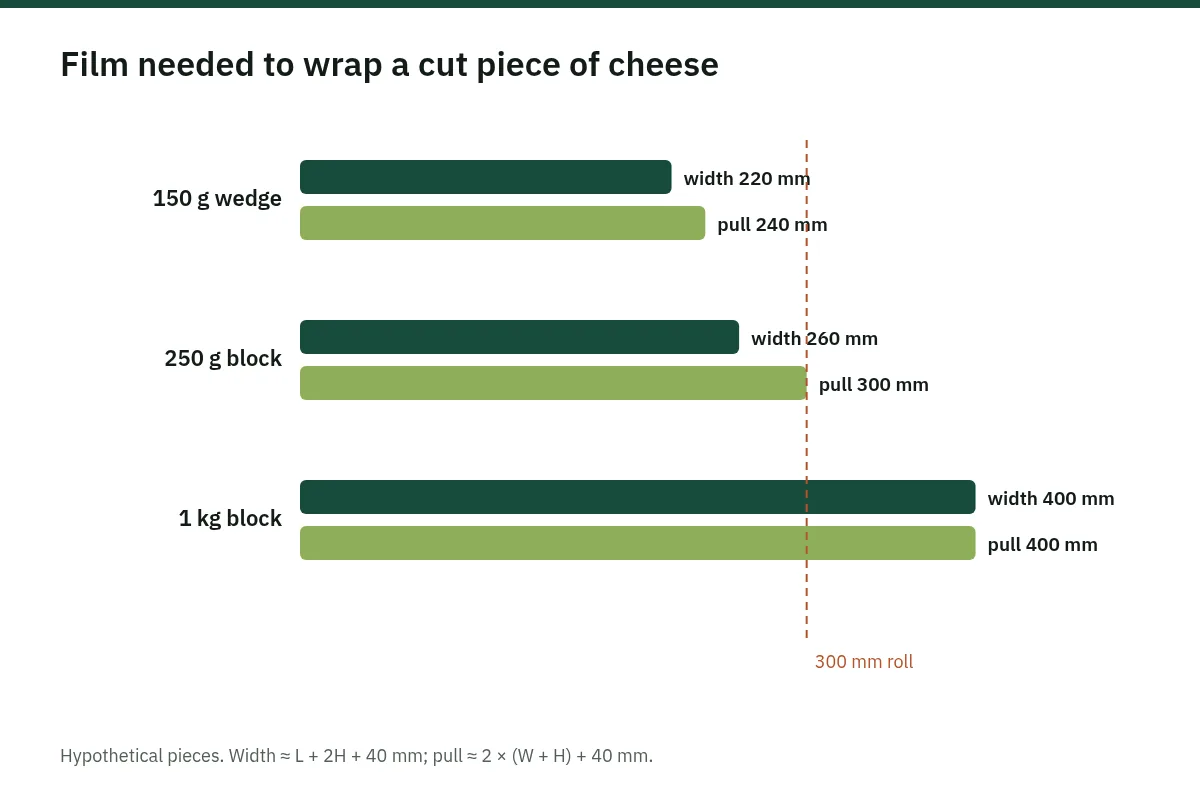
For a block of cheese L × W × H, a parcel wrap needs a roll width of about L + 2 × H + 40 mm, so the film can fold over both ends, and a pull of about 2 × (W + H) + 40 mm to go round the piece with an overlap.
| Piece (hypothetical) | Size | Width needed | Pull per piece | Roll |
|---|---|---|---|---|
| Small wedge, about 150 g | 100 × 60 × 40 mm | 220 mm | 240 mm | 300 mm |
| Block, about 250 g | 120 × 80 × 50 mm | 260 mm | 300 mm | 300 mm |
| Block, about 1 kg | 200 × 100 × 80 mm | 400 mm | 400 mm | 450 mm |
Most counters wrap retail pieces on a 300 mm roll and keep a 450 mm roll for large blocks and cut wheels. Our commercial cling film roll comes in 300, 350, 400 and 450 mm widths; the 300 mm × 300 m roll is explained in our counter roll guide.
Temperature and labelling
Film does not replace refrigeration. Under the FDA Food Code 2022, foods that need time and temperature control for safety are held cold at 5 °C (41 °F) or below, and many soft cheeses fall into that group. Which cheeses count depends on the cheese and on your local rules, so check with your food safety authority. Keep wrapped pieces in the chilled display and rotate them first in, first out.
If you sell pre-wrapped pieces, your market may also require ingredient, allergen and weight information on the label. That is a labelling question for your own business; the film is only the wrap.
Worked example (hypothetical)
A hypothetical deli counter cuts about 60 pieces a day, mostly 250 g blocks, and wraps them on a 300 mm × 300 m roll.
- Pull per piece: 2 × (80 + 50) + 40 = 300 mm.
- Pieces per roll: 300,000 ÷ 300 = 1,000 before waste, about 900 with a 10% allowance.
- Roll life: 900 ÷ 60 = 15 days.
The counter uses about two rolls a month for retail pieces. It keeps one 450 mm roll for the cut faces of wheels and 1 kg blocks, which uses far less film, and orders both widths together each quarter.
Data sources
Widths, lengths and the 8–12 μm thickness range are from our commercial cling film roll and PVC hand wrap product pages and the product catalog. The cold-holding temperature is from the FDA Food Code 2022. Piece sizes, wrap allowances and the counter’s volumes are hypothetical planning figures.
Ordering film for a cheese counter
Send us the sizes of your largest and most common pieces, how many you wrap a day, the dispenser you use and whether you want PE or PVC film. We can send samples in two thicknesses so you can test them on your own cheeses.
Custom sizes. Width, length, thickness and rolls per carton can all be adjusted to your specification. Custom specifications have a reasonable minimum order quantity. If your order is below it and you still need a custom size, a small customization fee may apply. We confirm both in the quotation.
Prepared by YIYUAN NEW MATERIALS, a cling film and aluminum foil packaging manufacturer in Shangqiu, China. We supply overseas importers and distributors at factory-direct prices with consistent quality, and we have completed orders with a large number of overseas buyers, many of whom first contacted us through this website or through WhatsApp and other social apps. Updated November 24, 2026.