
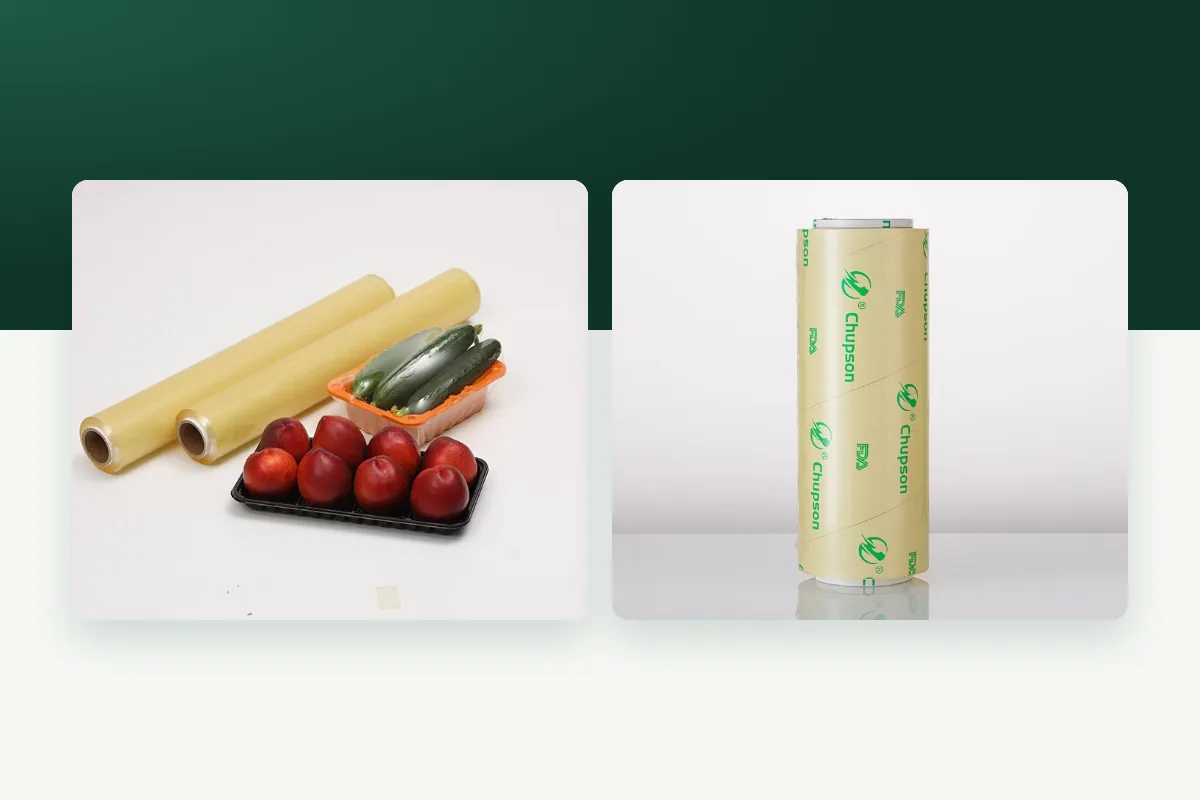
Egg packers and supermarkets that sell eggs on open trays use cling film to hold the eggs in place and keep the tray clean. Egg trays need a different approach from meat or produce: the film must hold firmly without pressing hard on the shells, and a 30-egg tray is so large that it needs a much wider roll than most fresh-food packs. Measure each tray with eggs in it, calculate the roll width for each format, and wrap with low tension. A packer selling 6, 10 and 30-egg trays usually needs two roll widths, not three.
What the film has to do on an egg tray
- Hold the eggs in their cells when the tray is lifted, tilted or stacked.
- Not crush or crack shells. Pull the film just tight enough to sit on the eggs; let the cling of the film hold the folds.
- Close underneath so the tray does not slide out when a customer picks it up by one edge.
- Stay clear so customers can check for cracked or dirty eggs without opening the pack.
PVC cling film suits this because it clings to itself under light tension. A film that only holds when stretched hard is the wrong choice for eggs.
Calculate the width for each tray
Use the planning rule from our other tray guides: roll width ≈ tray side across the roll + 2 × height with eggs + 2 × tuck-under allowance. Start with about 50 mm per side for the tuck-under. Measure the height with eggs in the tray; eggs stand well above a pulp tray’s rim.
Egg tray sizes vary by maker and market, so the dimensions below are examples a packer might measure, not standard sizes. Measure your own trays before ordering.
| Pack (hypothetical measurements) | Width needed | Film pulled per pack | Roll to use |
|---|---|---|---|
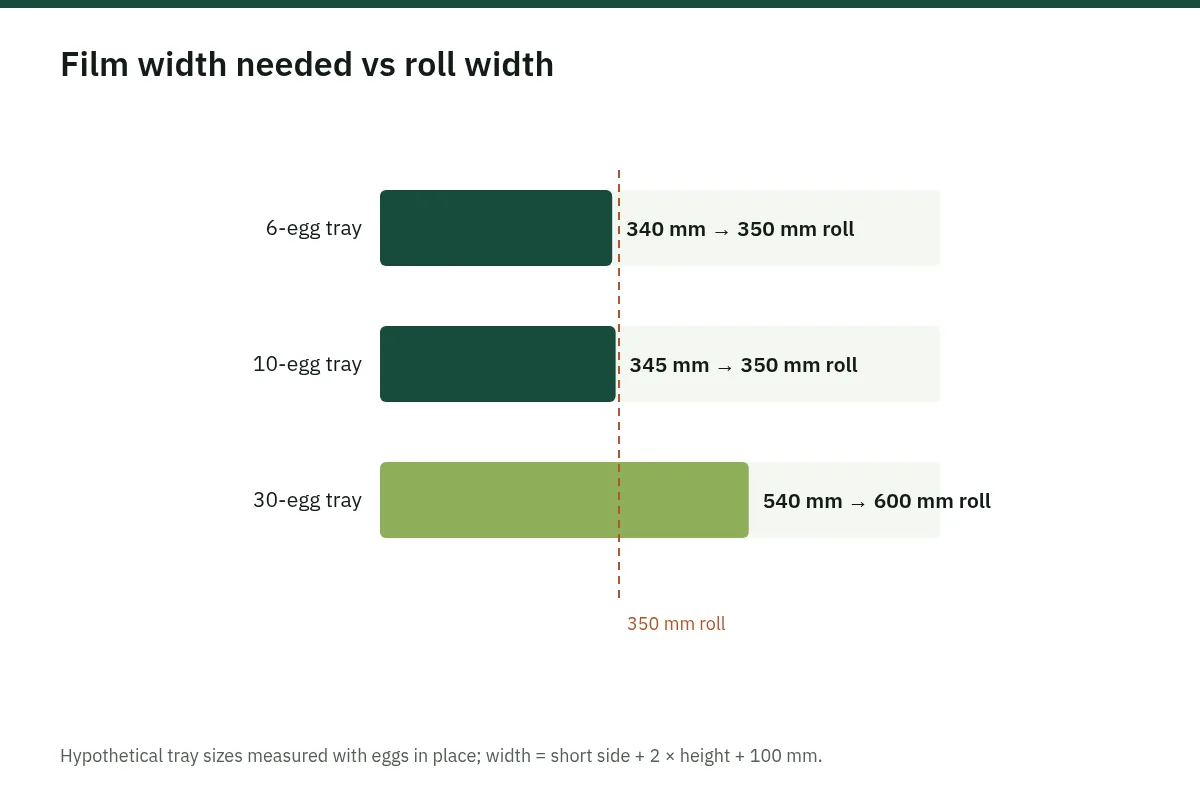
| 30 eggs, 300 × 300 mm, 70 mm high with eggs | 300 + 140 + 100 = 540 mm | 540 mm | 600 mm |
| 10 eggs, 255 × 115 mm, 65 mm high (115 mm side across) | 115 + 130 + 100 = 345 mm | 255 + 130 + 100 = 485 mm | 350 mm |
| 6 eggs, 160 × 110 mm, 65 mm high (110 mm side across) | 110 + 130 + 100 = 340 mm | 160 + 130 + 100 = 390 mm | 350 mm |
Both the 6 and 10-egg trays fit a 350 mm roll from our commercial cling film roll range (300, 350, 400 and 450 mm). The 30-egg tray needs the 600 mm × 1000 m PVC fresh wrap. If your 30-egg trays measure smaller than this example, recalculate; 450 mm will not be enough for a tray around 300 mm square.
Worked example (hypothetical)
A hypothetical egg packing room wraps 1,200 trays of 30 a day, plus 400 trays of 10.
- 30-egg trays on a 600 mm × 1000 m roll: 1,000,000 ÷ 540 ≈ 1,851 trays before waste, about 1,666 with a 10% allowance. At 1,200 trays a day, that is about one roll every 1.4 working days.
- 10-egg trays on a 350 mm × 300 m roll: 300,000 ÷ 485 ≈ 618 trays, about 556 with the same allowance. At 400 trays a day, a roll also lasts about 1.4 days.
Because both rolls happen to last about the same time, the packer orders the two widths in roughly equal numbers and reviews the ratio each month as its tray mix changes.
Wrap gently, then test the pack
- Pull the film over the tray with the leading edge already tucked under the near side.
- Lay the film onto the eggs instead of stretching it down onto them.
- Fold the far side and the two ends underneath and press the folds together; on a heated station, seal them on the plate at the setting recommended by the equipment maker.
- Pick the finished pack up by one edge and tilt it. If the tray moves inside the film, the folds are too short or the width too narrow.
For the full wrapping sequence, see how to hand-wrap a fresh food tray.
Keep eggs cold and watch for condensation
In the United States, the FDA advises buying eggs only from a refrigerated case and storing them at 4°C (40°F) or below; see What You Need to Know About Egg Safety. Rules differ by country, so follow your market’s requirements. Whatever the rule, plan the cold chain so wrapped trays do not move repeatedly between cold and warm areas: cold packs brought into warm air collect condensation under the film, which spoils the look of the pack.
Data sources
Roll widths and lengths are from our commercial cling film roll and PVC fresh wrap pages and the product catalog. Tray dimensions and daily volumes are hypothetical. Storage temperature is from the FDA egg safety page.
Requesting film for egg trays
Send us the dimensions of each tray with eggs in it, how many trays of each size you wrap a day, and whether you wrap by hand or on a heated station. We will confirm the widths and send sample rolls.
Custom sizes. Every width and length here can be adjusted to your specification. Custom specifications have a reasonable minimum order quantity. If your order is below it and you still need a custom size, a small customization fee may apply. We confirm both in the quotation.
Prepared by YIYUAN NEW MATERIALS, a cling film and aluminum foil packaging manufacturer in Shangqiu, China. We supply overseas importers and distributors at factory-direct prices with consistent quality, and we have completed orders with a large number of overseas buyers, many of whom first contacted us through this website or through WhatsApp and other social apps. Updated November 11, 2026.