
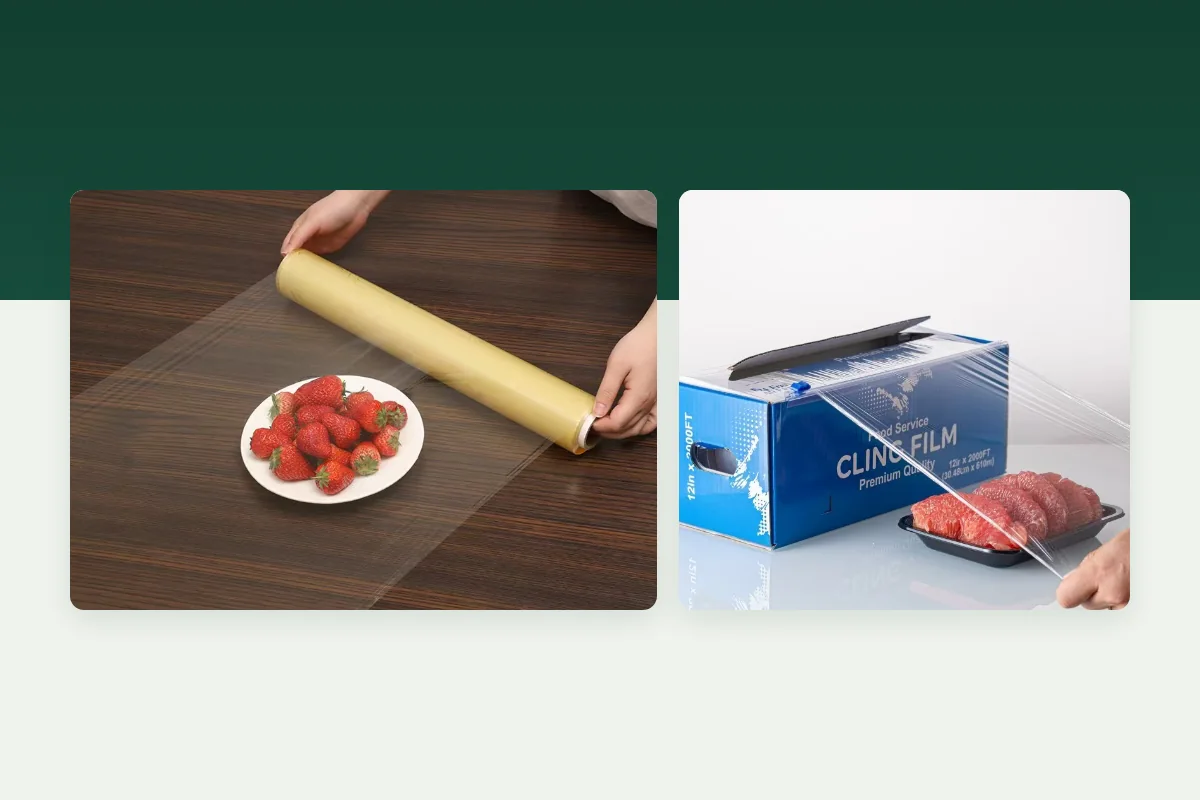
To hand-wrap a fresh food tray with PVC film, choose a film width that covers the tray, its sides and a fold-under margin. Pull the film taut over the tray, cut it, fold the ends and then the sides underneath, and seal the folds on the station’s heated plate. The two habits that matter most are folding in a consistent order and stretching the film evenly. Uneven stretch causes most of the loose corners and corner holes that end up being rewrapped.
This guide is written for supermarket and fresh-counter staff who wrap by hand on a manual station with a cutter and a heated sealing plate. If you are still deciding between hand-wrap and machine wrap, start with hand-wrap vs automatic overwrap.
Step 1: get the film width right
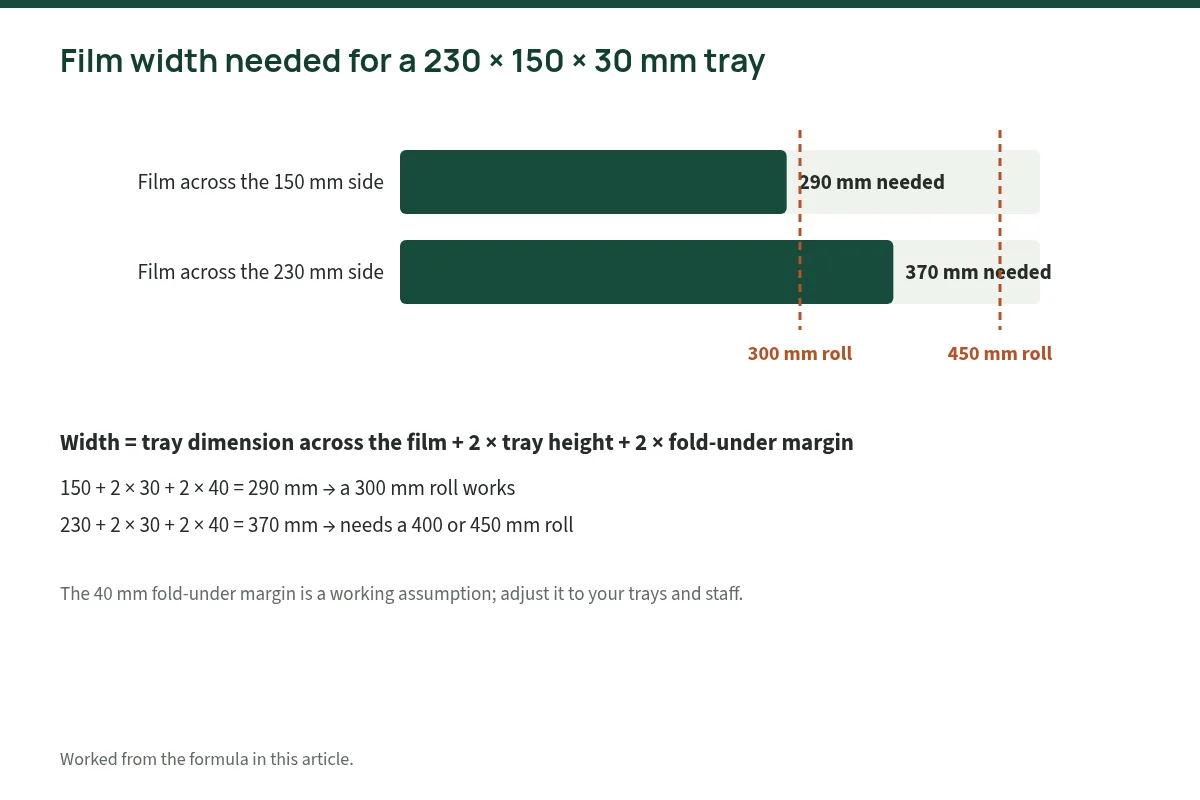
Most wrapping problems start with a roll that is too narrow for the tray. The film needs to cover the tray in one direction, run down both sides and tuck under the base with enough overlap to seal. A simple estimate:
Width needed = tray dimension across the film + 2 × tray height + 2 × fold-under margin
Take a tray of 230 × 150 × 30 mm and a fold-under margin of 40 mm on each side. The margin is a working assumption, so adjust it to your trays and staff.
- Film running across the 150 mm side: 150 + 2 × 30 + 2 × 40 = 290 mm. A 300 mm roll works.
- Film running across the 230 mm side: 230 + 60 + 80 = 370 mm. You would need a 400 or 450 mm roll.
The cut length is calculated the same way along the other tray dimension. If your counter uses several tray sizes, run this for the largest tray you wrap regularly. Our article comparing 300 mm and 450 mm rolls covers how to balance one wide roll against two narrower ones.
Step 2: wrap in a consistent order
- Check the tray. The tray rim and base should be dry and clean. Moisture and fat on the base stop the folds from sealing; see tray surface moisture and film performance.
- Pull the film over the tray. Draw film from the roll across the tray towards you. Stretch it just enough to remove wrinkles across the top. A smooth top layer comes from even tension, not maximum tension.
- Cut. Cut on the station’s cutter in one movement, holding the film so it doesn’t spring back.
- Fold the ends. Lift the tray slightly and fold the two cut ends under the base, pulling gently so the film stays tight over the top.
- Fold the sides. Fold each side under, over the end folds, pulling at the corners so they lie flat rather than bunching.
- Seal. Set the tray briefly on the heated plate so the overlapping layers underneath bond. Use the plate temperature recommended by the equipment manufacturer. Too hot can melt holes in the film; too cool leaves the folds open.
- Check. Look along the top for wrinkles, at the corners for thin spots and underneath for open folds. Label after checking, not before.
Every person at the counter should fold in the same order. Then a supervisor can see at a glance which step went wrong on a rejected pack.
Common faults and what usually causes them
| What you see | Likely cause | First thing to try |
|---|---|---|
| Loose film on top | Not enough tension before the end folds | Hold tension while folding the first end |
| Holes or splits at corners | Over-stretching at the corner; sharp tray corners | Pull more evenly; check whether the tray has sharp edges |
| Bunched, bulky corners | Side folds made before the end folds, or too much film | Follow the fold order; check the width calculation |
| Folds open underneath | Wet or greasy base; plate too cool; too short a contact | Dry the base; check plate setting per manual |
| Holes on the base | Plate too hot, or tray held on too long | Shorter contact; check plate setting |
| Fogging inside the pack | Condensation from temperature difference between product and display | Review product temperature at wrapping; ask about anti-fog film |
Fogging is often blamed on the film when it is really condensation. Our haze and condensation guide explains how to tell them apart. If you need anti-fog performance, confirm it with your supplier for the specific film. Don’t assume every PVC wrap has it.
Worked example (hypothetical)
Consider a hypothetical produce store that hires three new counter staff before a busy season. In the first week, the supervisor puts every rewrapped pack in a separate crate and notes why it was rejected. Over 1,200 packs wrapped, 96 are redone, a rewrap rate of 96 ÷ 1,200 = 8%. Of those, 52 are loose tops and 30 are corner holes.
Loose tops and corner holes point to tension, not film. The supervisor spends ten minutes with each new starter on the fold order and on pulling evenly at the corners. In the second week, 1,250 packs are wrapped and 40 are redone, which is 3.2%. The same store also found that one tray model with very sharp corners accounted for most of the remaining holes, and raised it with the tray supplier. All figures here are illustrative; your baseline will differ.
Film for hand-wrap stations
Our PVC fresh food hand wrap is a manual wrapping roll for supermarket produce counters and fresh food trays. Width, thickness, length and core are made to order, so match them to your trays and station. Our PVC fresh wrap film is listed in 300 mm × 300 m and 450 mm × 500 m (8–12 µm), and 600 mm × 1,000 m (10–15 µm). For food-contact evidence, the published PVC inspection report covers a 350 mm × 0.01 mm sample of our PVC film. It is not a performance test of cling or stretch.
Getting the right roll for your counter
When you contact YIYUAN about hand-wrap film, include your tray sizes (length × width × height), the station model and the roll core and diameter it takes. Tell us the products you wrap and whether fogging is a problem. If you can send a photo of a typical rejected pack, it shows the issue faster than a description.
Prepared by YIYUAN NEW MATERIALS. Updated October 30, 2026. Technique guidance is general; follow your equipment manufacturer’s settings. The worked example and its figures are hypothetical.