

A cling film supplier audit is useful only when its findings change the purchase decision. Before releasing the first order, record each gap, the affected product, the evidence needed to close it and who can approve closure. A high overall score must never cancel an unresolved food-contact or traceability concern.
This guide covers audit follow-up rather than another factory-tour checklist. It is intended for importers and private-label buyers who have collected audit observations but still need to decide whether to approve a supplier, approve a limited trial or keep the order on hold.
Separate approval gates from commercial preferences
Start with the exact roll specification: PE or PVC formulation reference, width, length, thickness tolerance, core, cutter or dispenser format, carton packing and destination market. An audit of a different line or a similar product does not establish readiness for this SKU.
Use two lists. Approval gates cover product identity, applicable use evidence, batch traceability and the ability to contain defective stock. Commercial preferences cover price, packing convenience, communication and forecast flexibility. Rank preferences only after the gates are satisfied.
For food-contact documents, check the material, supplier and intended conditions rather than looking for a generic certificate. The FDA regulatory-status guidance describes authorization routes and their use limitations; this is not a blanket certification of a finished film roll.
Apply the audit to YIYUAN’s quoted roll
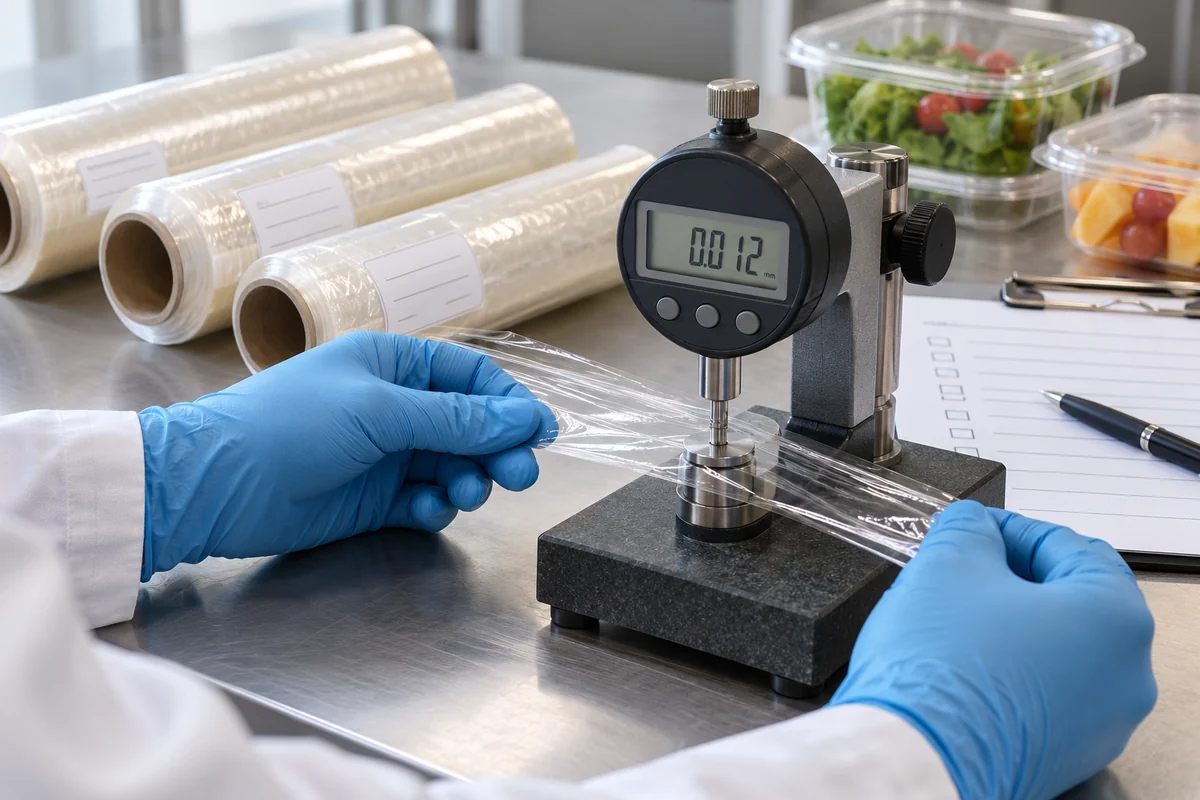
The YIYUAN commercial roll page lists a 300 mm × 100 m, 8–10 μm format at 24 rolls per carton. Make those fields the identity of a candidate order, then confirm PE or PVC, core and cutter configuration in the quote. An audit finding should name that specification rather than “cling film” in general.
The product catalog, film section describes PVC film with customizable dimensions and box packaging; it does not establish that a particular quoted roll has been tested. For a PVC proposal, use the PVC inspection report SPWT20260828019 as a document-matching example: its submitted sample is 350 mm × 0.01 mm. Ask how the evidence applies to the ordered roll and keep any unresolved gap in the audit register. Review the full report and its notices.
Create a corrective-action register
| Finding | Evidence requested | Release decision |
|---|---|---|
| Lot code on carton cannot be linked to roll production | Trace a selected carton to production record and raw-material lots | Hold approval until the trace exercise is complete |
| Width results exist, but instrument checks are missing | Instrument identification, verification record and repeated width readings | Approve only after the measurement process is credible |
| Technical report identifies a different film formulation | Explanation of applicability or evidence for the ordered formulation | Keep the affected SKU on hold |
| Capacity claim has no order-level schedule | Trial production slot, packing milestone and dispatch plan | Limit the first order to demonstrated capacity |
Add an owner, due date, containment action and closure reviewer to every row. Keep the original observation and the revised evidence together. A promise to improve later is not closure.
Verify the fix with a representative trial
- Select a sample that represents the planned production route and packing. Keep a retained reference and its identity record.
- Repeat the check that failed. For a width issue, record several positions using the agreed method; for traceability, trace a new lot rather than repeating the prepared demonstration.
- Confirm the correction applies to all affected SKUs, shifts or packing steps. Check whether the change also affects documents, dispenser fit or artwork.
- Write the result: closed, partly closed or not closed. State the remaining restriction before any trial order is released.
Choose a documented approval status
Approved: the required evidence and trial checks are complete. Conditional trial: only noncritical gaps remain, with defined quantity and release restrictions. On hold: identity, use evidence, traceability or another essential gate remains unresolved.
These are proposed buyer approval categories, not an industry certification scheme. Agree on severity definitions with your quality team. Confidential customer lists or full financial accounts may not be available; use appropriate alternative evidence rather than treating confidentiality as proof of misconduct.
Keep a dated approval memo naming the product, facility, document versions, accepted sample and authorized signer. Reopen the assessment when the formulation, site or important production process changes.
Prepare the next supplier discussion
Use the factory audit checklist to collect observations; use this closeout register to decide what must be fixed. Send the selected roll dimensions, material, core/cutter and the open audit findings to YIYUAN for a specification and document discussion.
Prepared by YIYUAN NEW MATERIALS. Updated October 8, 2026. These are buyer planning procedures; product claims require evidence for the ordered specification and intended use.