
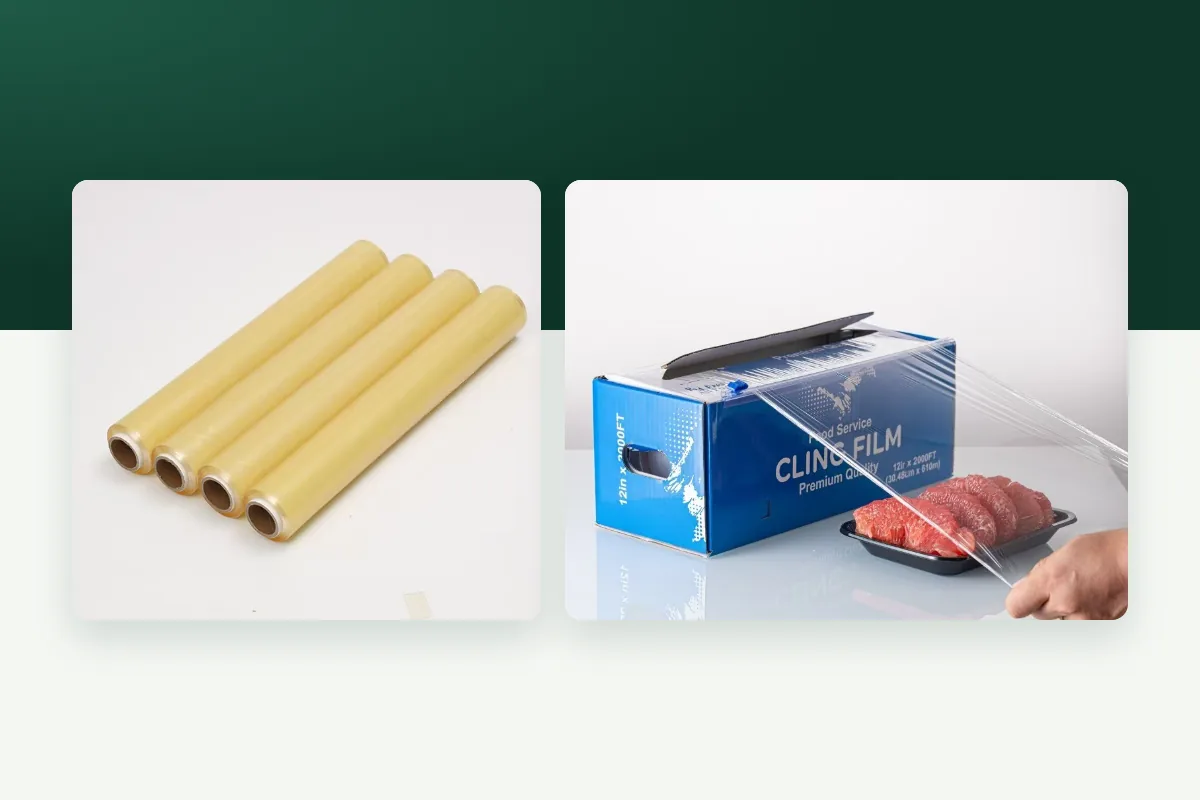
A sushi kitchen goes through cling film on four jobs: wrapping the bamboo rolling mat for inside-out rolls, shaping rice balls, covering prepared rice so it does not dry, and wrapping finished rolls for takeaway. All four work with a narrow roll. A 300 mm roll covers a standard mat with room to fold, and for most counters the 300 m length is better value than the 100 m roll, because a busy station uses tens of metres a day. Film does not change the food-safety rules for sushi rice; those depend on how the rice is acidified and held.
The four jobs
| Job | What the film does | Typical sheet (planning figure) |
|---|---|---|
| Wrapping the rolling mat | Stops rice sticking in the slats when rolling inside-out rolls; easier to clean | About 540 mm for a 240 mm mat |
| Shaping rice balls and temari | Lets staff shape rice through the film instead of by hand | About 250 mm per piece |
| Covering prepared rice | Slows drying of rice waiting in its container | About 500 mm per container |
| Wrapping takeaway trays | Overwrap for trays without lids | Tray length + 2 × height + 100 mm |
Wrapping the rolling mat
For inside-out rolls, where rice faces outward, cooks wrap the bamboo mat in film so the rice does not push into the slats. Mats are commonly about 240–270 mm square, so a 300 mm roll covers the width with a small fold at each edge.
- Pull a sheet about twice the mat length plus 60 mm.
- Lay the mat at one end, fold the film over so both faces are covered, and press the edges together on the back.
- Replace the film when it tears, when it is visibly soiled, and at the intervals your kitchen sets, for example at every shift change.
Thin film, 8–10 μm, follows the slats and does not wrinkle as much as thicker film. A slide cutter gives a cleaner start than tearing film against a blade with wet hands; see our comparison of metal, slide and plastic cutters.
Shaping rice by hand, without bare hands
The FDA Food Code 2022 does not allow bare-hand contact with ready-to-eat food unless an approved alternative is in place; it expects staff to use suitable utensils such as deli tissue, spatulas, tongs or single-use gloves. Some kitchens shape rice balls inside a sheet of film for the same reason. Whether your inspector treats film as a suitable utensil is a local question, so check before you rely on it in your procedures.
Rice, time and temperature
Covering rice with film slows drying; it does not keep the rice safe. Under the Food Code, cooked rice is a food that needs time and temperature control. Acidifying sushi rice so it can be held at room temperature requires a variance and a HACCP plan, and the alternative is to control the rice by time or temperature under the code’s rules. Your local authority decides which applies to your kitchen. Label covered containers with the time the rice was prepared so staff can follow whichever rule you work under.
Worked example (hypothetical)
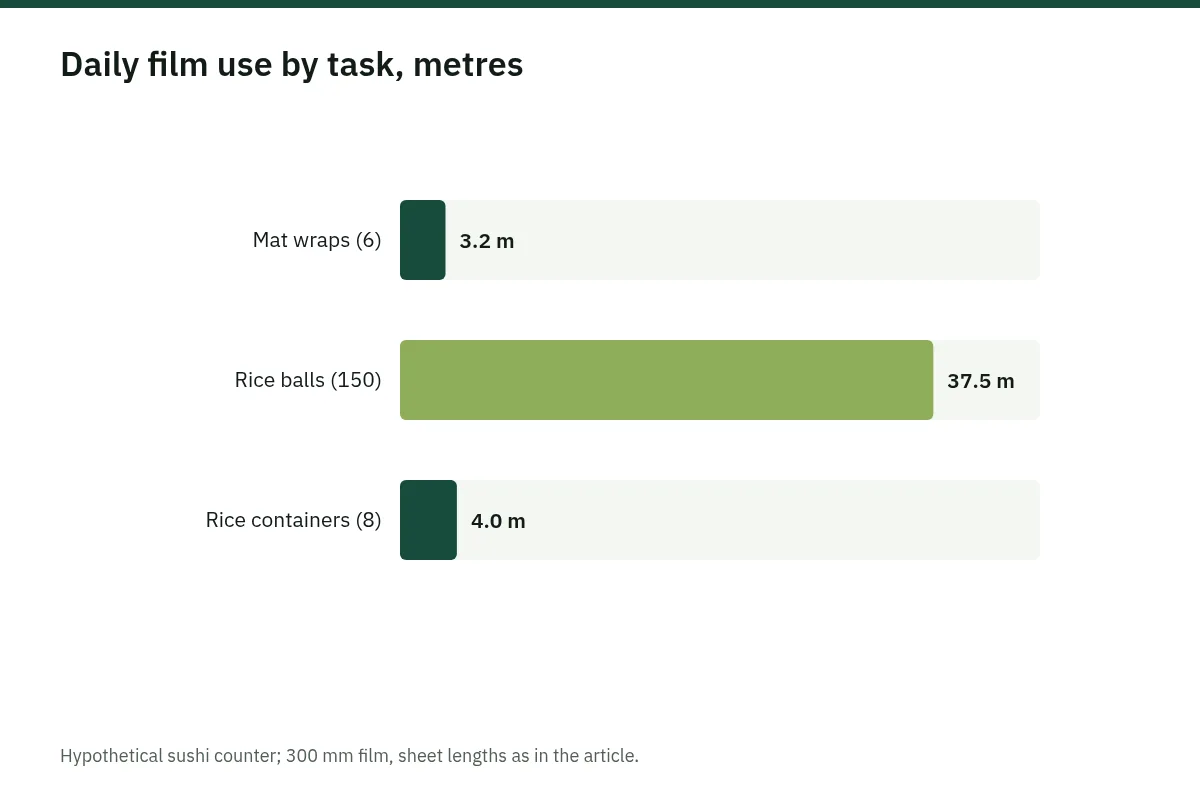
A hypothetical sushi counter estimates its daily film use:
- Mat wraps: 6 a day × 0.54 m = 3.2 m
- Rice balls: 150 a day × 0.25 m = 37.5 m
- Rice containers: 8 a day × 0.5 m = 4.0 m
- Total: about 44.7 m a day, or about 49 m with a 10% allowance for torn starts
A 300 mm × 100 m roll would last only about two days (100 ÷ 49 ≈ 2.0); a 300 mm × 300 m roll about six (300 ÷ 49 ≈ 6.1). The counter puts a 300 m roll at the main station and keeps 100 m rolls, which are lighter, at the takeaway packing table.
Data sources
Roll sizes (300 mm × 100 m at 8–10 μm, 24 rolls per carton; 300 mm × 300 m at 8–12 μm) are from our commercial cling film roll page and the product catalog. Rules on bare-hand contact, cooked rice and acidification are summarised from the FDA Food Code 2022; local adoption varies. Mat size, sheet lengths and the counter’s use are hypothetical planning figures.
Ordering film for a sushi kitchen
Send us the number of stations, your daily roll count, whether you want 100 m or 300 m rolls, the thickness you prefer and any private-label box. We can supply both lengths in one order.
Custom sizes. Width, length, thickness and rolls per carton can all be adjusted to your specification. Custom specifications have a reasonable minimum order quantity. If your order is below it and you still need a custom size, a small customization fee may apply. We confirm both in the quotation.
Prepared by YIYUAN NEW MATERIALS, a cling film and aluminum foil packaging manufacturer in Shangqiu, China. We supply overseas importers and distributors at factory-direct prices with consistent quality, and we have completed orders with a large number of overseas buyers, many of whom first contacted us through this website or through WhatsApp and other social apps. Updated November 28, 2026.