

For repeat cling film purchases, negotiate how the volume will be ordered and delivered before asking for a discount. A call-off agreement can combine an agreed purchasing framework with smaller releases, but it must distinguish forecasts from binding commitments and clarify when stock becomes payable.
This guide focuses on commercial terms for a known, approved SKU. It does not provide market discount benchmarks or a substitute for contract review.
Bring a forecast the supplier can quote
Prepare historical use by SKU, the next planning period, seasonal demand and the normal release size. Specify material, width, length, thickness tolerance, core, cutter and carton packing. Keep estimated growth separate from confirmed customer orders.
Ask the supplier to quote three structures on the same specification: individual orders, a firm batch with staggered dispatch and a framework with call-off releases. Each can have different inventory, cash and cancellation exposure.
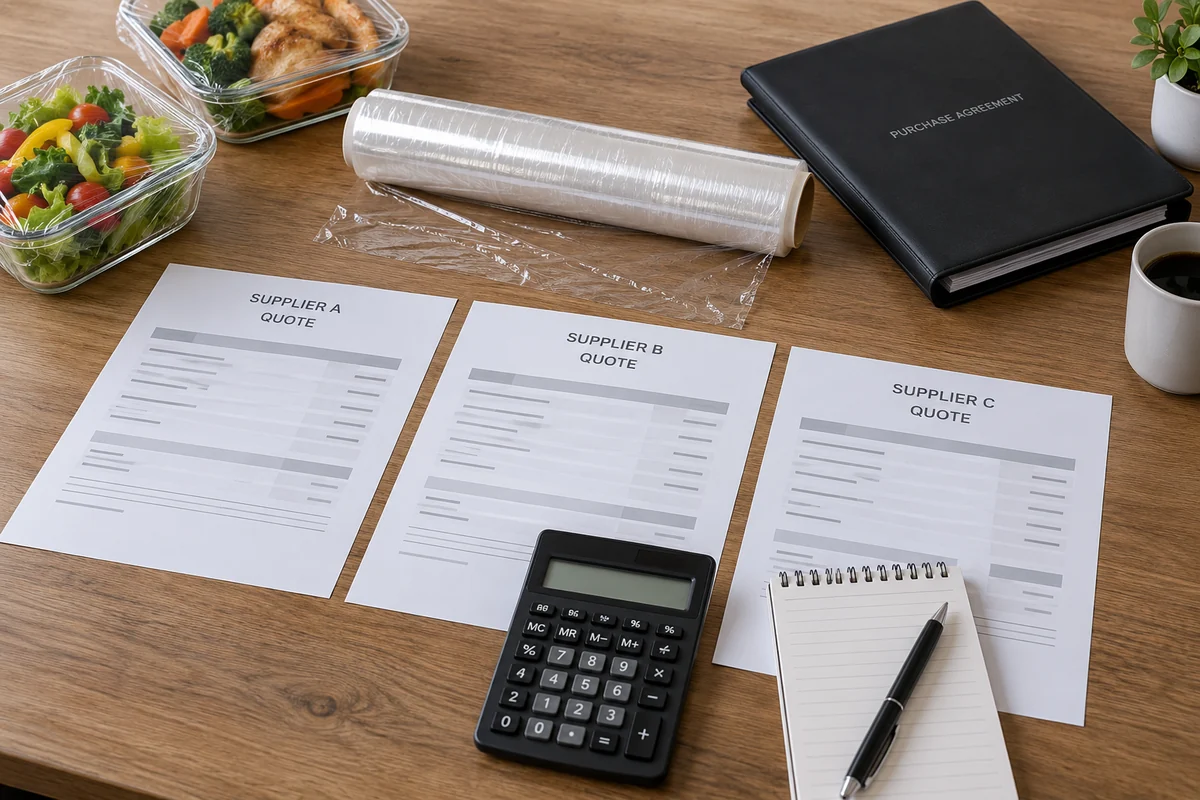
Write the agreement fields explicitly
| Term | What the buyer and supplier should settle |
|---|---|
| Volume basis | Forecast, minimum commitment, measurement period and eligible SKUs |
| Release schedule | Notice period, minimum call-off, delivery milestones and capacity confirmation |
| Price basis | Currency, unit basis, packing included and named delivery scope |
| Review rule | Fixed-price period or a stated adjustment mechanism with evidence |
| Payment trigger | Deposit, invoice event, credit period and stock ownership |
| Unused stock | Who holds it, storage conditions, end-of-period disposition and cancellation charges |
| Quality control | Approved specification, change notification, inspection and claims procedure |
Define the roll and carton behind the volume tier
The commercial roll page lists 300 mm × 100 m at 24 rolls/carton and 450 mm × 300 m at 6–12 rolls/carton. Negotiate each confirmed configuration as its own SKU. A monthly “roll” commitment without width, length, material and case pack can conceal a different purchasing volume.
For a 300 mm × 100 m call-off at the listed 24-roll case pack, 100 full cartons represent 2,400 rolls and 240,000 nominal linear metres. That is a quantity calculation, not a verified delivery or price offer. The catalog customization and ordering section describes logo and outer-packaging options; its order terms do not establish a universal discount, credit period or fixed lead time. Put the actual branding, release notice and commercial terms in the quote.
Compare the saving with added exposure
Hypothetical example: 10,000 identical rolls at USD 4.00 cost USD 40,000. A firm commitment at USD 3.90 costs USD 39,000, a USD 1,000 goods-price saving. If you expect only 8,000 rolls to be used and the rest remain noncancelable stock, the lower unit price alone does not justify the commitment.
Add storage, financing, dispatch charges and potential obsolete packing. Compare scenarios on the same quantity and scope, and disclose how remaining inventory is valued. Do not claim that a volume tier automatically earns a particular discount.
Keep payment arithmetic separate from price
If a recurring monthly invoice is USD 20,000, extending its due date by 30 days defers approximately one monthly invoice under steady ordering: USD 20,000. It does not create a saving of the same amount. A simplified annual financing effect at a hypothetical 10% rate is USD 20,000 × 10% = USD 2,000, before fees and timing differences.
These are illustrative inputs. Longer credit may raise price or require credit approval; early-payment discounts have their own due dates and conditions. State whether the term runs from invoice, shipment, delivery or acceptance.
Protect the approved specification
A cheaper quote must not silently change net film length, gauge, core weight, cutter or case pack. Refer to the approved specification revision and sample. Agree on notification and approval before formulation or packing changes.
Set a review schedule for forecast accuracy, delivery performance and claims. When demand falls, discuss the remaining commitment before the supplier manufactures unusable private-label stock.
Prepare the next supplier discussion
Normalize the quotes with width, length, weight and carton checks. Send the confirmed roll/case specification, forecast and call-off schedule to YIYUAN for an itemized recurring-order quote.
Prepared by YIYUAN NEW MATERIALS. Updated October 8, 2026. These are buyer planning procedures; product claims require evidence for the ordered specification and intended use.