
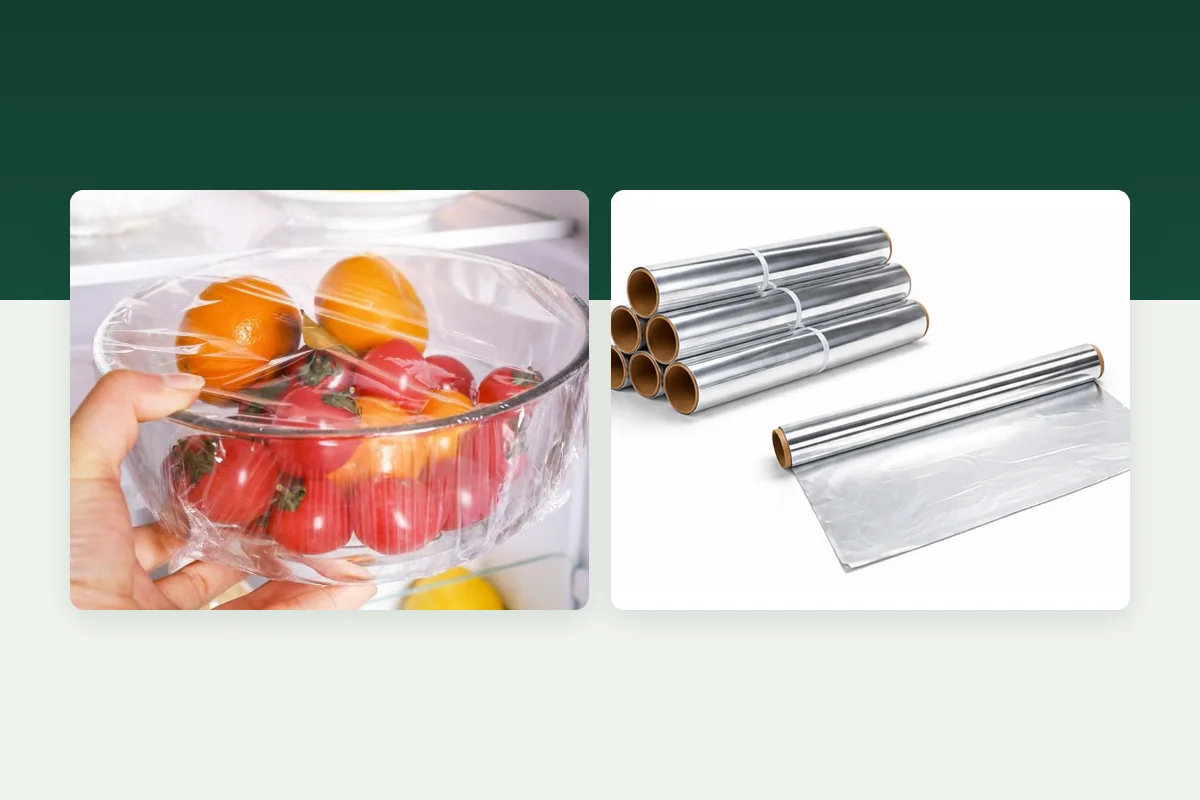
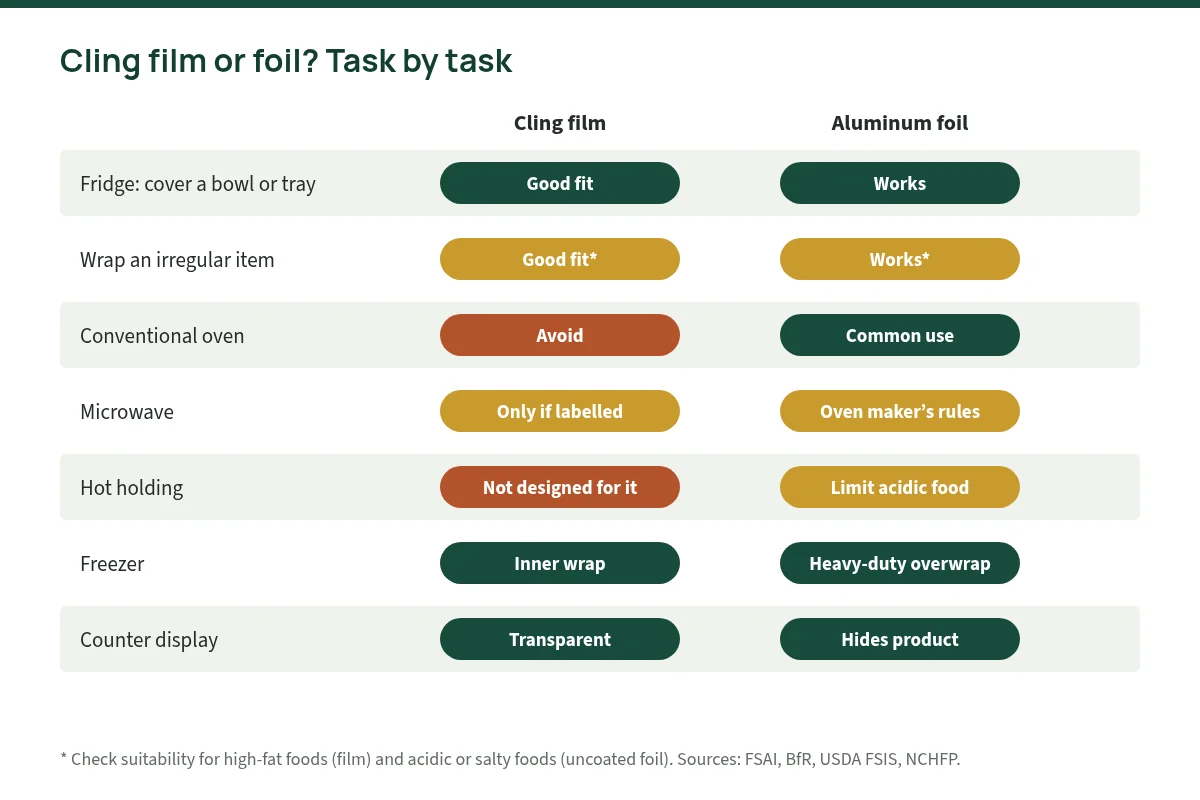
Use cling film when you need a tight, see-through seal on cold or room-temperature food. Use aluminum foil when the food is going into a conventional oven, needs a wrap that holds its shape, or needs an extra protective layer in the freezer. Several tasks fall in between, and those are where kitchens go wrong: microwaving, fatty foods, acidic foods kept warm, and long freezer storage. Each one has a specific caution from a food safety authority. We supply both products, so we have no reason to favour either. The table below is the short answer; the sections after it explain each line.
Task by task
| Kitchen task | Cling film | Aluminum foil |
|---|---|---|
| Covering a bowl or tray in the fridge | Usually the better fit: it grips the rim and you can see the contents | Works, but does not cling; label the contents because you cannot see them |
| Wrapping an irregular item | Good contact with the food surface; check suitability for high-fat foods | Holds a shape; take care with acidic or salty foods |
| Conventional oven | Generally not; it can melt | Common use; confirm the intended use for a specific container |
| Microwave | Only if the manufacturer says so, and not touching the food | Follow the microwave oven manufacturer’s instructions |
| Hot holding | Not designed for it | Common for trays, but avoid long warm holding of acidic food in uncoated foil |
| Freezer | As an inner wrap, with an overwrap for long storage | Heavy-duty foil as a wrap or overwrap; light household foil is not recommended for freezing |
| Retail or counter display | Transparent, so the product stays visible | Hides the product |
Where cling film wins
Cling film’s strength is in the name. It seals against a bowl rim or a tray edge without a lid, stays clear, and comes off a cutter box in one movement. For covering prep containers, wrapping portions for the walk-in and keeping a display tray visible, foil cannot match it. That is why many commercial kitchens keep a cling film roll at every prep station. It is also why many supermarkets wrap produce and meat trays in PVC fresh wrap rather than foil.
The common limit is heat. Ireland’s food safety authority, the FSAI, puts it plainly: in general, cling film should not be used in an oven because it can melt and could contaminate the food. It adds that some films may be made for oven use, so check the manufacturer’s instructions (FSAI, Cling Film Safety of Use).
Where foil wins
Foil goes where cling film can’t: into a conventional oven, over a roasting tray, around food on a grill rack. It also holds a crimped shape, which cling film does not. A foil-covered tray can be stacked; a film-covered one may not survive it. In the freezer, foil is a strong outer layer, as long as it is heavy enough.
Foil has one caution that cling film does not. Germany’s Federal Institute for Risk Assessment (BfR) has long recommended that aluminium foil, trays and uncoated aluminium dishes should not be brought into contact with acidic or salty foods (BfR Annual Report 2014). Its 2017 study found aluminium transferring from uncoated trays into acidic foods kept warm after cooking (BfR press release). A tomato sauce wrapped for ten minutes is a different situation from one held hot in an uncoated tray for hours. The second is the one to change.
The four grey areas
Microwaving
For cling film, the FSAI advice is to check the manufacturer’s instructions to see whether the film is safe for microwave use. If it is used, the film should not touch the food. For foil, follow the microwave oven manufacturer’s instructions. Many ovens restrict or prohibit metal, and the rules differ by model. Neither material should go in a microwave just because someone has done it before.
Fatty foods
The FSAI notes that some cling film is not suitable for wrapping high-fat foods such as cheese, fried meats or pastry, and advises checking the manufacturer’s instructions. For a buyer this is practical: if your kitchen wraps a lot of cheese or fried items, ask your supplier what the film’s documents say about fatty foods. Then make sure the instructions on the box match. Our article on cling film use claims explains how to link a use to its evidence.
Acidic food kept warm
This is foil’s grey area, covered above. Choosing between materials matters less here than how long the food is held, and at what temperature.
Long freezer storage
The USDA’s Food Safety and Inspection Service says original store wrap is permeable to air. For prolonged storage, it advises overwrapping the package as you would any food for long-term storage (FSIS, Freezing and Food Safety). The National Center for Home Food Preservation adds that heavy-duty foil can be used as a freezer wrap but tears easily, so an overwrap is wise. Lightweight household foil, it says, is not satisfactory for freezing (NCHFP). In practice, many kitchens use both: film against the food, foil or a freezer bag outside.
Worked example (hypothetical)
Consider a hypothetical hotel banquet kitchen preparing a tomato-based pasta bake the day before an event. On the day, the dish is baked, held hot for service and some leftovers are frozen.
- Overnight in the walk-in (unbaked): cling film over the tray, pressed to the rim and labelled. Staff can see the contents.
- Baking: the cling film comes off. If a cover is needed in the oven, it is foil.
- Hot holding: the kitchen previously held the bake in an uncoated foil tray for three hours. After reading the BfR guidance, the chef moves it to a stainless-steel hotel pan for holding. Foil is used only as a temporary cover.
- Leftovers to the freezer: portioned, wrapped in cling film, then overwrapped in heavy-duty foil and labelled with the date.
Neither material handles every step. The kitchen uses each one for the steps it suits.
The products behind this comparison
For cling film, our commercial cling film rolls come in 300, 350, 400 and 450 mm widths, typically 8–12 µm. They are supplied in cutter boxes or as refill rolls, in PE or PVC depending on the target market. For foil, our foodservice aluminum foil rolls range from 300 mm × 100 m to 450 mm × 300 m, plus 12 in and 18 in rolls for North America. Foil thickness is confirmed with the quotation, so tell us whether you need a heavier gauge for freezer or oven work. Dimensions are in the aluminum foil catalog and the product catalog.
Buying both from one supplier
If you stock both materials, one enquiry can cover both. Tell YIYUAN the cling film width, length and material and the foil roll size and thickness you need, plus the tasks each is for. If you supply kitchens that microwave, freeze or hold food hot, say so. That determines which documents and instructions should come with each product.
Prepared by YIYUAN NEW MATERIALS. Updated October 26, 2026. Guidance is quoted from the linked food safety authorities; the worked example is hypothetical. Always follow the instructions supplied with the specific product.