
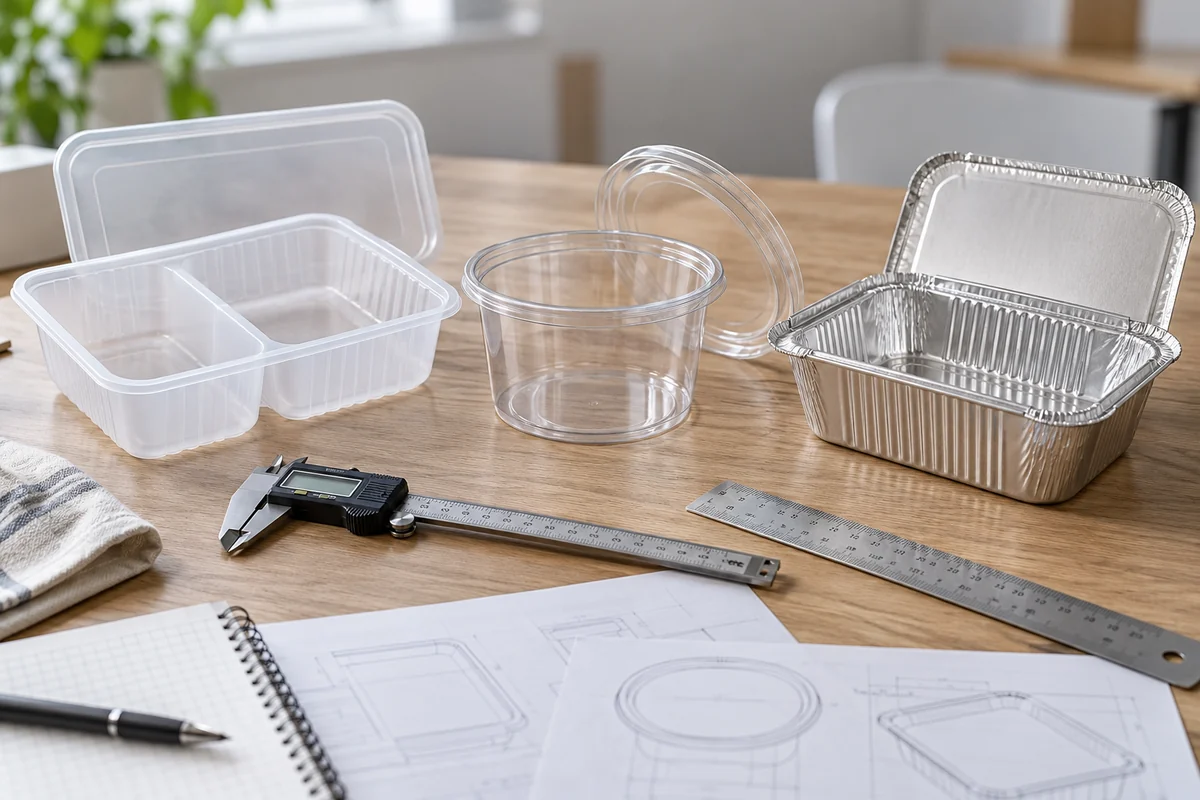
A food container RFQ should define the complete pack, not simply a capacity and a target price. Send the tray, lid or sealing-film specification, intended food use, required quantity and packing details together. Ask the supplier to mark every assumption and deviation so the quotations can be compared.
For a custom design, separate the quotation from engineering approval. The supplier should propose manufacturable geometry and tolerances; the buyer should confirm fit and performance against the application before releasing tooling or production.
Start with the application and component pair
Describe the food, fill process, storage conditions, contact duration, delivery handling and any proposed heating instruction. State whether you need a snap lid, a hinged lid or a film-sealed tray. Identify equipment that constrains the flange, footprint or overall dimensions.
Specify nominal capacity and the usable fill level separately. A brimful volume does not tell the supplier how much food the container must hold with the lid closed and an appropriate headspace.
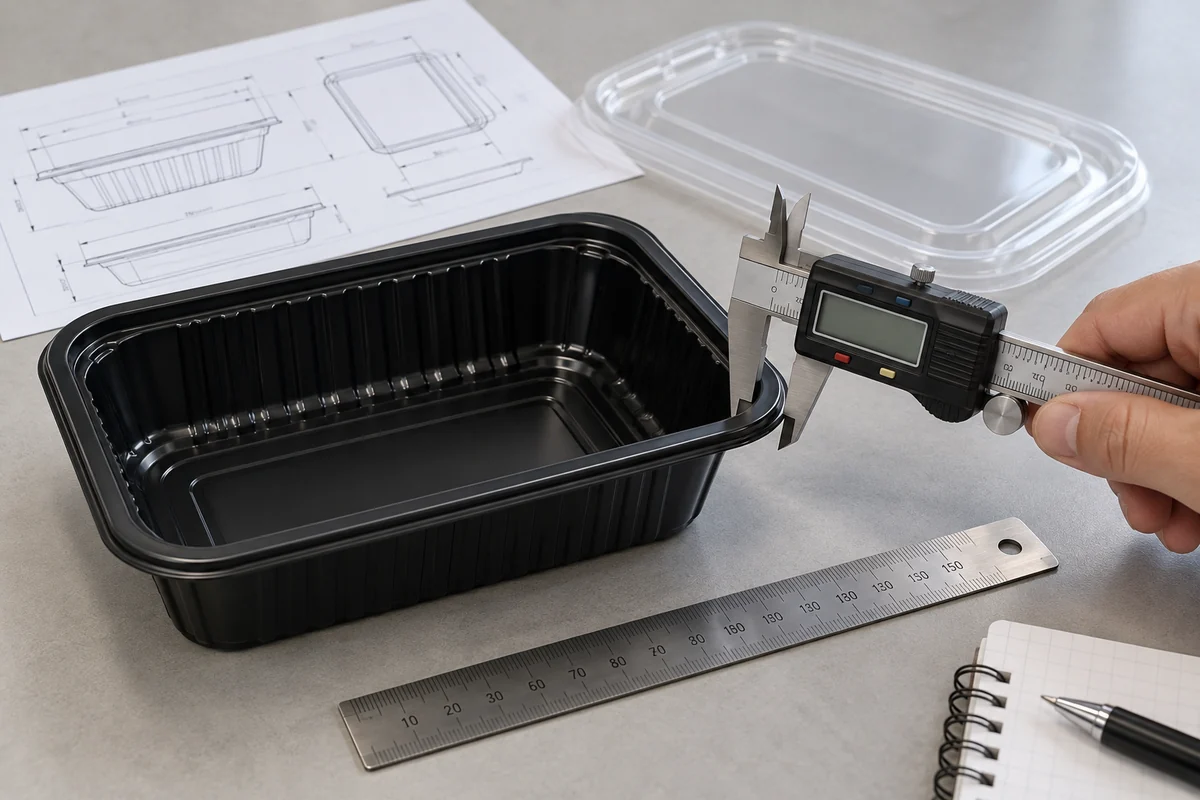
Use this RFQ field list
| RFQ section | Buyer supplies | Supplier confirms |
|---|---|---|
| Product identity | Reference sample, drawing or functional description; tray and lid requirements | Stock codes or proposed custom design and drawing revision |
| Material and use | Required construction, food types, time and temperature exposure | Exact component materials and available use evidence |
| Critical dimensions | Equipment interface, footprint, usable depth and closure requirements | Proposed tolerances and measurement methods |
| Quantity | Trial order, forecast, order mix and delivery dates | MOQ by component, production lot and dispatch milestones |
| Tooling | New mold requirement, approval stages and requested ownership terms | Separate tooling quote, maintenance, custody and modification terms |
| Packing | Handling constraints, separate or paired packs, destination | Units per carton, dimensions, gross weight and pallet plan |
| Commercial scope | Currency, named delivery location and requested quote basis | Price validity, charge inclusions, payment terms and deviations |
| Release criteria | Sample checks, inspection rights and document needs | Evidence supplied before tooling, production and dispatch |
Choose a real catalog reference for the RFQ
For PP containers, use the product catalog compartment section and the 500/750/1,000 ml box range to describe the desired format. Specify the base and lid separately; the catalog pictures and a capacity label do not identify the complete approved pair.
If aluminum is suitable for the application, the foil catalog, page 22 provides two concrete RFQ references:
| Model | Listed capacity | Top dimensions × height | Listed containers/carton |
|---|---|---|---|
| 220 | 1,000 ml | 215 × 160 × 55 mm | 1,000 |
| 2317 | 1,000 ml | 230 × 170 × 45 mm | 1,000 |
Compare model 220 with model 2317: equal nominal capacity does not mean the same footprint, usable fill geometry or lid. Ask for the selected model, closure, thickness/alloy, drawing tolerance and packing to be confirmed in the quotation. The catalog is a specification source, not food-contact certification.
Give the supplier measurable acceptance tasks
Identify the dimensions that control lid fit, de-nesting and equipment alignment. Attach a drawing where available. Do not apply a generic percentage tolerance to every feature: a closure rim can require different control from an overall height.
Ask for samples of the exact component combination. Trial filling, closing, handling and stacking under documented conditions. If film sealing is required, include the lidding film and actual sealing process; a bare tray does not demonstrate seal performance.
Separate tooling and unit-price decisions
Request tooling, samples, printing setup and recurring product cost as separate lines. Record when tooling payment becomes due, how sample approval works and who bears modification costs if the design changes. State ownership, storage and access rather than assuming payment automatically transfers all rights.
Tooling amortization should use a declared quantity. For a hypothetical USD 12,000 tool, spreading the cost across 200,000 units adds USD 0.06 per unit; across 600,000 units it adds USD 0.02. These are arithmetic examples, not mold-price estimates.
Require a returned deviation sheet
Ask the supplier to return each RFQ field as confirmed, proposed alternative or not included. Compare the quotes only after differences in lid inclusion, carton quantity, tooling scope and sample evidence are resolved. Keep the approved sample and drawing revision with the purchase order.
A request for a food-contact claim should name the destination market and use conditions. A general certificate, a resin name or a melting point is not sufficient evidence for the finished pack.
Prepare the next supplier discussion
Use the food container sample-testing checklist to define the approval stage. Send the catalog model or capacity/compartment brief, closure requirement, quantity and destination to YIYUAN for a returned RFQ with stated deviations.
Prepared by YIYUAN NEW MATERIALS. Updated October 8, 2026. These are buyer planning procedures; product claims require evidence for the ordered specification and intended use.