
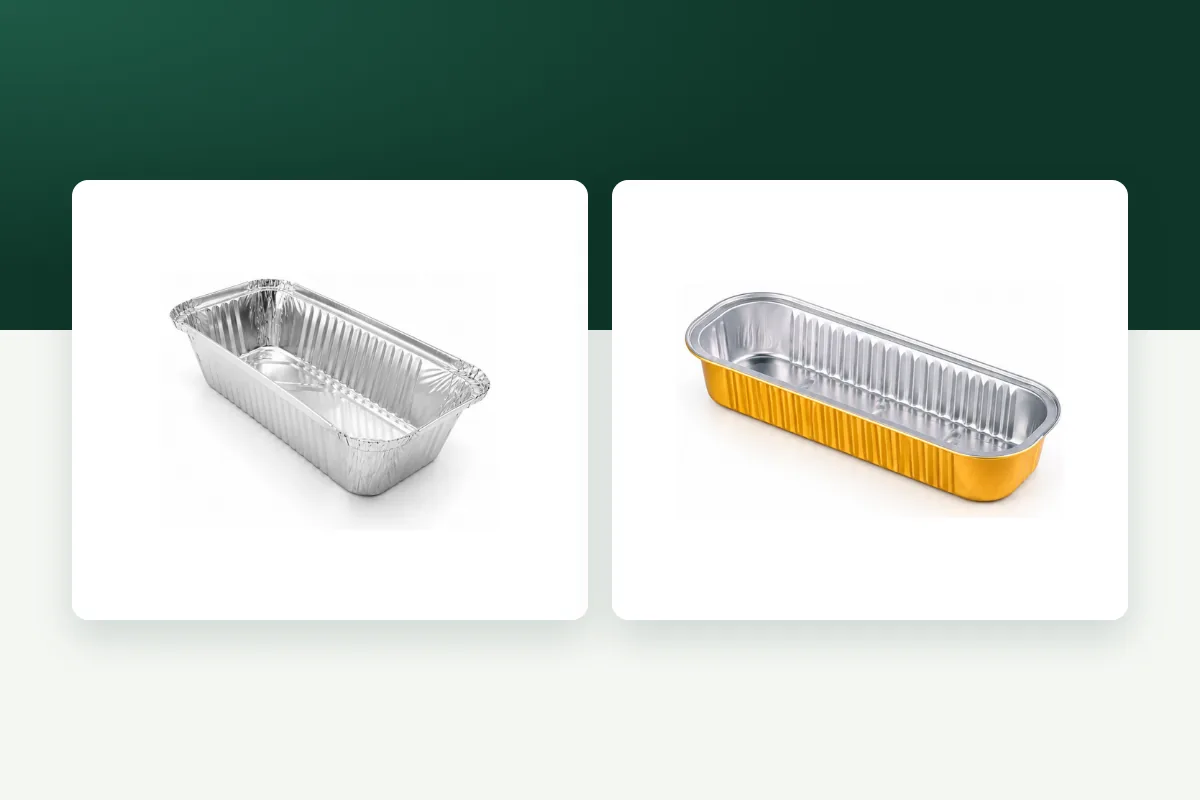
If you bake banana bread, pound cake or meat loaf to sell in the container it was baked in, you need a loaf-shaped foil tray. In our range that means two near-identical 650 ml models, the silver 205 (2011) and the L-2011, both about 205 × 110 mm at the top and 55–57 mm deep, plus the gold 166-200 for single-portion bars. For a cake that rises, a common starting point is to fill the tray about two-thirds, so a 650 ml tray takes roughly 400–450 g of batter. Confirm the fill and bake time with a test bake, because foil behaves differently from a heavy tin.
The loaf-shaped models
| Model | Capacity | Top × height | Base | Packing | Carton |
|---|---|---|---|---|---|
| 205 (2011) | 650 ml | 205 × 110 × 57 mm | 162 × 70 mm | 1,000 / carton | 630 × 250 × 420 mm |
| L-2011 | 650 ml | 204 × 111 × 55 mm | 160 × 70 mm | 1,000 / carton | 465 × 318 × 425 mm |
| Gold 166-200 | 200 ml | 166 × 64 × 29 mm | Not listed | 1,000 / carton | 345 × 245 × 265 mm |
The two 650 ml trays differ by a millimetre or two, which will not change your recipe. What differs is the carton: per 1,000 trays, the 205 (2011) takes about 0.066 m³ and the L-2011 about 0.063 m³, roughly 5% less. Choose by price and lead time, and keep to one of them so your bakers see a consistent shape.
Reading the shape
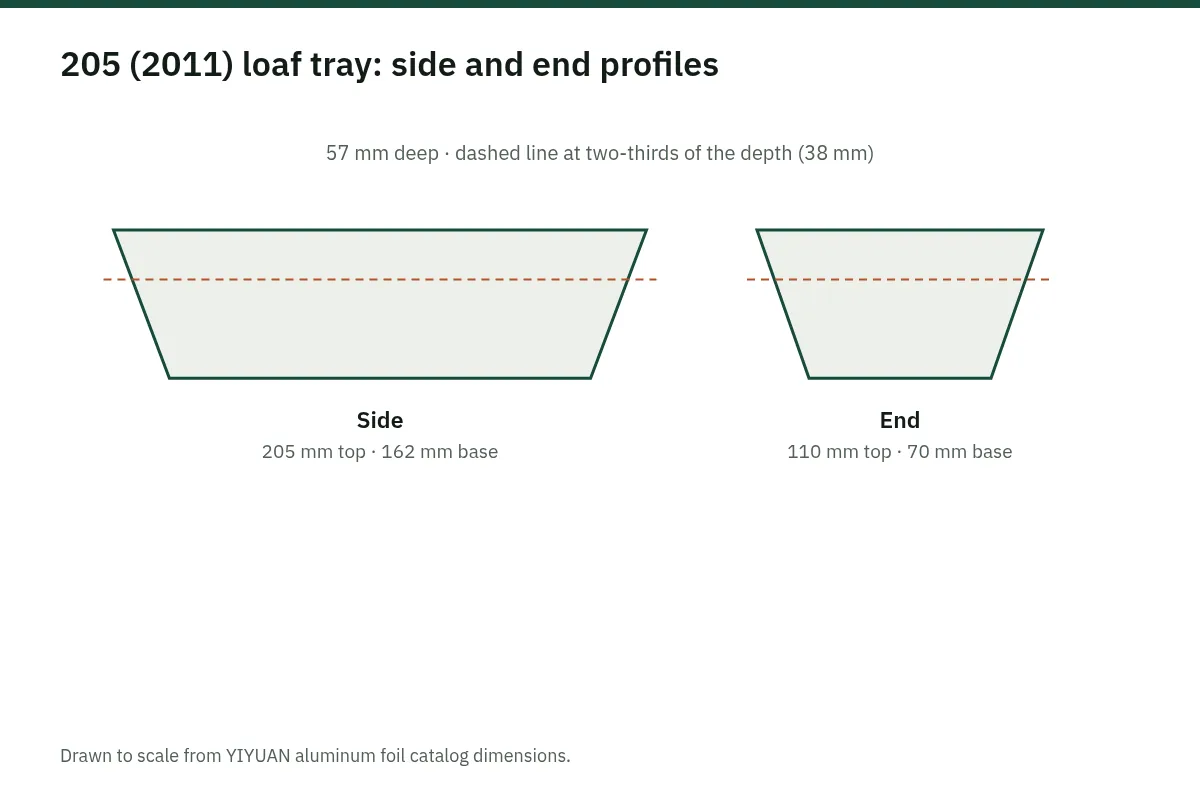
Both 650 ml trays taper strongly, from 205 × 110 mm at the top to about 160 × 70 mm at the base. Three consequences for a baker:
- Slices are wider at the top than the bottom. That suits banana bread and pound cake, which are usually sliced from the top. A sandwich-style loaf with square slices needs a straighter tin.
- The narrow base is only 70 mm wide. Dense batters set from the edges inwards; check that the centre is baked through at the end of your test bake.
- The trays nest. That is why 1,000 fit in one carton, and why you need to separate trays carefully on a busy line.
Baking in foil, not in a tin
Thin foil holds far less heat than a heavy loaf tin, so a recipe written for a tin may brown and set differently. Do a test bake before you change a product line:
- Weigh the batter into the tray at about two-thirds of capacity and note the weight.
- Bake at your usual temperature and check the centre from about 10 minutes before your tin time.
- Place trays on a flat baking sheet, not straight on an oven rack, so the soft base stays flat and the trays are easy to move.
- Check the bottom and side colour, and whether the cake releases or is sold in the tray.
The catalog does not list a maximum oven temperature. For the silver trays, tell us your baking temperature with your enquiry. For gold trays, the colour is a finish on the foil, so ask whether the model you choose is suitable for your oven; our gold vs silver guide lists the questions to ask.
The 200 ml single-portion bar
The gold 166-200 is a narrow 166 × 64 mm tray, only 29 mm deep. Filled about two-thirds, it takes roughly 130 ml of batter: one portion of banana bread, a brownie bar or a small savoury bake for a café counter. Its carton is small (about 0.022 m³ per 1,000), so it is easy to stock alongside larger trays. For individual desserts in round or square cups, see our guide to foil baking cups.
Worked example (hypothetical)
A hypothetical bakery switches its banana bread from tins to the L-2011 so it can sell the loaf in the tray. A test bake settles on 420 g of batter per tray. Its mixer makes 10 kg of batter per batch: 10,000 ÷ 420 = 23.8, so 23 loaves per batch with a little batter left for testing. At three batches a week it uses 69 trays a week, and one carton of 1,000 lasts about 14 weeks (1,000 ÷ 69 ≈ 14.5). It orders two cartons at a time and keeps them dry, away from the oven.
Data sources
Capacities, dimensions, packing and carton sizes are from the three product pages and the aluminum foil catalog; the catalog does not list a base size for the 166-200 or a maximum oven temperature for any model. Thickness, alloy and OEM details are confirmed with the quotation. The two-thirds fill is a common starting point, not a specification. The bakery and its figures are hypothetical.
Requesting loaf trays
Send us the product you bake, your batter weight, oven temperature, whether the loaf is sold in the tray and how it is closed, and your monthly volume. We will send samples for a test bake.
Custom sizes. Every size and pack count here can be adjusted to your specification. Custom specifications have a reasonable minimum order quantity. If your order is below it and you still need a custom size, a small customization fee may apply. We confirm both in the quotation.
Prepared by YIYUAN NEW MATERIALS, a cling film and aluminum foil packaging manufacturer in Shangqiu, China. We supply overseas importers and distributors at factory-direct prices with consistent quality, and we have completed orders with a large number of overseas buyers, many of whom first contacted us through this website or through WhatsApp and other social apps. Updated November 25, 2026.