
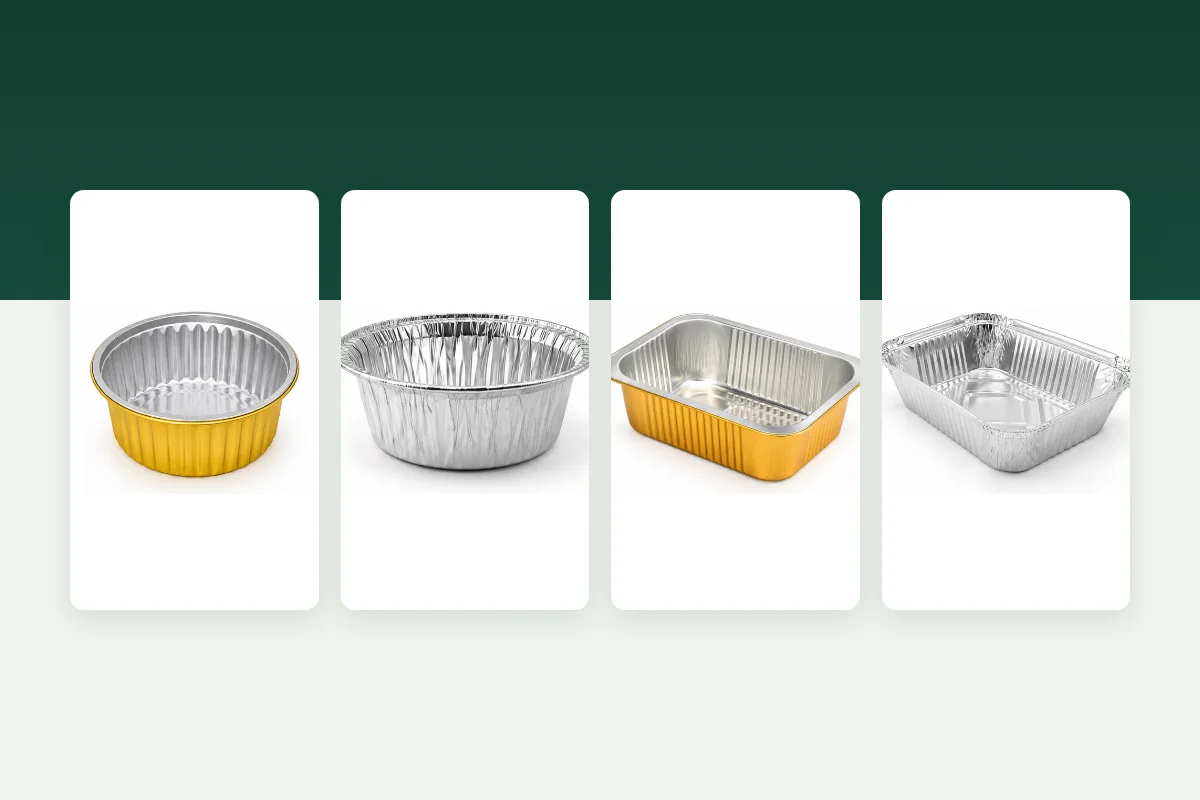
Choose gold aluminum foil containers when the container is part of the presentation: desserts on a counter, event catering, gift boxes. Choose silver when the container mainly needs to work and the food is what customers see. In our catalog, though, the two series differ in more than colour. The gold series is built in footprint families: one opening size in several depths, which makes it easy to scale a dish up or down. The silver series covers a wider spread of shapes and extremes, from a 35 ml cup to a 10,500 ml tray, plus plates, compartment trays and lidded pots. And one question applies to every gold container: what the gold finish actually is.
What the two ranges contain
| Series | Product pages | Listed capacities | Main shapes |
|---|---|---|---|
| Gold containers | 53 | 60–8,600 ml | 26 round, 18 rectangular, 4 square, 2 round cups, plus a heart, a mini oval cup and a round container with ear tabs |
| Silver containers | 32 | 35–10,500 ml | 18 rectangular, 5 round cups, 2 round bowls, 3 plates, a heart, plus 3 lids |
| Silver L containers | 32 | 260–9,700 ml | 17 rectangular, 4 oval trays, 5 pots with lids, 3 plates, compartment and square trays |
Counts are product pages in our aluminum foil range; capacities are as listed in the aluminum foil catalog (gold on pages 7–15, silver L on pages 16–21, silver on pages 22–26).
Gold is built in families
Many gold models share an opening size and step up in depth. For a caterer this is useful: the same dish can come in several portion sizes that look identical from above, and a single lid footprint may serve them all, subject to confirmation.
| Family (opening) | Depths | Capacities | Packing |
|---|---|---|---|
| Rectangular 161 × 110 mm | 30 / 38 / 55 mm | 320 / 510 / 680 ml | 1,000 per carton |
| Rectangular 184 × 128 mm | 35 / 40 / 45 / 55 mm | 580 / 665 / 750 / 930 ml | 1,000 per carton |
| Rectangular 221 × 168 mm | 40 / 56 / 75 mm | 1,025 / 1,400 / 1,800 ml | 500 per carton |
| Round φ180 mm | 47 / 60 / 80 / 97 mm | 920 / 1,130 / 1,370 / 1,700 ml | 500 per carton |
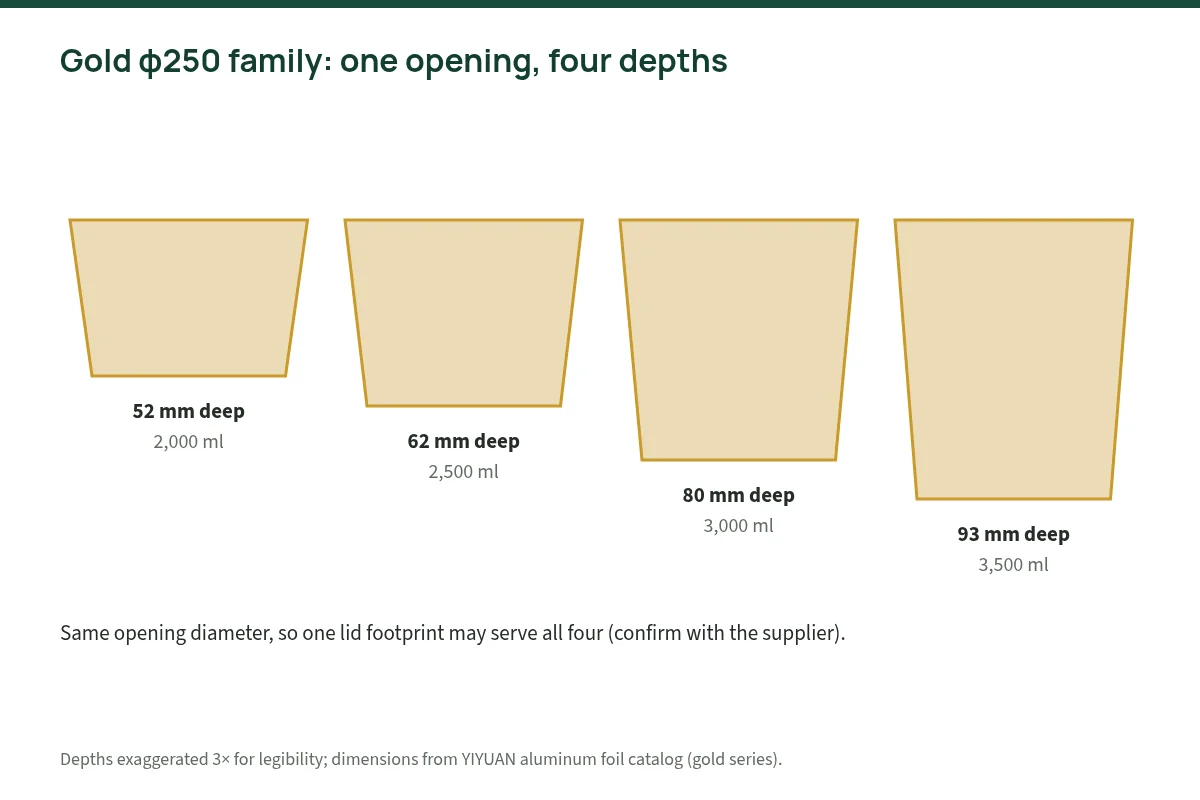
| Round φ250 mm | 52 / 62 / 80 / 93 mm | 2,000 / 2,500 / 3,000 / 3,500 ml | 200 per carton |
| Round φ280 mm | 87 / 110 / 133 mm | 4,000 / 5,000 / 6,000 ml | 200 per carton |
Examples: 184-580, 184-930, 180-920, 250-2000, 250-3500, 280-6000.
The silver series has a few depth pairs, such as the 195 Shallow and 195 Deep or the 350 and 350 Deep. Most silver models are a single size.
Silver covers the extremes and the special shapes
- Very small and very large. The silver Y74 cup (35 ml) is the smallest container in the catalog. The silver 525 (10,500 ml) is the largest.
- Lids. The only separately listed lids are silver: the 320 and 370 rectangular lids and the φ183 round lid. Silver L pots are supplied with lids as sets.
- Plates and compartments. Round plates, oval trays and two- and three-compartment trays are in the silver ranges.
- Takeaway rectangles. The silver 225–1,000 ml range is set out in our foil container size guide.
Ask what the gold finish is
The catalog describes these models as “Finish: Gold”. It does not say how the colour is produced or which surfaces it covers. In the foil container trade, colour is generally a coating or lacquer on the foil. Rather than assume, ask three questions for the model you choose:
- Is the gold colour a coating, and is it on the outside only, the inside only or both sides?
- Which surface touches the food, and what food-contact documentation covers that surface?
- Are there use limits, for example oven temperature, for the coated product?
The answer also matters for acidic and salty foods. The guidance discussed in our article on acidic and salty foods distinguishes coated from uncoated aluminium. A coating on the outside alone does not change what the food touches.
Worked example (hypothetical)
Picture a hypothetical event caterer launching a premium line of baked rice and pasta dishes. The dishes are sold as party trays for 4, 6, 8 and 10 guests. The caterer wants trays that look the same in every size.
The φ250 gold family fits the brief: 2,000, 2,500, 3,000 and 3,500 ml in one opening diameter. The caterer’s test portion is about 300 ml per guest, and the trays need about 10% headroom. That gives 4 × 300 = 1,200 ml for four guests, 1,800 ml for six, 2,400 ml for eight and 3,000 ml for ten. Allowing 10% headroom, those portions need about 1,320, 1,980, 2,640 and 3,300 ml.
Matching each requirement to the smallest tray that holds it: six guests (1,980 ml) just fit the 2,000 ml tray, eight guests (2,640 ml) need the 3,000 ml, and ten guests (3,300 ml) need the 3,500 ml. Four guests (1,320 ml) also go in the 2,000 ml tray, because it is the shallowest in the family. It will be about 1,200 ÷ 2,000 = 60% full, which the caterer accepts for a level-filled bake. That is three models instead of four. The 2,500 ml tray is dropped because no portion size needs it. Before ordering, the caterer asks for a lid that fits the φ250 opening on all three depths, and for confirmation of the coating and oven use.
Data sources
Model counts, capacities, dimensions and packing come from the YIYUAN aluminum foil catalog and product pages. The catalog states that thickness, alloy, matching lids, order quantity and OEM configuration are confirmed with the quotation. It does not specify coatings, so this article makes no claim about the gold finish beyond its appearance.
Requesting gold or silver containers
Send YIYUAN the models or the family you are considering, the food, whether the containers go in the oven, and whether you need lids. If you want gold for presentation, ask about the finish and the documentation together. If you only need a gold version of a size we list in silver, ask; it may be possible.
Prepared by YIYUAN NEW MATERIALS. Updated November 4, 2026. Figures are catalog specifications; portion sizes in the worked example are hypothetical.