
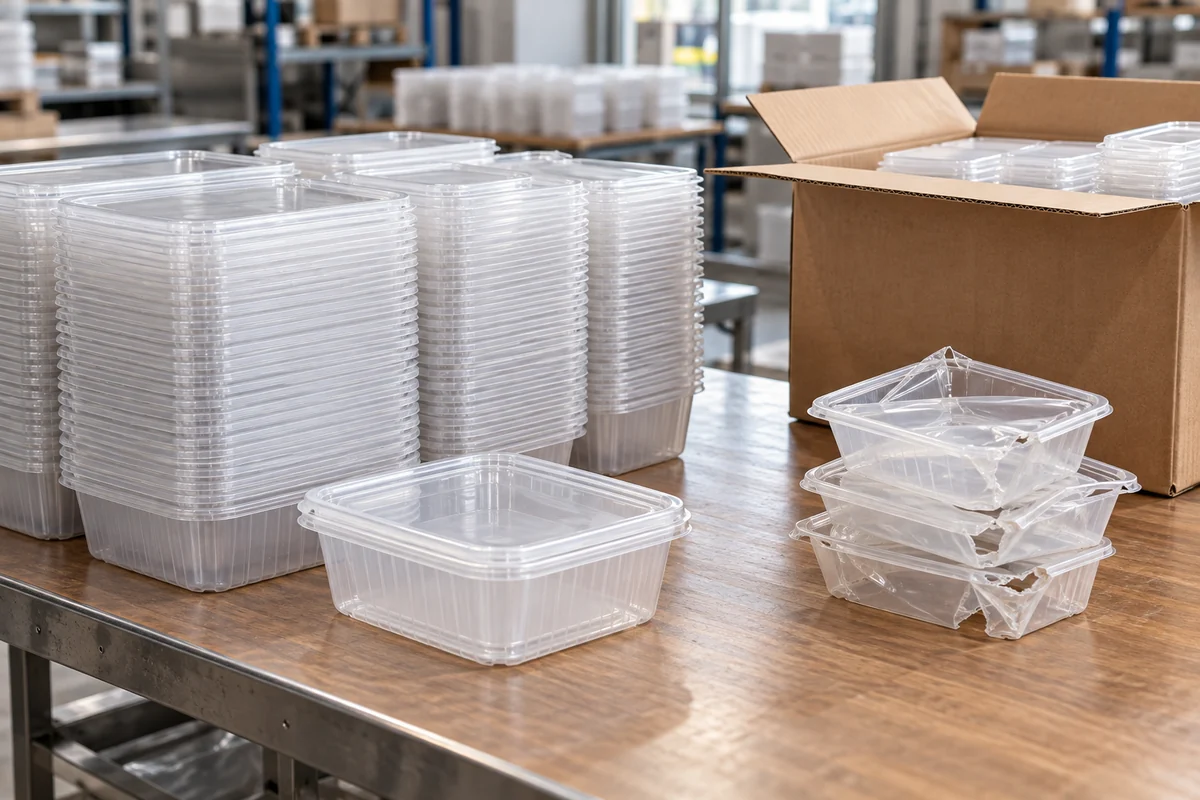
Measure food container waste by complete usable tray-and-lid packs, not just purchased trays. Add landed product cost and attributable handling losses, then divide by the packs available for use. This exposes the cost of damaged rims, missing lids, de-nesting failures and packing that consumes freight space.
Keep financial loss and physical volume in separate measures. A denser carton can reduce space per set while increasing damage or slowing de-nesting; both outcomes belong in the decision.
Establish a waste baseline
For a defined delivery or period, record purchased trays and lids, quantities rejected on arrival, stock lost in storage and stock damaged during handling. Categorize the reason and avoid counting a container at more than one loss stage. Keep supplier credits separate until received or confirmed under an agreed settlement.
Use compatible lids, not every lid in the warehouse, when calculating the number of complete packs. Extra trays and excess incompatible lids are separate inventory exposures.
Calculate cost per usable pack
Hypothetical example: a delivery contains 100,000 tray-and-lid sets with a total nonrecoverable landed cost of USD 20,000. Receiving inspection rejects 2,000 sets; handling later damages another 1,000 sets. The delivery leaves 97,000 usable packs.
Before additional handling costs or credits, USD 20,000 ÷ 97,000 = USD 0.2062 per usable pack, rounded to four decimal places. The purchased-set cost was USD 0.20. If sorting and disposal add USD 300, the revised cost is USD 20,300 ÷ 97,000 = USD 0.2093.
These numbers illustrate the calculation only. Do not use them as a target reject rate, an actual supplier result or a market price.
Compare packing volume on the same basis
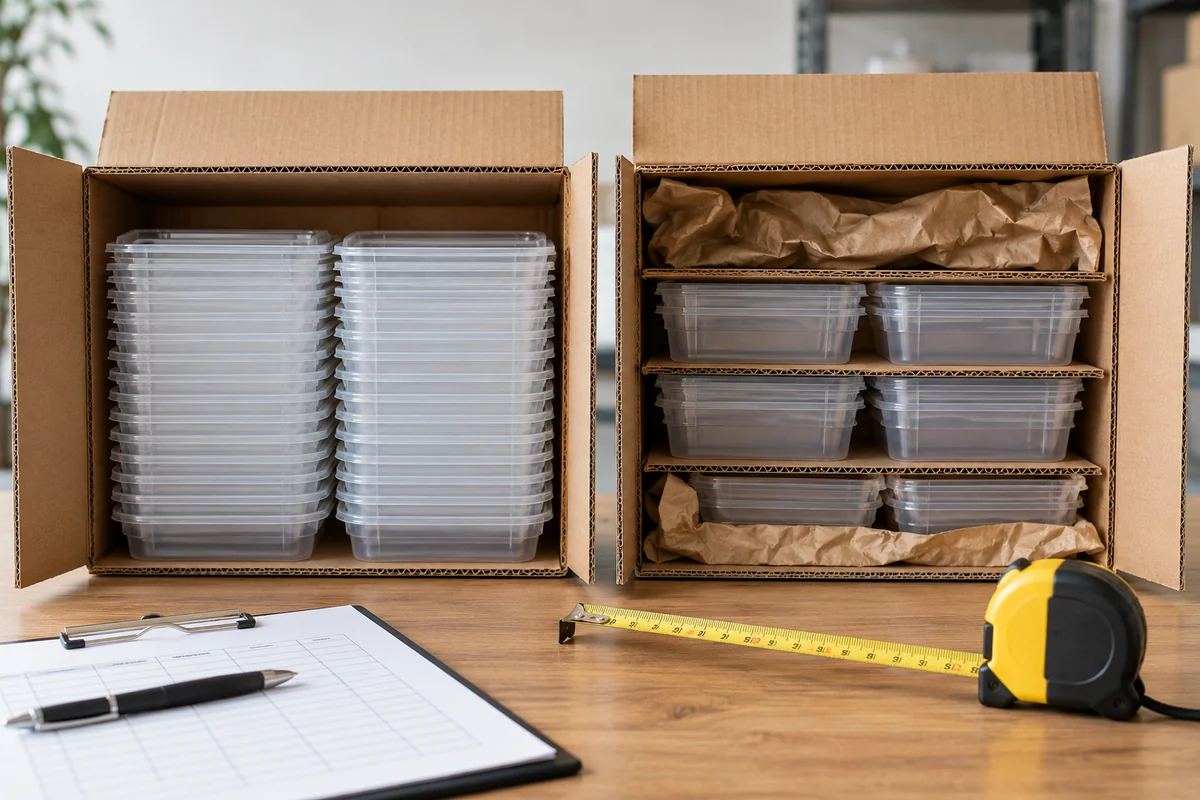
Carton volume in m³ = external length × width × height in metres. For separate tray and lid cartons, add the allocated volumes needed to supply the same number of complete sets.
| Hypothetical packing | Sets represented | Combined carton volume | Volume per 1,000 sets |
|---|---|---|---|
| Packing A | 500 | 0.060 m³ | 0.120 m³ |
| Packing B | 600 | 0.060 m³ | 0.100 m³ |
B uses about 16.7% less carton volume per set in this example. That does not automatically mean 16.7% lower freight: pallet layout, weight, chargeable-volume rules and actual loading determine the shipment charge.
Use real foil carton dimensions for the volume calculation
The YIYUAN foil catalog, page 22 lists 220 and 2317 as 1,000 ml models packed at 1,000 containers per carton. Their published external carton dimensions produce the following calculated volumes:
| Model | Catalog carton dimensions | Calculated carton volume | Basis |
|---|---|---|---|
| 220 | 585 × 330 × 435 mm | 0.083976750 m³ | 1,000 containers; closure packing to confirm |
| 2317 | 520 × 480 × 360 mm | 0.089856000 m³ | 1,000 containers; closure packing to confirm |
These volume results are calculated from actual listed dimensions, not invented carton measurements. They are not a like-for-like freight saving: the tray geometries differ, and lid packing, pallets and usable yield still need confirmation. For PP/PET formats, use the product catalog to select the format and request its own confirmed carton drawing; do not reuse the foil dimensions.
Trial a denser pack before approving it
- Keep product, lid and handling conditions unchanged while changing the proposed packing arrangement.
- Record external carton dimensions, actual quantities, gross weight and the protective packing.
- Check de-nesting time and whether operators damage rims during separation.
- Inspect arrival condition after a representative handling or shipment trial.
- Compare usable yield and handling cost with the baseline, not carton density alone.
Removing separators or adding material additives can affect more than freight. Obtain supplier agreement and review product or food-contact evidence where the material construction changes.
Choose one improvement and verify the result
Start with the largest recorded loss category. A lid mismatch needs component control; transit damage needs packing and handling review; de-nesting loss needs geometry and separation checks. Set a measured target based on your own baseline rather than promising a universal waste reduction percentage.
Prepare the next supplier discussion
Combine this cost measure with container sample tests before bulk production. Send the selected model, lid requirement, order quantity and packing constraints to YIYUAN, and request the confirmed carton plan before modeling savings.
Prepared by YIYUAN NEW MATERIALS. Updated October 8, 2026. These are buyer planning procedures; product claims require evidence for the ordered specification and intended use.