

Food container incoming inspection should lead to a lot-level release decision. Define the lot, select the sampling plan, inspect against approved defect criteria and record who may release or hold the stock. Checking convenient cartons from the top of a pallet is not enough to support the whole shipment.
This procedure is for empty disposable containers and their closure components. It combines visual receiving checks with application-specific functional checks; it does not replace food-contact documentation or supplier process control.
Define the lot and its identity first
Use production and traceability records to define a reasonably homogeneous lot. Keep different product codes, lid combinations and production runs distinguishable. A pallet may contain several lots, and a lot may span several pallets.
Check carton labels, quantity, damage and wet packing before drawing product samples. Quarantine unidentified or suspect stock so it cannot be issued while the investigation is open.
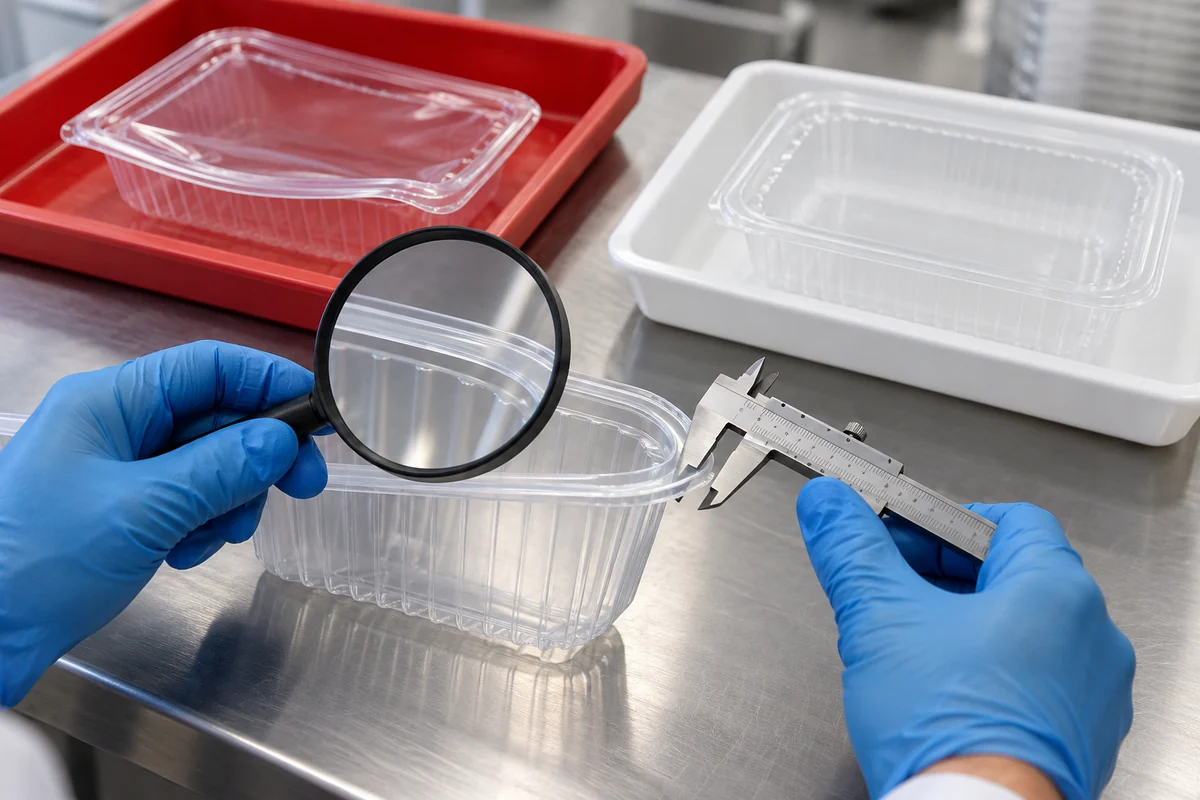
Select the agreed sampling plan correctly
When using an attributes standard such as ISO 2859-1, document the edition, lot size, inspection level, normal or tightened status, AQL for each defect class, sample size and acceptance/rejection numbers. Use the applicable tables and switching rules rather than inventing a percentage sample.
AQL is not a rule that the measured sample defect percentage must be below the AQL number. The selected plan’s acceptance and rejection counts determine the decision. Acceptance sampling also does not establish zero defects in the lot.
Agree critical-defect escalation separately with your quality team. Do not treat possible contamination or a safety concern as an ordinary cosmetic issue that can be averaged away.
Write receiving checks for the selected YIYUAN format
The YIYUAN container page lists 2/3-compartment trays at 150–300 pieces per carton. Select the exact tray and closure codes from the approved quote; use the PP product catalog to identify the intended compartment arrangement. Inspect carton quantity, rim condition and lid engagement against that approval rather than a generic “meal box” sample.
For a foil receiving lot, model 220 has cataloged top dimensions and height of 215 × 160 × 55 mm; model 2317 is 230 × 170 × 45 mm. Both are listed as 1,000 ml in the foil catalog, so measuring only capacity could miss the wrong model. Agree drawing tolerances and the measurement method before inspection; nominal catalog dimensions are not tolerance limits.
Separate defect definitions from example tolerances
| Check | Record against the approved specification | Action if unresolved |
|---|---|---|
| Identity and cleanliness | Product and lot codes, foreign material, unexplained odor or contamination | Hold and investigate; do not release by appearance alone |
| Dimensions and rim | Agreed measurement points and drawing tolerances | Classify the defect and apply the agreed plan |
| Closure | Exact lid code, engagement, rim distortion and repeat closure | Hold the affected pairing pending functional review |
| De-nesting and handling | Separation behavior, cracks and edge damage | Check additional affected positions and supplier cause |
| Packing | Carton count, sleeve condition and transport damage | Isolate affected stock and document disposition |
Add the functional tests your application needs
Test the assembled tray-and-lid pair. For filled-pack handling, define fill level, load, orientation, duration and acceptance criteria. For film sealing, use the approved lidding film and recorded process settings. A snap-lid check cannot validate a heat-sealed pack.
Keep functional sample sizes and criteria explicit; they may differ from the visual attributes plan. A quick water check does not establish food-contact suitability or universal leak resistance.
Draw samples across the physical lot
Use a documented random selection method across cartons and accessible positions, then inspect units from within the selected sleeves or stacks. Preserve randomness; do not replace the plan with fixed convenient carton numbers. Where cavity codes exist, record them to help investigate clustered defects.
Record release, hold and follow-up
The inspection record should include lot identity, plan inputs, counts by defect class, functional results, photos, instrument identification and disposition. For a hold, name the owner and supplier response needed. Release after sorting or rework should follow an approved reinspection procedure, with traceability to the affected lot.
Prepare the next supplier discussion
Use the lid fit and leak-resistance test guide when specifying functional checks. Send the selected tray/lid or foil model, approved drawing and receiving-check requirements to YIYUAN before agreeing the first shipment.
Prepared by YIYUAN NEW MATERIALS. Updated October 8, 2026. These are buyer planning procedures; product claims require evidence for the ordered specification and intended use.