
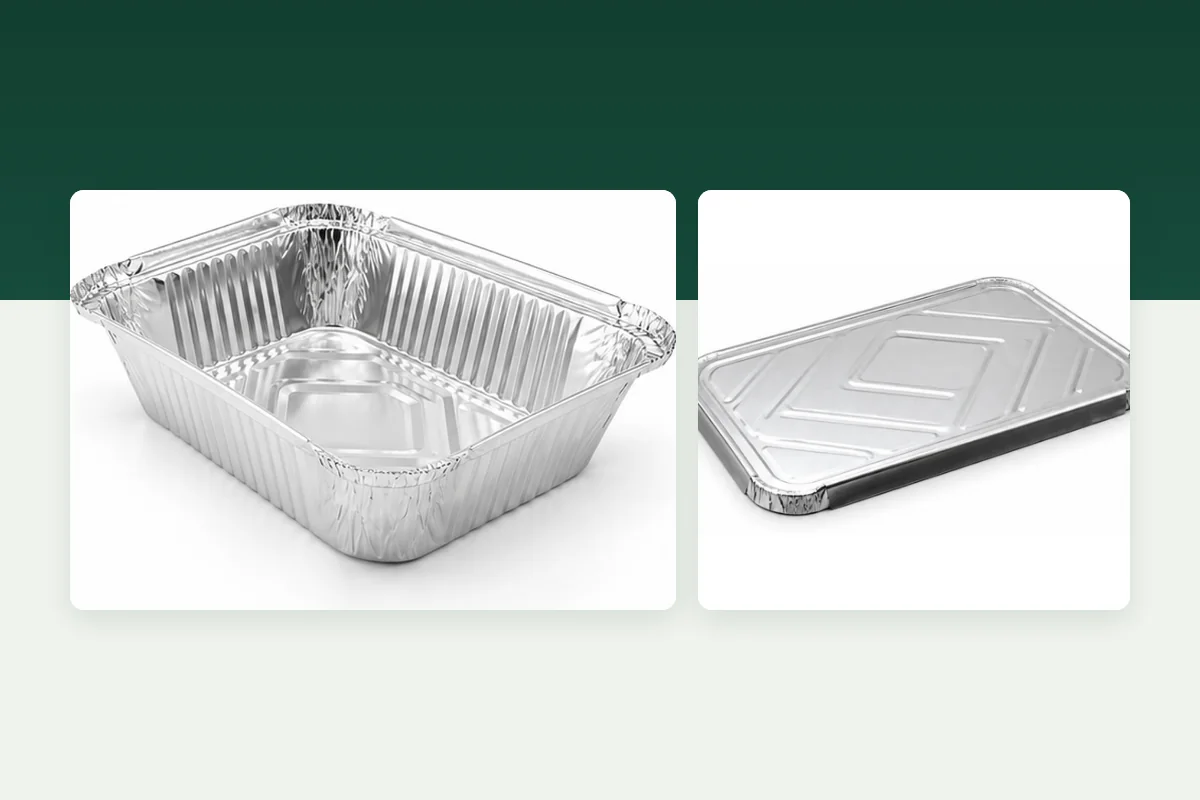
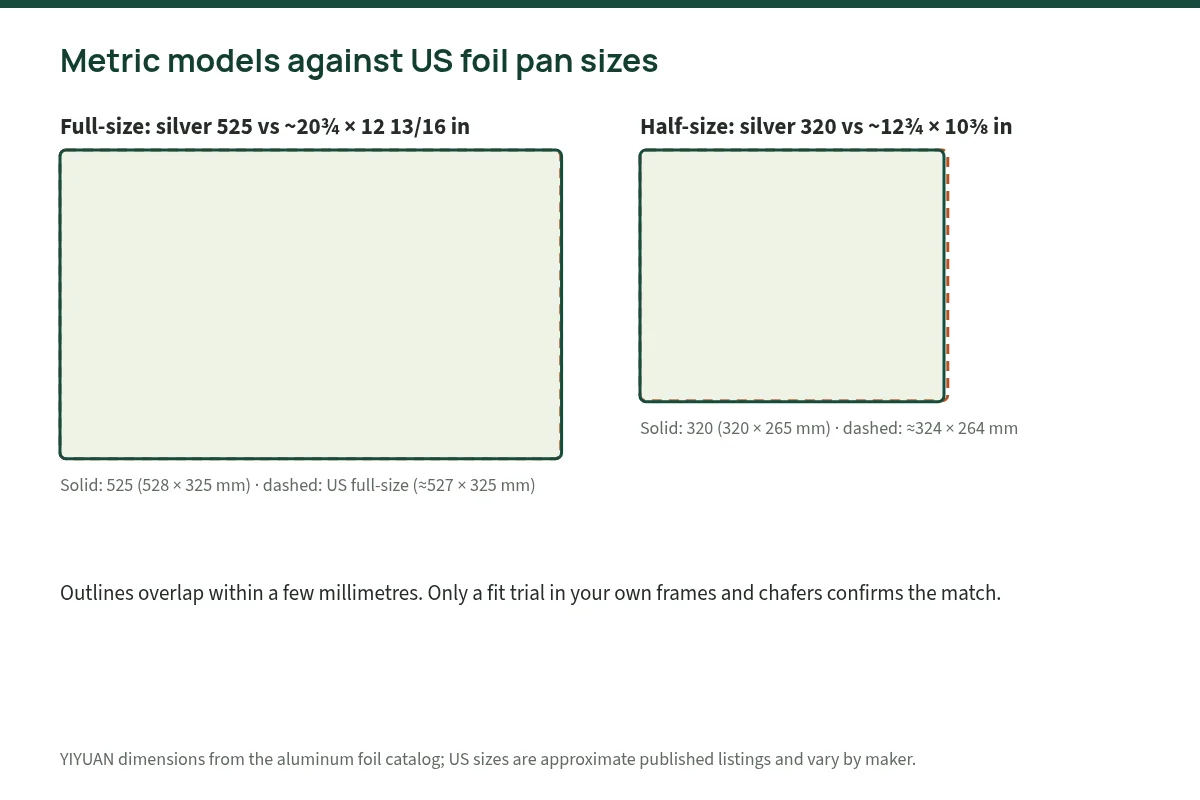
Two of our metric aluminum foil containers come within a few millimetres of the North American “full-size” and “half-size” foil pan footprints. The silver 525 measures 528 × 325 mm at the rim, against a full-size pan of about 20¾ × 12 13/16 in (527 × 325 mm). The silver 320 measures 320 × 265 mm, against a typical half-size pan of about 12¾ × 10⅜ in (324 × 264 mm). Close on paper, though, is not the same as fitting your chafing dishes. This article converts the numbers and shows the trial that settles it.
Why foil pan sizes don’t line up neatly
In the US and Canada, buyers describe foil pans by the steam-table system: full-size, half-size, third-size and so on. These names come from metal hotel pans. Foil versions are made to sit in the same frames and chafing dishes. Manufacturers do not all use identical dimensions, though. Published full-size listings are typically about 20¾ in long and 12¾ to 12 13/16 in wide. Half-size listings cluster around 12¾ in long and either 10⅜ in or 9⅜ in wide. Depth is even less consistent, which is why the size name alone is not enough to order by.
Our catalog is metric. Each model is described by top length × width × height and a bottom size in millimetres, so a North American buyer has to convert.
The metric models that match
| Model | Top × height (mm) | In inches (converted) | Listed capacity | Packing | Closest US reference |
|---|---|---|---|---|---|
| Silver 525 | 528 × 325 × 82 | 20.79 × 12.80 × 3.23 | 10,500 ml | 50 pcs / carton | Full-size, deep |
| Silver L-525 | 525 × 327 × 68 | 20.67 × 12.87 × 2.68 | 9,700 ml | 50 pcs / carton | Full-size, shallower |
| Silver 320 | 320 × 265 × 60 | 12.60 × 10.43 × 2.36 | 3,200 ml | 100 pcs / carton | Half-size |
| Silver L-320 | 320 × 264 × 60 | 12.60 × 10.39 × 2.36 | 3,500 ml | 100 pcs / carton | Half-size |
Conversions use 25.4 mm per inch and are rounded to two decimals. Metric figures come from the aluminum foil catalog (pages 18, 23 and 24).
Two details are easy to miss. First, the 320 and L-320 have practically the same rim and height, yet the catalog lists 3,200 ml and 3,500 ml. Their bases differ (250 × 195 mm versus 260 × 200 mm), so the walls slope differently. Second, the 525 is 14 mm deeper than the L-525, and that 14 mm affects whether a lid clears the food. If you plan by volume, use the capacity of the model you will actually order, and verify it with a water fill (see our foil container size guide for the method).
What about the in-between sizes?
Several of our larger rectangular containers do not correspond to a steam-table size, and we would rather say so plainly:
- Silver 370 (370 × 270 × 70 mm, 4,700 ml) is longer than a half-size pan but far short of full-size. It has a matching 370 rectangular lid in the catalog.
- Silver 315 (315 × 215 × 50 mm, 2,100 ml) is narrower than a half-size pan.
- Silver L-430 (428 × 308 × 68 mm, 5,830 ml) is a large tray between the two standard sizes.
These work well as standalone catering and roasting trays, delivered and served on their own. Just don’t expect them to drop into a standard frame.
Run a fit trial before the first order
A converted dimension tells you the pan should be close. Only a trial in your own equipment tells you whether it fits. Use samples and the frames, chafers and racks your customers actually use.
- Frame fit. Set the empty pan in the frame or chafing dish. The rim should rest evenly without forcing, and the pan should not drop through or rock.
- Loaded fit. Fill with water to your normal level and set it in again. A filled foil pan flexes. Check that the rim still sits on the frame and the walls do not bow out against the sides.
- Lid and stack. If you deliver closed pans, test the closure. The catalog lists a 320 rectangular lid (320 × 265 mm). No lid is listed for the 525 sizes, so ask about lid availability with your quotation. Stack two filled, lidded pans and check the bottom one.
- Carrying. Lift a filled full-size pan from one end, the way staff will. Foil pans are often carried on a sheet tray or in a carrier. Record whether yours needs one.
- Record it. Note the frame make and model, pan model, fill level and result. Next season you can re-order with confidence instead of re-testing from memory.
Do not treat a pass in one frame as a pass in all frames. Equipment varies between manufacturers, just as foil pans do.
Worked example (hypothetical)
Picture a hypothetical catering distributor in the southern US. It currently buys half-size deep foil pans from a domestic supplier and full-size pans from a second source. It is considering metric containers for a private-label line.
The distributor requests samples of the 320, L-320, 525 and L-525 and tests them in the three chafing-dish models its largest customers use. The 320 and L-320 sit correctly in all three. The 525 sits correctly in two; in the third, the rim rests on the frame but the deeper body touches the water pan beneath when filled. The L-525, 14 mm shallower, clears it. The distributor lists the L-525 as its full-size pan, with a note on the spec sheet naming the frames it was tested in.
Then the numbers. A half-size case of the 320 contains 100 pans; a full-size case of the L-525 contains 50. The distributor’s customers buy half-size pans in cases of 100 already, so the pack works as is. For full-size pans, the customers are used to cases of 50, so no repacking is needed either. Had either case count been wrong for the channel, a packing change would have gone on the RFQ.
Sources for the dimensions
YIYUAN dimensions, capacities and packing quantities come from the aluminum foil catalog and the linked product pages. US pan sizes are approximate published dimensions from North American foodservice suppliers, and they vary by manufacturer. For example, Handi-Foil’s Tru-Fit range is listed at 20¾ × 12 13/16 in for the full-size pan and 12¾ × 10⅜ in for the half-size pan. Thickness and alloy for each model are confirmed with the quotation, so this article makes no claim about load-bearing strength.
What to include in your enquiry
When you ask YIYUAN for a quotation, list the models from your fit trial and the frames you tested them in. Say whether you need lids and which closure style, and give the case count your channel expects. Include the monthly volume for each size. If your trial found a near-miss, send the measurement too. It tells us more than the size name does.
Prepared by YIYUAN NEW MATERIALS. Updated October 25, 2026. Dimensions are catalog specifications; US sizes are approximate and vary by maker. The worked example is hypothetical.