
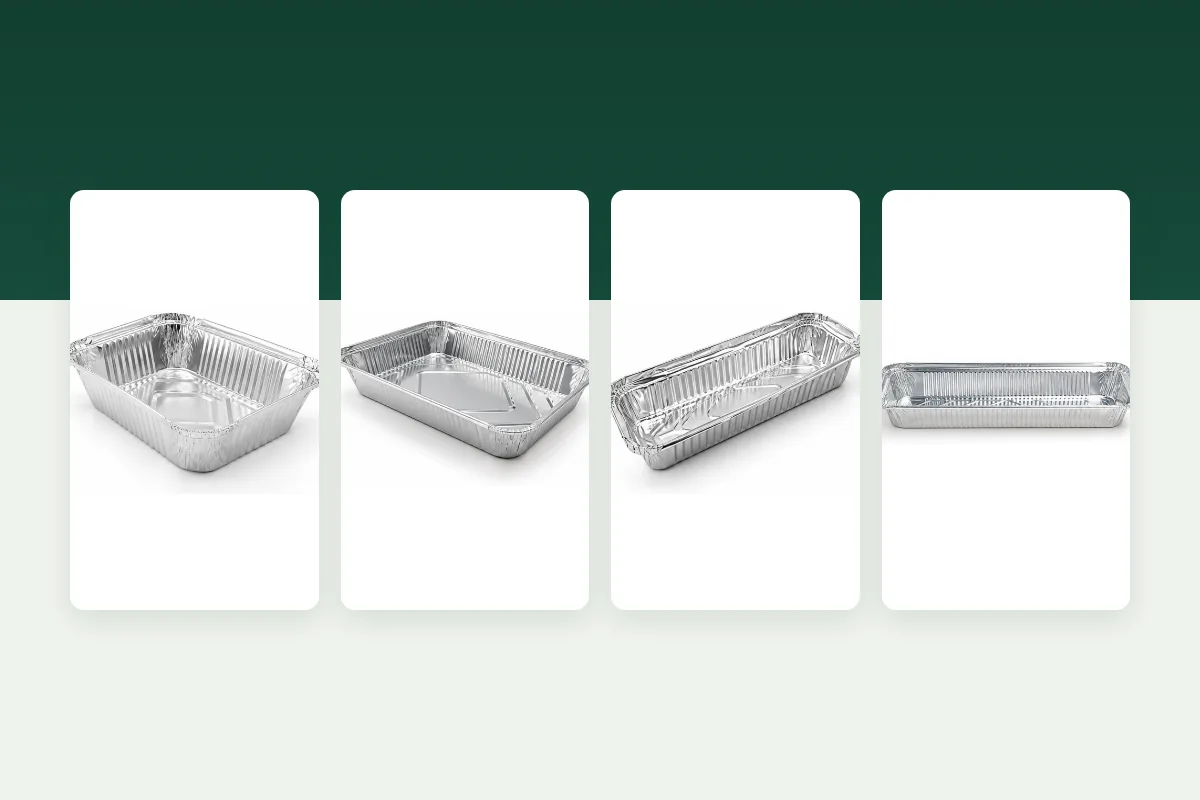
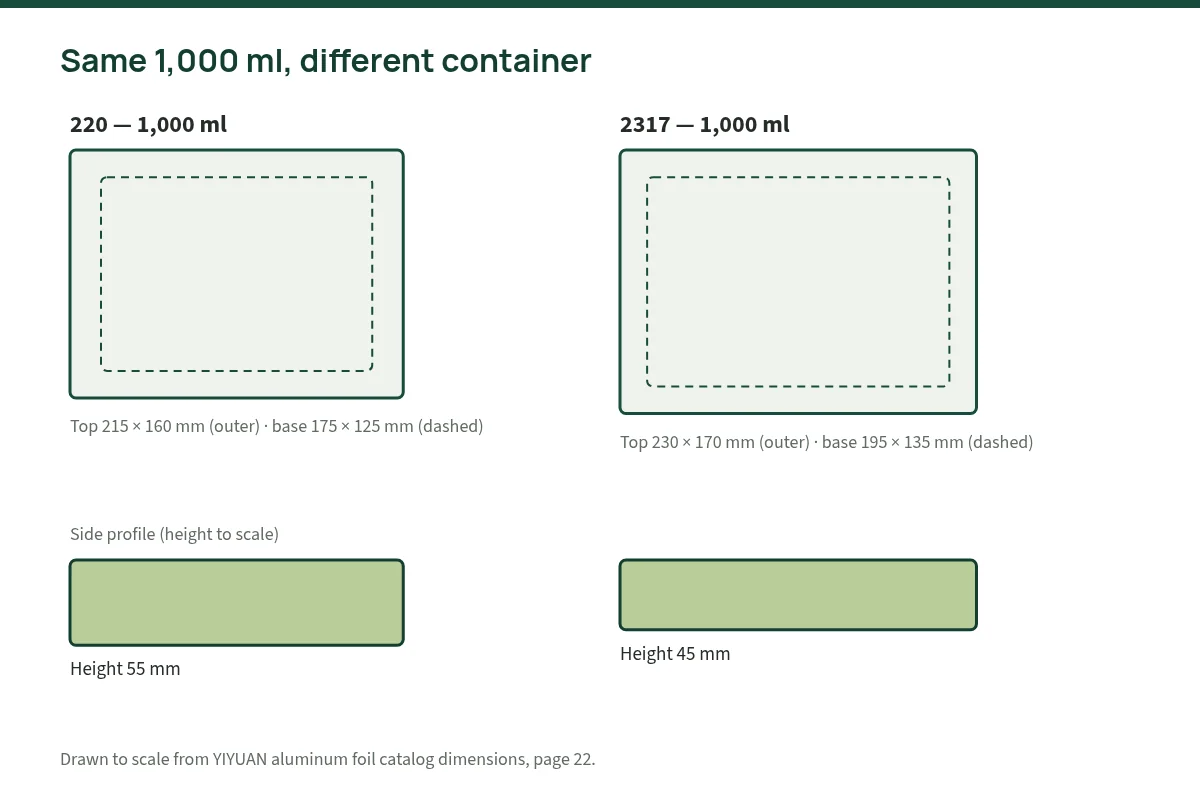
Pick an aluminum foil container by the portion you actually serve, then by the shape that portion needs. The capacity printed in a catalog tells you how much the container holds in total. It does not tell you how full your staff will fill it, how the food will sit, or which lid will close over it. Two of our 1,000 ml models prove the point: one is 55 mm deep, the other 45 mm deep with a noticeably larger opening.
This guide walks through the small and mid-size rectangular range in the YIYUAN silver series, 225 ml to 1,000 ml, and shows a simple water test for turning a menu into a short list of models.
The 225–1,000 ml rectangular range at a glance
All figures below come from the aluminum foil catalog, pages 21–22. Top dimensions are length × width × height at the rim; the bottom dimension is the flat base.
| Model | Listed capacity | Top × height (mm) | Bottom (mm) | What the shape tells you |
|---|---|---|---|---|
| 130 (1310) | 225 ml | 131 × 101 × 37 | 90 × 60 | Smallest base in the range; side dishes and sauces |
| 150 (1512) | 400 ml | 150 × 125 × 48 | 106 × 80 | Compact and fairly deep for its size |
| 175 (1711) | 450 ml | 175 × 110 × 40 | 142 × 80 | Long and shallow; a longer base than the 150 |
| 165 (1613) | 600 ml | 165 × 130 × 45 | 120 × 95 | Compact 600 ml option |
| 195 Shallow (1914) | 600 ml | 195 × 140 × 40 | 155 × 105 | Same capacity as the 165, spread over a wider base |
| 205 (2011) | 650 ml | 205 × 110 × 57 | 162 × 70 | Narrowest opening for its length; the deepest of the small models |
| 185 (1813) | 750 ml | 185 × 130 × 50 | 145 × 98 | Mid-depth, mid-width |
| 2114 | 800 ml | 210 × 140 × 43 | 174 × 103 | Wide and relatively shallow |
| 195 Deep | 850 ml | 190 × 140 × 55 | 150 × 100 | Deep version of the 195 footprint |
| 220 | 1,000 ml | 215 × 160 × 55 | 175 × 125 | Deep 1,000 ml |
| 2317 | 1,000 ml | 230 × 170 × 45 | 195 × 135 | Shallow 1,000 ml with the largest opening here |
Every model in this table is packed 1,000 pieces per carton, according to the catalog. Carton dimensions differ by model and are listed on each product page.
Same capacity, different container
The table has two pairs that share a capacity but not a shape. They are the clearest reason to stop choosing by millilitres alone.
| Pair | Opening area | Base area | Height |
|---|---|---|---|
| 220 vs 2317 (both 1,000 ml) | 344 cm² vs 391 cm² | 219 cm² vs 263 cm² | 55 mm vs 45 mm |
| 165 (1613) vs 195 Shallow (1914) (both 600 ml) | 214 cm² vs 273 cm² | 114 cm² vs 163 cm² | 45 mm vs 40 mm |
Areas are calculated from the listed dimensions (length × width) and rounded to whole square centimetres. They ignore the rounded corners, so treat them as comparisons, not exact surfaces.
What changes in practice:
- How the food sits. The 2317 spreads a portion thinner. That can suit items you want laid out in one layer. The 220 keeps the same volume in a deeper pool, which leaves more distance between a sauce and the rim.
- The lid. A 230 × 170 mm opening needs a different closure from a 215 × 160 mm opening. Two models with the same capacity do not share a lid unless the supplier confirms they do.
- Space in the bag and the carton. A larger footprint takes more room on a delivery shelf and in a carrier bag. In the carton, the 220 and 2317 also differ; our cost-per-usable-pack article works through their published carton volumes.
Measure your fill volume before you shortlist
Listed capacity is useful for comparing models. To choose one, you need the volume your kitchen actually puts in. A kitchen scale and water give you that number in a few minutes.
- Take a sample of each model you are considering.
- Weigh the empty container and zero the scale.
- Fill it with water to the level your staff would stop at for that dish. Leave the space you need for the lid, for toppings and for carrying without spills.
- Read the weight. At room temperature, 1 g of water is close enough to 1 ml for this purpose.
- Repeat three times, ideally with the person who plates the dish, and use the average.
Divide the measured fill by the listed capacity. That ratio is your fill factor for that model and that dish. It will vary between kitchens and between dishes; a soup and a dry stir-fry are filled differently.
Worked example (hypothetical)
Consider a hypothetical takeaway kitchen that sells a curry, a rice portion and a small side. The owner wants as few container models as possible. After the water test, staff find they consistently stop at about 80% of listed capacity. That 80% is an assumption for this example, not a figure that applies to every kitchen.
| Dish | Portion measured | Minimum listed capacity at 80% fill | Candidates |
|---|---|---|---|
| Curry | 500 ml | 500 ÷ 0.8 = 625 ml | 205 (2011) 650 ml; 185 (1813) 750 ml |
| Rice | 400 ml | 400 ÷ 0.8 = 500 ml | 165 (1613) 600 ml; 195 Shallow (1914) 600 ml |
| Side dish | 150 ml | 150 ÷ 0.8 = 187.5 ml | 130 (1310) 225 ml |
For the curry, the 205 (2011) fits on paper with only 25 ml to spare. Its 110 mm width also makes ladling harder. The kitchen chooses the 185 (1813), which has a 130 mm-wide opening and more headroom. For rice, both 600 ml models work. The owner picks the 165 (1613) because the narrower footprint packs more containers into each delivery bag.
The kitchen then checks whether the 185 (1813) could take the rice as well. That would mean one fewer model, one fewer lid and simpler stock. At 80% fill, 750 ml holds 600 ml. A 400 ml rice portion would look sparse in it. So the owner keeps two main models and accepts the extra stock line. The shortlist is three models instead of the six that “looked about right” before measuring.
Plan the closure at the same time
For this size range, the catalog does not list a dedicated lid model. It states that matching lids are confirmed with the quotation. Ask about the closure type when you shortlist the containers, not after. A board lid, a foil lid and a plastic dome each need confirming against the exact rim. For the general method of checking fit and leakage, see how to test lid fit and leak resistance.
Where these figures come from
Model numbers, capacities, top and bottom dimensions and packing quantities are taken from the YIYUAN aluminum foil catalog (specifications revised 2026-09-30) and the matching product pages in the aluminum foil packaging range. The catalog states that thickness, alloy, matching lids, order quantity and OEM configuration are confirmed with the quotation. This article therefore makes no claim about wall thickness, stiffness or oven performance for any model.
What to send when you ask for a quotation
A useful enquiry for foil containers includes:
- the shortlisted models and the dish each one is for;
- the fill volume you measured, so the supplier can flag a model that is too tight;
- the closure you want (board, foil or plastic lid) and whether lids are packed separately;
- expected monthly quantity per model and the destination market;
- any food that is especially acidic or salty, so the material and use conditions can be discussed.
For a broader view across plastic, paper and foil formats, our disposable food container size guide covers other container types. When your shortlist is ready, send YIYUAN the model numbers, fill volumes, lid preference and monthly quantity. We will confirm thickness, lids and carton details for those models.
Prepared by YIYUAN NEW MATERIALS. Updated October 23, 2026. The worked example is hypothetical; product figures are catalog specifications, not measured performance.