
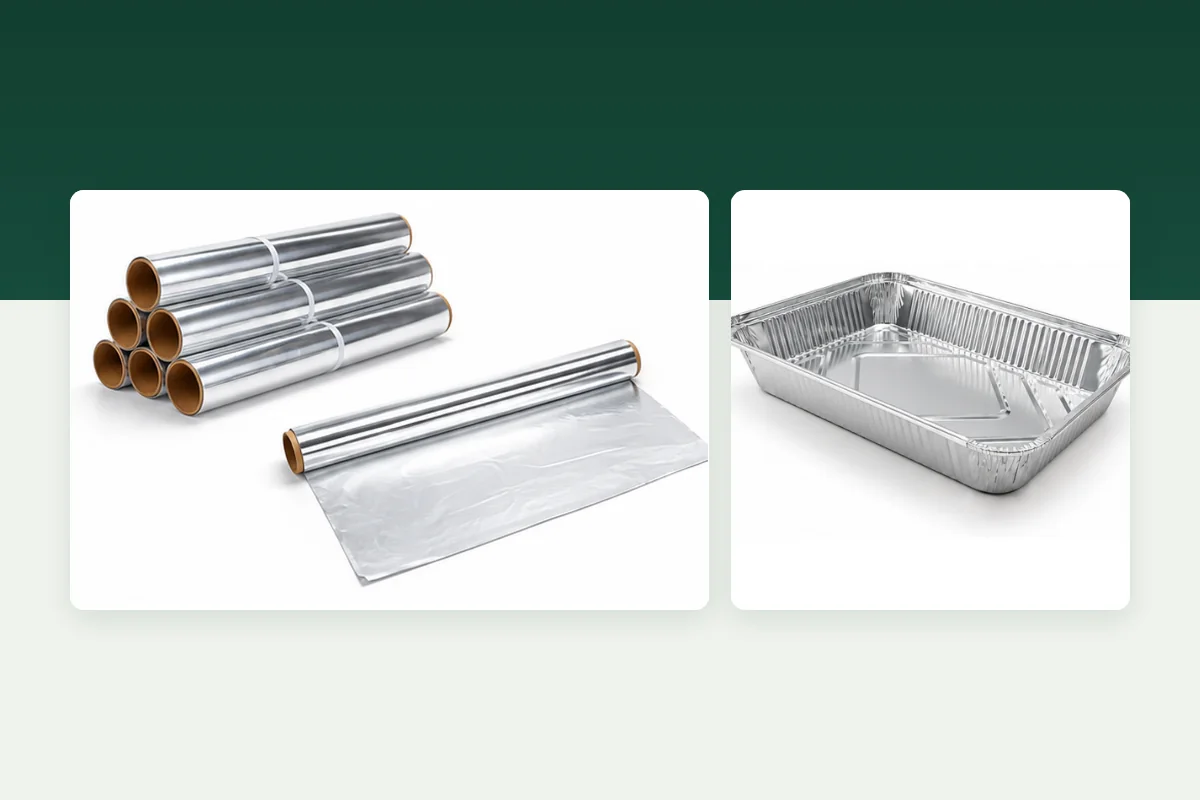
Household aluminum foil rolls are short and narrow, sized for a kitchen drawer and sold one at a time. Foodservice rolls are long and wide, and kitchens buy them by the carton or pallet. The size labels hide two traps. First, metric and imperial rolls that look equivalent are not: 12 in × 500 ft is 3.2% more foil than 300 mm × 150 m. Second, the label usually says nothing about thickness, which decides whether the foil is suitable for jobs such as freezer wrapping. This guide puts our household and foodservice sizes on one basis so they can be compared.
The sizes we list
From the aluminum foil catalog, pages 3–4:
| Range | Metric sizes | Imperial sizes | How it is packed |
|---|---|---|---|
| Household rolls | 250 mm × 8 m / 16 m; 300 mm × 5 m / 10 m / 50 m; 450 mm × 5 m / 10 m / 20 m | 25 sq ft (12 in × 25 ft); 37.5 sq ft (18 in × 25 ft); 75 sq ft (12 in × 75 ft); 200 sq ft (12 in × 200 ft) | 12–120 rolls per carton |
| Foodservice rolls | 300 mm and 450 mm × 100 m / 150 m / 300 m | 12 in and 18 in × 500 ft / 1,000 ft | 4–6 rolls per carton (metric); 160–216 rolls per pallet (imperial) |
The imperial household labels follow the North American habit of stating square feet: 12 in is one foot, so 12 in × 25 ft = 25 sq ft. We checked all four: 18 in × 25 ft = 1.5 × 25 = 37.5 sq ft; 12 in × 75 ft = 75 sq ft; 12 in × 200 ft = 200 sq ft.
Compare by area, not by label
Foil is sold by roll, but what a kitchen uses is area. Converting every size to square metres puts metric and imperial quotations on one basis.
Area (m²) = width (m) × length (m), using 1 in = 0.0254 m and 1 ft = 0.3048 m.
| Roll | Width × length (metric) | Area |
|---|---|---|
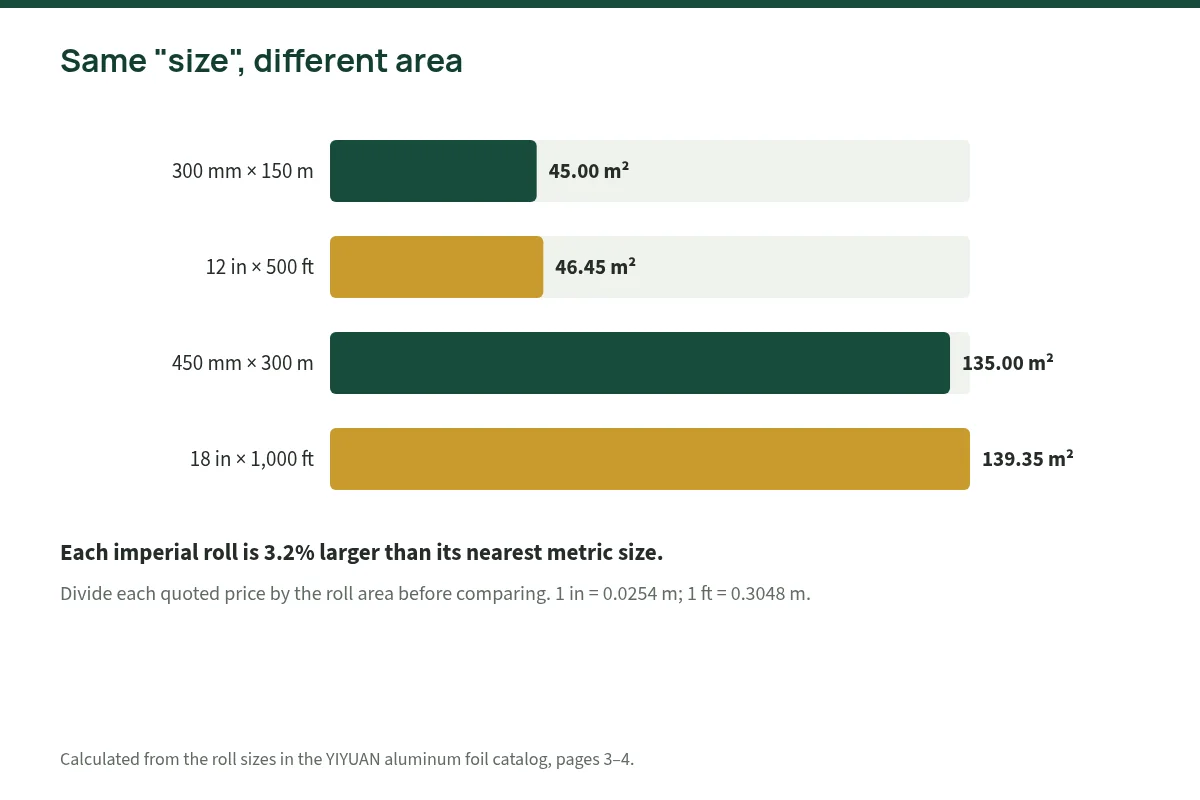
| 300 mm × 150 m | 0.300 × 150.0 m | 45.00 m² |
| 12 in × 500 ft | 0.3048 × 152.4 m | 46.45 m² |
| 450 mm × 300 m | 0.450 × 300.0 m | 135.00 m² |
| 18 in × 1,000 ft | 0.4572 × 304.8 m | 139.35 m² |
The imperial roll is 3.2% larger in both pairs. If two quotations for “a 12-inch, 500-foot-ish roll” differ by less than 3%, the metric roll may actually be the more expensive one per square metre. Divide each price by its area before comparing. Our price per kilogram, roll and metre article applies the same idea to cling film.
Thickness: the number most foil labels leave out
Our catalog confirms thickness and alloy with the quotation rather than listing one figure per roll. That is deliberate: the same roll size can be made in different gauges for different customers. It does mean your RFQ has to state what you need.
- State thickness as a number. Give microns or millimetres plus a tolerance. Terms like “standard”, “heavy duty” and “extra heavy duty” are not used consistently across markets and suppliers.
- Tie it to the job. The US National Center for Home Food Preservation advises that heavy-duty foil can be used as a freezer wrap, and that lightweight household foil is not satisfactory for home freezing (NCHFP freezing FAQ). If your customers freeze food in foil, the gauge belongs in the specification.
- Verify it on arrival. Check thickness on samples and deliveries with a calibrated micrometer, or by weighing a measured area. The method is similar to the one in our cling film thickness tolerance guide.
How much foil fits in a carton
Shorter rolls carry more packaging per square metre of foil. Using the listed carton sizes:
| Roll and pack | Foil per carton | Carton volume | Foil per m³ of carton |
|---|---|---|---|
| Household 300 mm × 10 m, 48 rolls (330 × 240 × 320 mm) | 144 m² | 0.0253 m³ | about 5,700 m² |
| Household 300 mm × 50 m, 12 rolls (230 × 175 × 335 mm) | 180 m² | 0.0135 m³ | about 13,300 m² |
| Foodservice 450 mm × 300 m, 4 rolls (510 × 215 × 215 mm) | 540 m² | 0.0236 m³ | about 22,900 m² |
Calculated from catalog dimensions and rounded. Retail packing, cores and boxes probably account for much of the difference. The figure helps you plan storage and freight; it is not a reason to sell kitchen-length rolls to households.
Worked example (hypothetical)
Picture a hypothetical distributor in North America that supplies both supermarkets and restaurants. It currently buys 12 in × 25 ft household rolls and 18 in × 500 ft foodservice rolls, and is reviewing a metric alternative of 450 mm × 150 m.
- 18 in × 500 ft = 0.4572 × 152.4 = 69.68 m²; 450 mm × 150 m = 67.50 m². The metric roll has 3.1% less foil.
- The distributor’s restaurant customers order “18-inch by 500-foot”. Switching would change both the width and the length on the label.
- The foodservice rolls are listed by pallet (160 rolls for the 18 in sizes). The metric 450 mm rolls come six to a carton, which suits smaller restaurant orders.
The distributor keeps imperial sizes for the US restaurant channel. It uses the metric 450 mm × 150 m only for a Canadian customer who prefers metric labelling. Both orders state a required thickness in microns, so a price comparison per square metre compares like with like.
Product sources
Roll sizes and packing data are from the YIYUAN aluminum foil catalog and the household and foodservice roll pages. Thickness, alloy, roll labelling and retail packaging are confirmed with the quotation. For the North American pallet sizes, the catalog lists 216 rolls per pallet (1,050 × 1,060 × 990 mm) for the 12 in rolls. For the 18 in rolls it lists 160 rolls per pallet (1,200 × 1,080 × 900 mm for 500 ft; 1,050 × 1,130 × 1,000 mm for 1,000 ft).
What to put in a foil roll RFQ
Send YIYUAN the width and length (with units), the thickness and tolerance, and whether you need retail boxes with a cutter edge or plain foodservice packing. Add the label language, the units of measure your market expects, and the quantity per size. If the foil is for freezing or oven use, say so. We will confirm the gauge and packing that fit.
Prepared by YIYUAN NEW MATERIALS. Updated November 2, 2026. Areas and volumes are calculated from catalog dimensions; the worked example is hypothetical.