
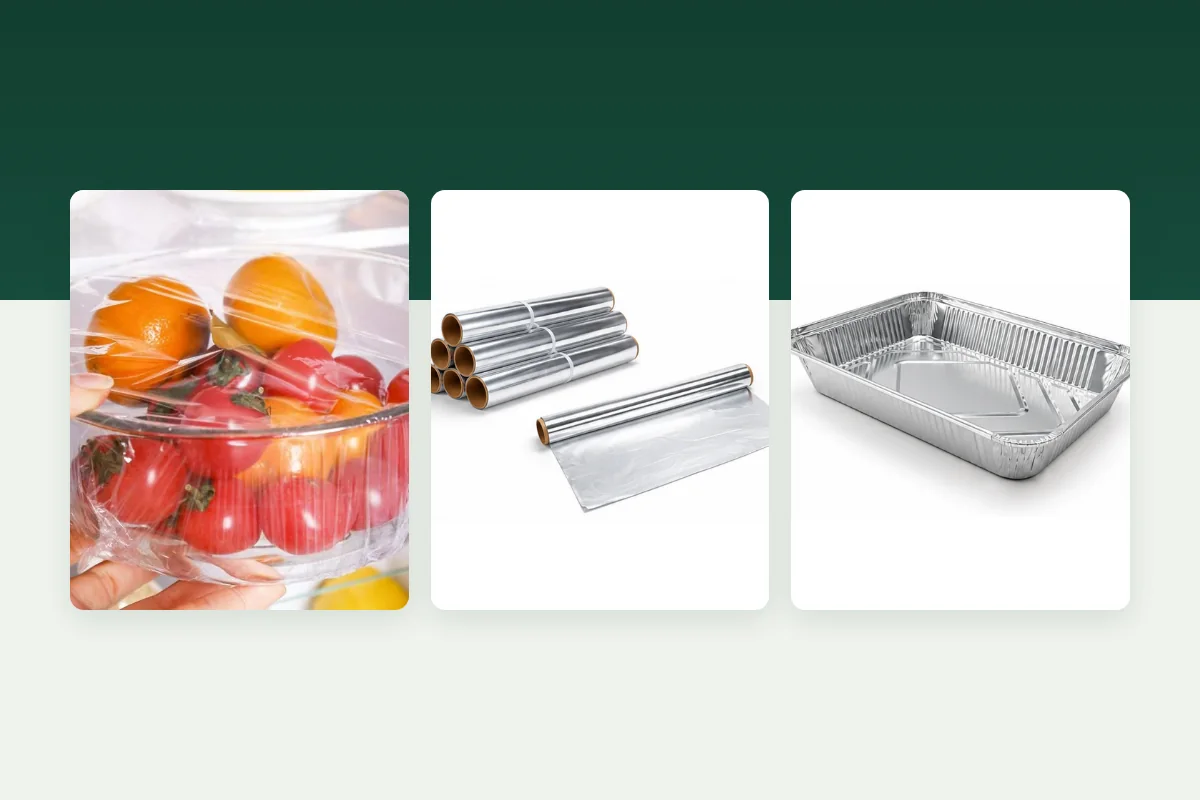
To wrap food for the freezer, keep air away from the food surface and protect the wrap from tearing. In practice that usually means two layers. Cling film goes tight against the food, then heavy-duty foil or a freezer bag goes over it, and the outside is labelled with what it is and the date. Lightweight foil on its own is not a good freezer wrap, and neither is store wrap for long storage. Freezer burn is a quality problem, not a safety one, but it is the main thing good wrapping prevents.
What the food safety guidance says
Two US sources cover freezer packaging clearly:
- The USDA Food Safety and Inspection Service says it is safe to freeze meat or poultry in its original packaging. That wrap is permeable to air, though, so quality may diminish over time. For prolonged storage, it advises overwrapping these packages as you would any food for long-term storage. It describes freezer burn as grayish-brown leathery spots caused by air coming into contact with the surface of the food, and states that freezer burn does not make food unsafe (FSIS, Freezing and Food Safety).
- The National Center for Home Food Preservation says freezer packaging should be moisture-vapour resistant and durable. It states that heavy-duty aluminium foil can be used as a freezer wrap but can be torn or punctured easily, so an overwrap is wise. Lightweight household foil, it says, is not satisfactory for home freezing. It also lists rigid aluminium containers among good freezing materials (NCHFP freezing FAQ).
FSIS also states that food stored constantly at 0 °F (−18 °C) will always be safe, and that recommended freezer storage times are for quality only.
Why two layers work better than one
| Layer | What it does | Its weakness alone |
|---|---|---|
| Cling film, inner | Clings to an irregular surface and pushes out air pockets | Thin; easily torn by frozen edges or other packs |
| Heavy-duty foil, outer | Holds its shape; adds a durable barrier and blocks light | Doesn’t seal itself; can tear or puncture at corners |
| Freezer bag, outer (alternative) | Closes completely; easy to label and stack | Air stays inside unless pressed out |
| Rigid foil container | Protects shape; can go from freezer to oven where the use is confirmed | The air gap between food and lid; press film onto the surface first |
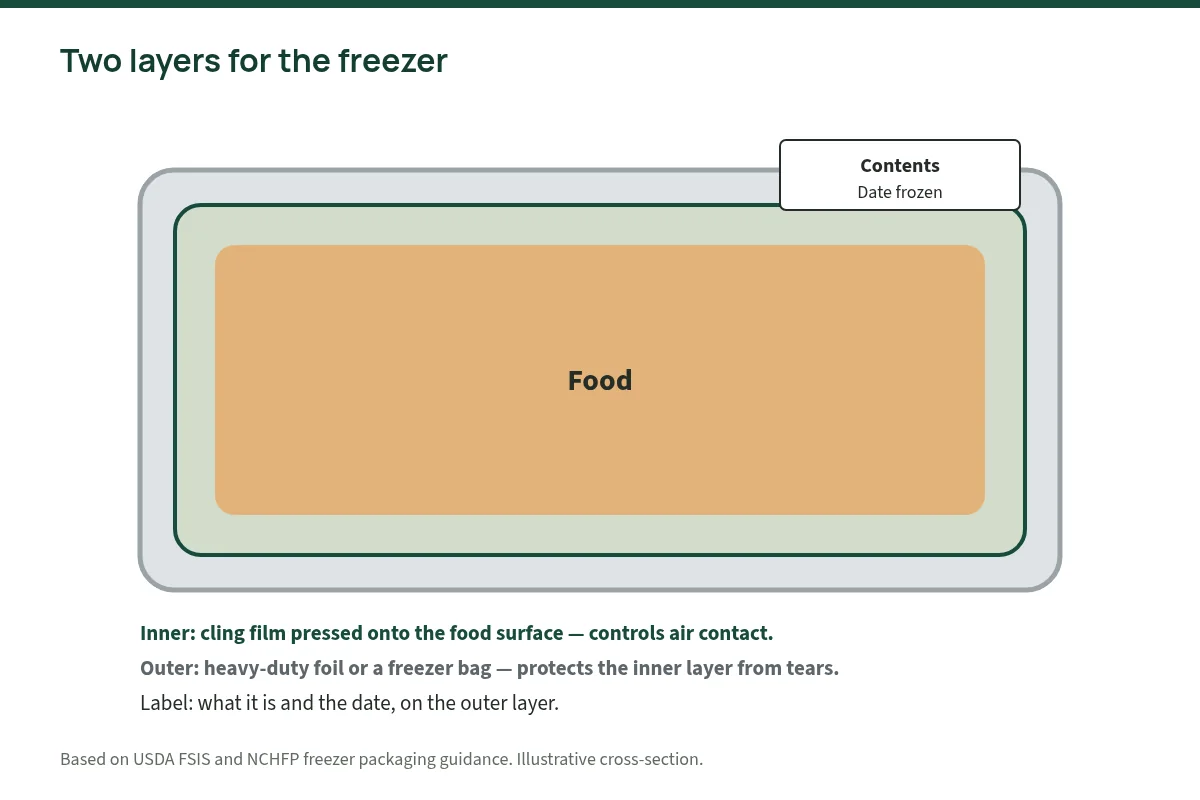
The inner layer controls air contact. The outer layer protects the inner one. If you only use one layer, choose the one that protects best and accept some freezer burn on long storage.
Step by step
- Cool first. Follow your food safety plan for cooling cooked food before freezing.
- Portion. Freeze in the sizes you will thaw. Smaller, flatter packs freeze and thaw faster.
- Wrap tight in film. Press cling film onto the food surface, smoothing out air pockets. Check that the film you use is suitable for freezer use according to the manufacturer’s instructions.
- Overwrap. Wrap in heavy-duty foil, crimping the edges, or put the pack in a freezer bag and press out the air.
- Label. Write the contents and the date on the outer layer.
- Containers. For food in a foil container, press film onto the surface of the food before fitting the lid. This reduces the air gap above the food.
- Before cooking. FSIS advises discarding any wrapping or absorbent paper from meat or poultry when cooking from frozen. Take the film off before the food goes into the oven.
One caution for acidic and salty foods
Long storage is where acidic or salty food and uncoated aluminium meet for the longest time. The Council of Europe guidance recommends that storage of acidic, alkaline or salty liquid foods in uncoated aluminium should be limited. For frozen tomato sauces, brined foods or citrus marinades, put a film or bag layer between the food and uncoated foil, or freeze them in another container. Our article on aluminum foil and acidic or salty foods explains the sources.
Worked example (hypothetical)
Consider a hypothetical meal-prep kitchen that freezes 400 portions a week: 250 rice-and-curry meals in foil containers and 150 wrapped items such as burritos. The figures are illustrative.
- Containers: each foil container gets a 0.25 m sheet of film pressed onto the food before the lid goes on: 250 × 0.25 = 62.5 m of film.
- Wrapped items: each burrito takes 0.35 m of film and an overwrap of 0.35 m of 300 mm heavy-duty foil: 150 × 0.35 = 52.5 m of each.
- Weekly totals: 62.5 + 52.5 = 115 m of cling film and 52.5 m of foil.
A 300 mm × 300 m cling film roll lasts about 300 ÷ 115 ≈ 2.6 weeks. A 300 mm × 100 m foodservice foil roll lasts about 100 ÷ 52.5 ≈ 1.9 weeks. Before this calculation, the kitchen was overwrapping the containers with foil as well. That doubled foil use without adding much protection, since the lid and pressed film already did the job. Dropping it saved about 62.5 m of foil a week.
One dish needs more thought. The kitchen’s curry is tomato-based, and the pressed film covers only its top surface. The base and sides still touch the container for the weeks the meal sits in the freezer. So for that dish, the kitchen asks its supplier whether a coated container is available, and plans to move the curry to another container if not.
Products for freezer packing
For the inner layer, our commercial cling film rolls come in 300–450 mm widths and 100–500 m lengths, in PE or PVC. For the outer layer, foodservice foil rolls run from 300 mm × 100 m to 450 mm × 300 m, and household rolls start at 250 mm × 8 m. Foil thickness is confirmed with the quotation. If the foil is for freezing, ask for a heavy gauge and state the thickness you need. Containers and lids are listed in the aluminum foil catalog.
Ordering both layers
Send YIYUAN the cling film width and length, and the foil roll size and thickness you need. If you freeze food in foil containers, include the container models. Tell us the foods involved, especially anything acidic or salty, and your weekly volume. We will confirm documentation for freezer use and suggest roll lengths that match your usage.
Prepared by YIYUAN NEW MATERIALS. Updated November 6, 2026. Guidance is summarised from the cited USDA FSIS, NCHFP and Council of Europe sources; the worked example is hypothetical.