
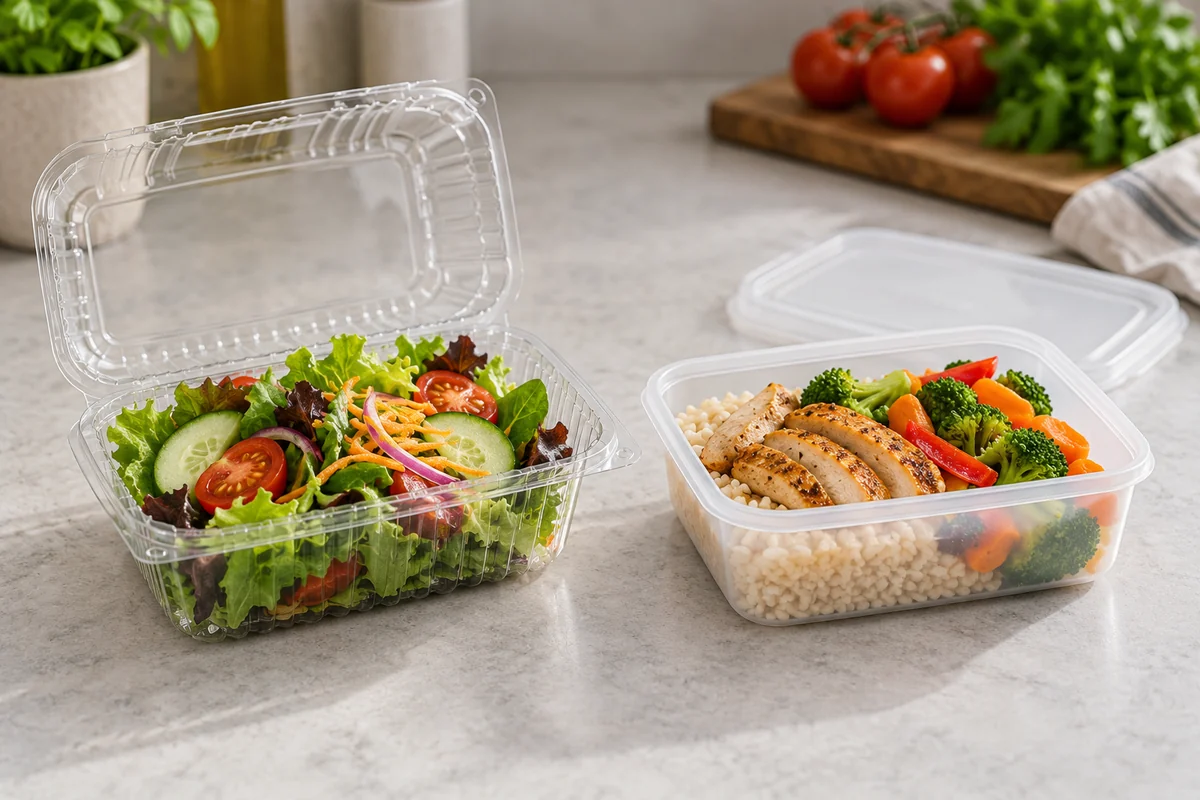
When comparing PET vs PP food containers, specify the base and lid separately. A PP base may be supplied with a PET lid, so a statement about the base cannot automatically be used for the complete pack. Confirm the exact component combination, intended use and supporting evidence before approving artwork or placing a bulk order.
This is a specification guide for buyers choosing between quoted container-and-lid sets. The practical question is whether the assembled pack meets the required filling, storage, display and handling conditions.
Write the use conditions before choosing resin
Record the food type, fill temperature, contact duration, chilled or ambient storage, delivery handling and any proposed consumer reheating instructions. Include fats, sauces and acidic foods where relevant. A resin melting point is not a finished-container operating limit.
Clear PET formats are commonly offered for cold display, while particular PP formats are offered for heat-and-eat applications. These are starting points, not approval criteria. The Point Five Packaging material guide also distinguishes CPET heat-and-eat packaging from other PET formats. Do not transfer CPET use claims to an ordinary clear PET salad container.
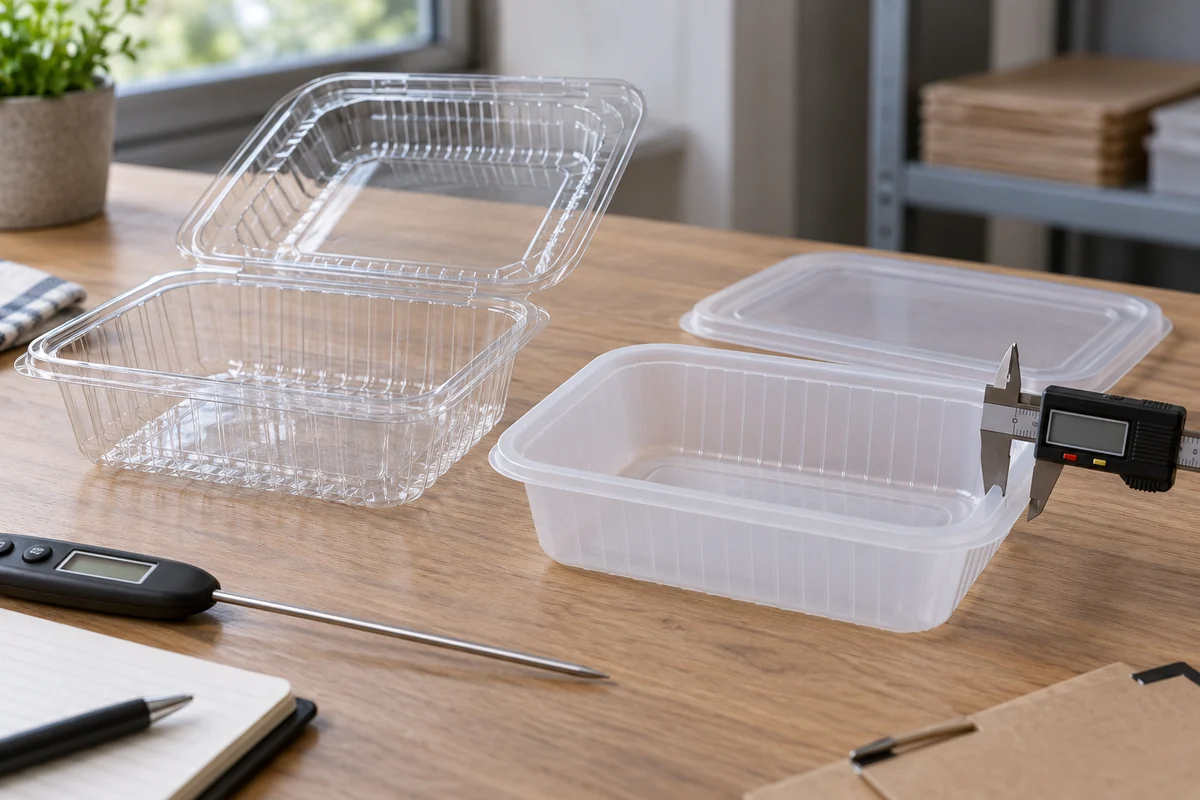
Compare the quoted component combinations
| Quoted set | Check before approval | Instruction risk |
|---|---|---|
| PET base + PET lid | Exact grade, food-contact scope, closure and chilled-use conditions | Do not assume oven or microwave suitability |
| PP base + PP lid | Both component specifications, heating evidence where requested and lid instructions | Venting or lid-removal instructions must match the supplied set |
| PP base + PET lid | Separate use conditions and test coverage for each component | Base reheating evidence does not establish lid suitability |
| Container + sealing film | Tray flange, lidding-film specification and validated sealing process | A snap-lid specification cannot substitute for a film-seal trial |
Start from the YIYUAN container range
The YIYUAN container range lists 500 ml, 750 ml and 1,000 ml round or rectangular boxes, alongside 2- and 3-compartment trays and sauce/deli cups. Its box packing range is 200–500 pieces per carton, depending on the selected format. These are selection ranges; obtain a base code, lid code and confirmed drawing before treating two quotes as equivalent.
The PP container specifications in the product catalog also shows compartment options. That catalog section describes PP; it is not a PET specification or a component-level heating assessment. For a PP/PET comparison, request the quoted base and lid materials separately and verify the proposed instructions for the exact pair.
Ask for a component-level specification sheet
- Identity: base code, lid code, resin or material construction, drawing revision and production site.
- Fit: outer dimensions, flange profile, locking features and agreed dimensional tolerances.
- Use: the food, time and temperature conditions supported for each component and the assembled pack.
- Packing: bases and lids per carton, separate carton dimensions, sleeves and protective packing.
- Evidence: product-specific declarations, relevant test reports and a clear explanation of which variants they cover.
If the supplier substitutes a lid after quotation, treat it as a specification change. Recheck closure, stacking and instructions even if the outer dimensions look identical.
Run an assembled-pack sample trial
Use the actual food or a suitable operational substitute, planned fill level and expected handling sequence. Record whether operators can close the lid consistently, whether the rim distorts and whether the filled pack stays stable during stacking and delivery. Set application-specific pass criteria before the trial.
Leak checks demonstrate performance under the recorded procedure; they do not prove that a pack is leak-proof in every orientation or food application. An appearance check also cannot replace food-contact assessment.
Release one identified combination
The purchase order should name both component codes and the approved sample revision. Require written approval for changes to the base, lid or material construction. Compare prices per complete usable set, including separate lids and the packing needed to keep the pair available together.
Prepare the next supplier discussion
For the initial application choice, read PP vs PET for hot and cold food; this guide adds component-level approval control. Send the required capacity, food/use conditions and separate base-and-lid requirements to YIYUAN for a matched sample and quote.
Prepared by YIYUAN NEW MATERIALS. Updated October 8, 2026. These are buyer planning procedures; product claims require evidence for the ordered specification and intended use.