
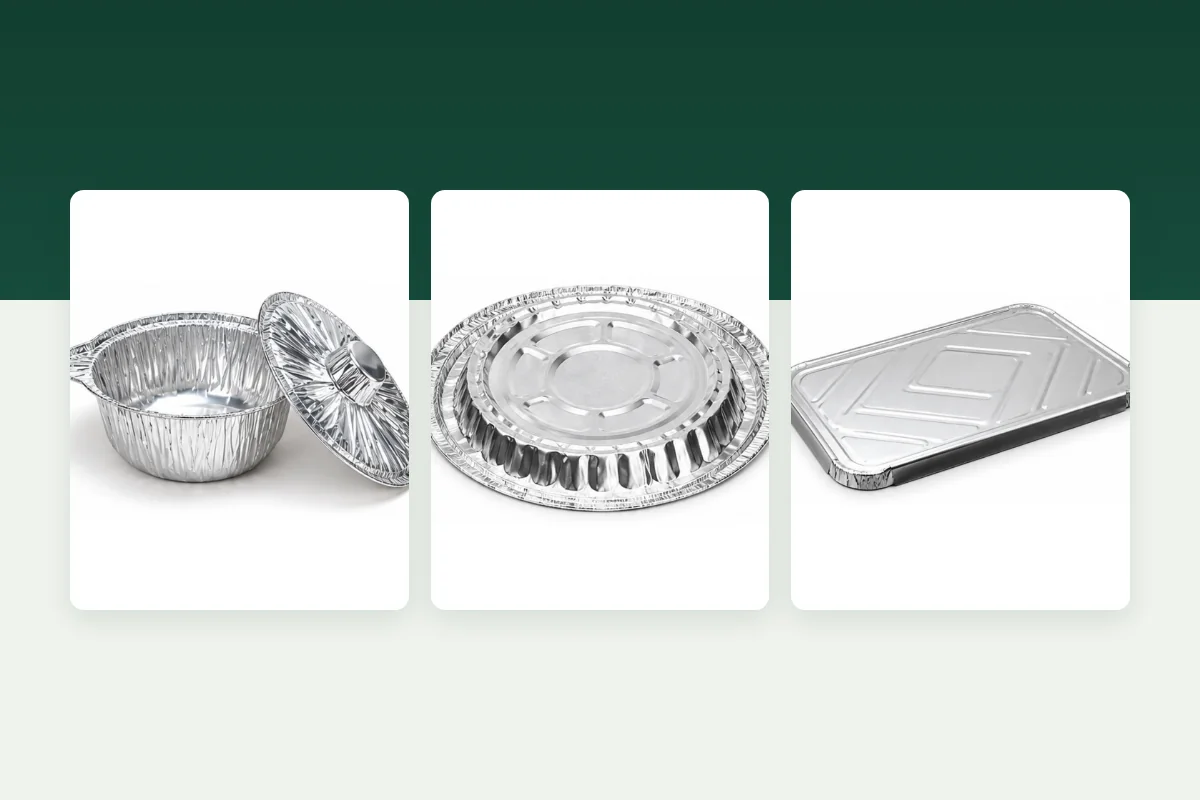
A foil container lid has to match the rim, not the capacity. Before you order, confirm three things: the lid is made for that container’s rim dimensions, the closure method suits your food and handling, and a filled, closed sample survives your real delivery conditions. The catalog name or the nominal size is only the starting point. In our own catalog, one round lid is named for two different bowls whose rims are 2 mm apart. That is exactly the kind of detail a sample test settles.
How foil container lids close
Most foil containers have a curled rim, a rolled edge around the opening. Lids work with that rim in one of a few ways:
- Foil lids sit over the opening, and the lid edge is pressed or crimped down around the rim. They can go where the container goes, oven included, if the use is confirmed for that product.
- Board lids are a flat card lid, usually with a foil or coated face. The lid is placed inside the rim and the rim edge is folded over it, by hand or with a closing machine. The top can be written on or printed.
- Plastic dome lids snap over the rim and leave room above the food. They are not for oven use.
The choice depends on what happens after closing. A takeaway meal that is closed and delivered within the hour has different needs from a tray that is closed, chilled, stacked and reheated the next day.
Which YIYUAN lids match which containers
The aluminum foil catalog lists three separate lid models. It also lists pots that are supplied with lids as sets. For every other model, the catalog says matching lids are confirmed with the quotation.
| Lid | Lid size | Intended containers | What to confirm |
|---|---|---|---|
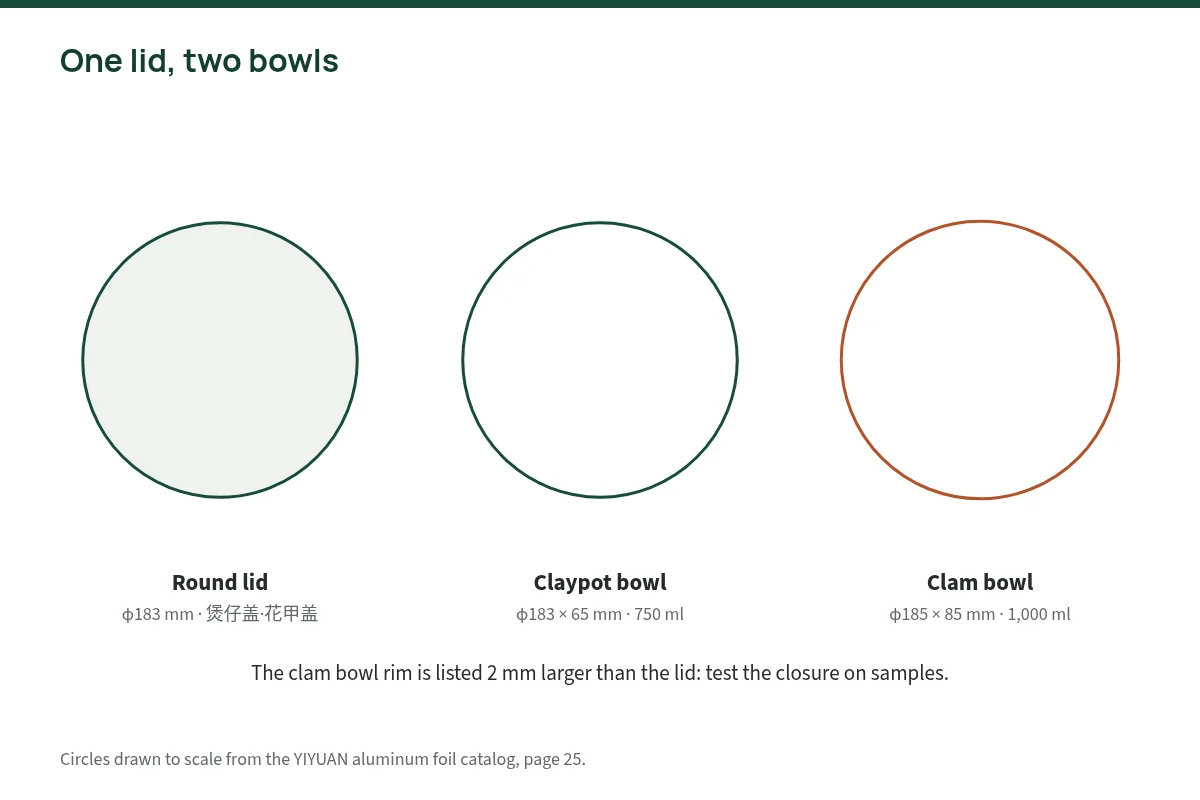
| Round bowl lid | φ183 mm | Claypot bowl (φ183 × 65 mm, 750 ml) and clam bowl (φ185 × 85 mm, 1,000 ml) | Closure on the 185 mm clam bowl rim |
| 320 rectangular lid | 320 × 265 mm | Silver 320 (320 × 265 × 60 mm) | Fit on L-320 (320 × 264 mm) if you use that model instead |
| 370 rectangular lid | 370 × 270 mm | Silver 370 (370 × 270 × 70 mm) | Fit on L-370 and on the gold 370-4670 (both listed at 370 × 270 mm) |
| Pots with lid, e.g. L-212 | Supplied with the pot | Sold as sets (e.g. 200 sets per carton for L-212) | That the set suits your food and reheating method |
The round lid’s Chinese catalog name is 煲仔盖·花甲盖, literally “claypot lid · clam lid”. It is designed for both bowls. The claypot bowl rim is listed at φ183 mm, the same as the lid. The clam bowl is listed at φ185 mm. A crimped foil lid can often take up a small difference, but “often” is not good enough for a soup going out on a scooter. Test it.
The gold 370-4670 has the same listed rim as the silver 370 lid. A silver lid on a gold container also changes how the pack looks, and that may matter more to a dessert shop than the fit.
A five-minute lid test
- Dry fit. Close an empty container with the lid, using the method your staff will use. Check that the lid sits evenly all round and the rim folds or crimps without tearing.
- Filled fit. Fill with water to your normal level and close again. A filled container flexes, and the rim can move.
- Tilt. Tilt the closed container over a sink, to about the angle it reaches in a delivery bag. Note where water escapes and how much.
- Stack. Stack two or three closed, filled containers for a few minutes, then check the bottom one.
- Real food. Repeat with the actual dish at serving temperature. Steam and fat behave differently from cold water.
Foil-and-lid closures are not normally designed to be leak-proof when inverted. The aim is a closure that survives your handling, not one that passes a test you would never run in service. For a more general method, see how to test lid fit and leak resistance.
Worked example (hypothetical)
Picture a hypothetical noodle shop that sells clam noodle soup and claypot rice for delivery. It wants one lid for both dishes to keep stock simple, which is what the φ183 round lid is meant for.
Staff request samples of the claypot bowl, the clam bowl and the round lid, and run the five-minute test. On the claypot bowl the lid crimps evenly at the first attempt. On the clam bowl, the first two closures leave a short loose section. Staff then work round the rim in small presses rather than one squeeze, and the third closure is even. In the tilt test with hot soup, a little liquid reaches the rim but none escapes.
The shop keeps the single lid, adds the closing technique to its training card, and starts filling the soup a little lower. It also notes that clam noodle soup is salty. Because each bowl is filled to order and delivered within the hour, contact time is short. That is quite different from the long warm holding described in our article on aluminum foil and acidic or salty foods.
Source of the lid data
Lid and container dimensions, capacities and packing quantities are taken from pages 18–19 and 25–26 of the YIYUAN aluminum foil catalog and the linked product pages. The catalog does not list board or plastic lids, and it states that matching lids are confirmed with the quotation for each model. If you need a closure type not shown, ask for it by name with your container model.
Ordering containers and lids together
Lids are easy to under-order. Reorder points for containers and lids should be planned together; our tray and lid reorder article shows how. When you request a quotation from YIYUAN, list each container model with the lid type you need, the food and its serving temperature, and the expected monthly quantity of each. If you have tested samples, tell us what happened. A note like “loose section on the clam bowl until we changed technique” saves everyone a round of samples.
Prepared by YIYUAN NEW MATERIALS. Updated October 29, 2026. Dimensions are catalog specifications; the worked example is hypothetical. Closure performance depends on your food, method and handling, so test samples before ordering.