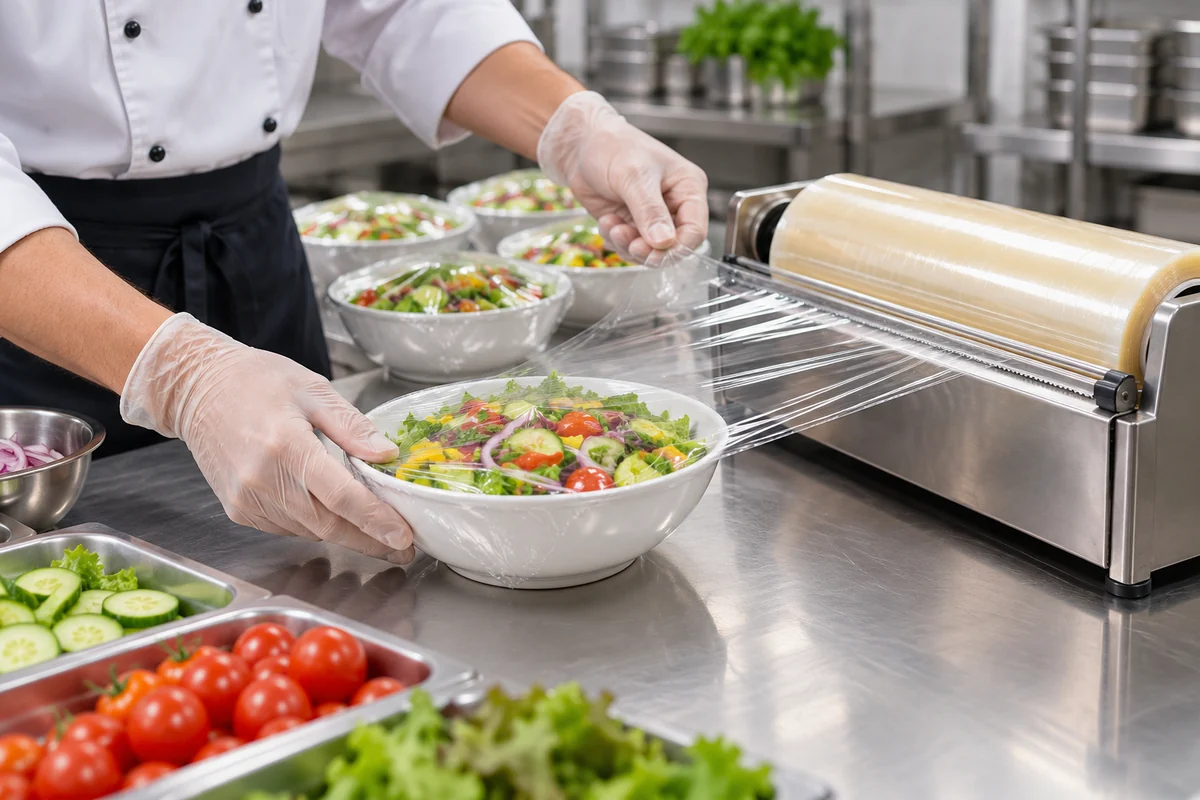
Cling film field testing should compare repeated wrapping tasks under recorded conditions. Keep an operator performance log that separates successful covers, tears, restarts, dispensing problems and film consumed. Decide the pass criteria before the trial so a favored sample does not receive a different standard.
A field trial evaluates operational suitability. It cannot establish chemical migration compliance, extend food shelf life or authorize temperatures outside the product’s supported use conditions.
Define one representative wrapping task
Select the actual pan, bowl or tray, normal fill level, surface condition, dispenser and storage sequence. Record whether the rim is dry or damp. Test materially different tasks separately: a hand-covered bowl and an automatic overwrap line do not share the same performance procedure.
Identify each film by supplier, formulation reference, roll dimensions, sample lot and production status. Retain a reference roll. Compare new candidates with the current approved film rather than relying on memory.
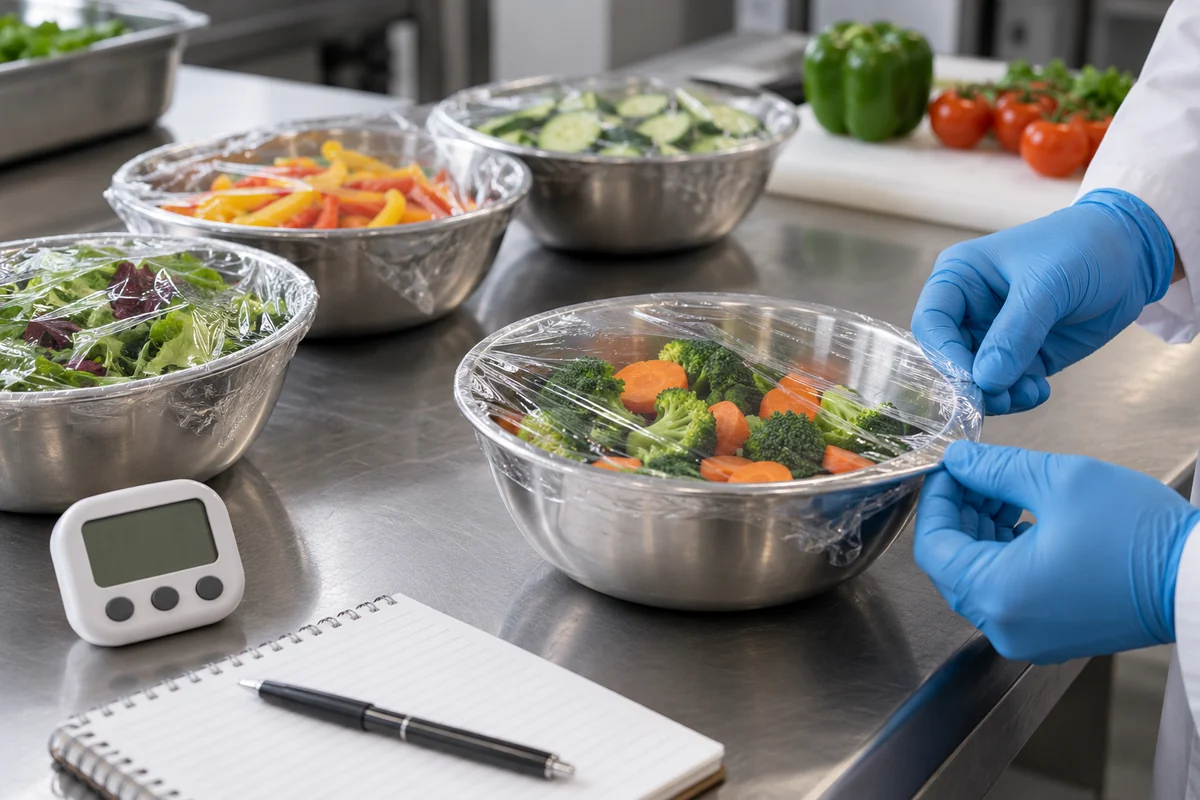
Prepare the YIYUAN sample and evidence packet
The YIYUAN commercial range lists widths of 300/350/400/450 mm, lengths of 100/200/300/500 m and a typical 8–12 μm gauge range, with customization subject to the order. For the trial log, record the actual supplied width, verified length, agreed gauge, core and cutter rather than copying every range into one sample description.
Use the product catalog when describing the box or refill requirement. Attach the appropriate full PE report or PVC report as a separate document-review record. The public PE sample is 400 mm × 13 μm and the PVC sample is 350 mm × 10 μm; neither reports the operator trial proposed here, and neither establishes coverage for every ordered sample.
Make the comparison repeatable
- Prepare matched containers and the same task instructions.
- Check the roll and dispenser fit before timing the wrapping task.
- Train participating operators on the agreed technique, then alternate product order where practical.
- Run repeated tasks per operator. Keep each attempt in the log, including failures.
- Observe covers at the predefined checkpoints within the supported food, time and temperature conditions.
- Investigate differences and repeat the affected task after any controlled adjustment.
Use an appropriate trial quantity for the decision and variability you expect. An informal kitchen trial is not a standardized mechanical test; avoid presenting its results as certified tensile or migration data.
Use this operator log
| Field | What to record |
|---|---|
| Identity | Date, site, operator, film code, formulation reference and lot |
| Task conditions | Container, fill level, rim condition, dispenser and environment |
| Wrapping attempts | Attempt count, accepted covers, restarts and rejected covers |
| Failure mode | Tear, blocking, cutter issue, edge lifting or other observed event |
| Material use | Measured film consumed under the chosen method |
| Follow-up | Observation checkpoint, photo reference and investigation action |
Calculate performance from the recorded task
Hypothetical trial: Candidate A uses 32 metres to produce 80 acceptable covers; Candidate B uses 30 metres for the same 80 acceptable covers. Their measured consumption is 0.400 and 0.375 metres per acceptable cover respectively. B uses 6.25% less film per acceptable cover in this trial.
This is an arithmetic example, not an actual test result. Compare cost per usable metre as well as consumption before concluding which film is cheaper in use. Record task duration separately if labor cost is relevant; a single operator’s fastest run is not a reliable average.
Keep acceptance and investigation distinct
Define application-specific limits for repeat failures, acceptable appearance and handling before you start. For an unexplained odor, contamination concern or unsupported use claim, stop the affected trial and refer it for quality review. Do not diagnose residual chemicals from smell alone or recommend airing the roll as a safety remedy.
Confirm the first production shipment
Approve the exact supplier, formulation, roll and packing revision. Keep the trial logs and retained sample, then compare the first shipment against them. If equipment, operators, food-contact conditions or film construction change, review whether the trial needs to be repeated.
Prepare the next supplier discussion
Use the importer sample checklist to collect the film identity and preliminary checks. Send the trial roll dimensions, dispenser, wrapping task and observation conditions to YIYUAN for an identified sample request.
Prepared by YIYUAN NEW MATERIALS. Updated October 8, 2026. These are buyer planning procedures; product claims require evidence for the ordered specification and intended use.