
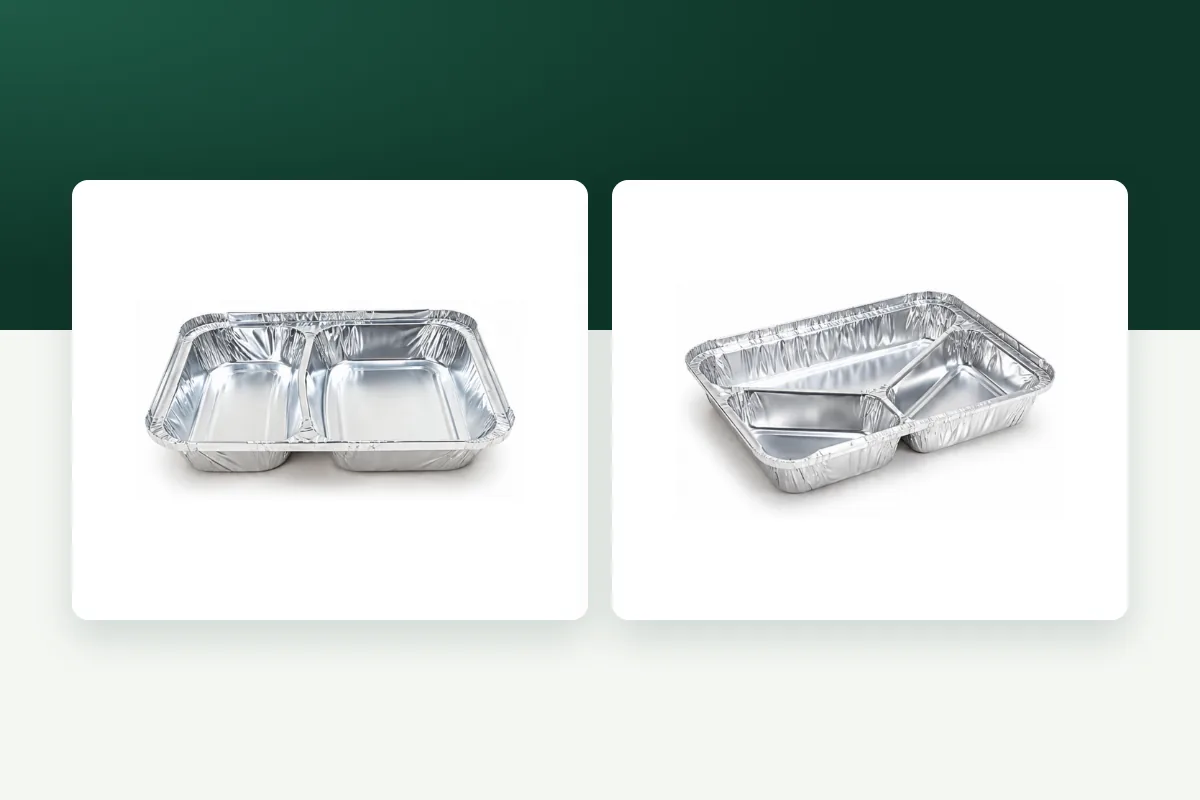
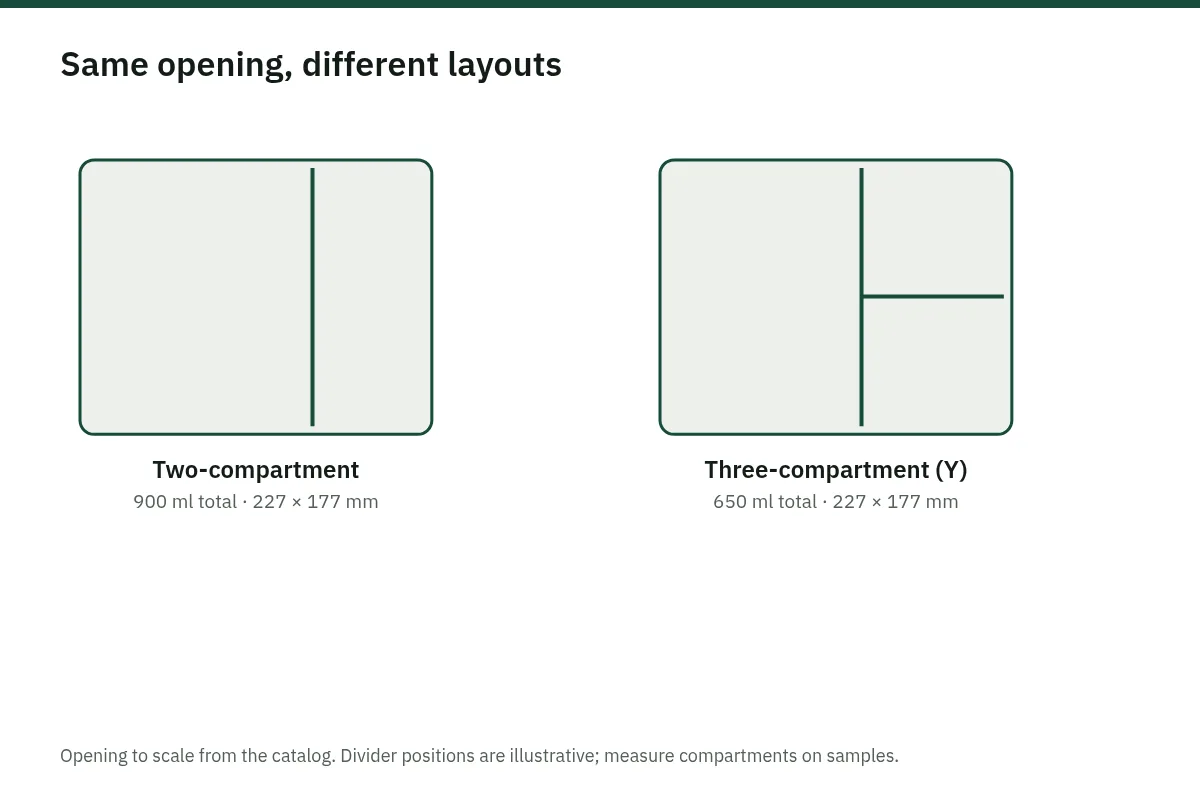
Compartment foil containers keep the parts of a meal apart: rice away from curry, a main away from its sides. They are used for set meals, school and institutional catering, and ready meals that go into an oven. Our two-compartment and three-compartment containers have the same top size, 227 × 177 mm, but the two-compartment tray holds 900 ml and the three-compartment holds 650 ml. The catalog gives the total, not the size of each compartment. Measure each compartment with water before you design a menu around it.
The two trays side by side
| Model | Total capacity | Top × height | Base | Packing | Carton |
|---|---|---|---|---|---|
| Two-compartment | 900 ml | 227 × 177 × 36 mm | 197 × 145 mm | 500 per carton | 472 × 310 × 375 mm |
| Three-compartment (Y) | 650 ml | 227 × 177 × 36 mm | 190 × 150 mm | 500 per carton | 370 × 355 × 480 mm |
Same footprint, same height, 250 ml less capacity. The extra divider and the compartment shapes account for the difference. The practical consequence: the two trays can share shelf space, oven racks and outer packaging, and possibly a lid, but not a menu.
Measure each compartment
A compartment’s real capacity is what decides whether a portion fits. Measure it once per model:
- Set the tray on a level scale and tare it.
- Fill one compartment with water to where your food will reach, not to the brim. A line 5 mm below the divider top is a sensible limit, so food does not spill over.
- Read the weight in grams; 1 g of water is about 1 ml.
- Empty, dry and repeat for each compartment. Measure three trays and use the average.
Record the results. They are your menu limits for that model and the figures to give a kitchen team.
Match the menu to the compartments
- Two compartments fit a base and a topping: rice and curry, pasta and sauce, mash and stew. The larger compartment usually takes the carbohydrate.
- Three compartments fit a main and two sides: a protein, a vegetable and a starch, or a school meal with a dessert portion.
Leave headroom: about 10% below your measured fill level for food that will be reheated, because sauces bubble and rise. A lid that presses on food will also pull it across the divider.
Worked example (hypothetical)
A hypothetical meal producer measures the three-compartment tray with water and finds one large compartment of about 320 ml and two small ones of about 165 ml each, 650 ml in total. Its menu needs a 280 ml main and two 140 ml sides. With 10% headroom, the main needs 308 ml and each side 154 ml, so both fit, with little room to spare.
For a rice-and-curry line it measures the two-compartment tray: about 600 ml and 300 ml. The menu needs 450 ml of rice and 250 ml of curry. With headroom, that is 495 ml and 275 ml, which also fit. The producer runs both lines on trays with the same footprint and loads them into the same oven racks and outer cartons.
These compartment volumes are the hypothetical producer’s measurements. Measure your own samples; the catalog lists totals only.
Lids and covering
The catalog lists the 320 and 370 rectangular lids and a round lid, but no lid for the 227 × 177 mm compartment trays. Ask what covering is available for your order. Options buyers commonly consider are board lids, foil lidding and cling film over the top. Whatever you choose, test it after reheating, when steam pressure is highest. Our lid fit guide covers rim and seal checks.
Shipping space
Both trays pack 500 to a carton. The two-compartment carton is about 0.055 m³ and the three-compartment carton about 0.063 m³, so roughly 0.00011 m³ and 0.00013 m³ per tray. If you import both, plan them in the same shipment; see our guide to foil container sizes for the single-compartment range.
Data sources
Total capacities, dimensions, packing and carton sizes are from the two- and three-compartment product pages and the aluminum foil catalog. The catalog does not list per-compartment volumes or a lid for these trays, and confirms thickness and alloy with the quotation. Compartment volumes and menus in the worked example are hypothetical.
Requesting compartment trays
Send us the model, your menu portions, whether the trays are reheated, the covering you want and your monthly volume. Ask for samples of both trays so you can measure the compartments yourself.
Custom sizes. Every size, compartment layout and pack count here can be adjusted to your specification. Custom specifications have a reasonable minimum order quantity. If your order is below it and you still need a custom size, a small customization fee may apply. We confirm both in the quotation.
Prepared by YIYUAN NEW MATERIALS, a cling film and aluminum foil packaging manufacturer in Shangqiu, China. We supply overseas importers and distributors at factory-direct prices with consistent quality, and we have completed orders with a large number of overseas buyers, many of whom first contacted us through this website or through WhatsApp and other social apps. Updated November 14, 2026.