
Supermarkets cut melons, cabbages, pumpkins and other large produce so customers can buy a half or a quarter. Wrapping those pieces well comes down to three things: put the film directly on the cut face, use a roll wide enough to close the film underneath the piece, and keep cut melon and cut greens cold with the cutting time on the label. Wrapping makes the cut face look fresh for longer, but cold storage is what keeps it safe. Large halves such as watermelon are often wider than the widest roll, so plan them as quarters or wrap them with two crossed sheets.
Why cut produce is handled differently
Whole melons and whole cabbages are protected by their rind and outer leaves. Once cut, the exposed flesh dries, discolours and can support bacterial growth. The FDA Food Code, the model code most U.S. states adopt, treats cut melons, cut tomatoes and cut leafy greens (a term that covers lettuces, cabbage, spinach and similar greens) as foods that need time and temperature control for safety. In practice that means holding them at 5°C (41°F) or below. The FDA’s consumer guide to selecting and serving produce safely gives shoppers the same advice: buy cut produce only if it is refrigerated or surrounded by ice. Other countries have their own rules; follow those in your market.
Wrap with the film on the cut face
- Place the piece cut side up on the station, or on a tray if it does not sit steadily.
- Lay the film onto the cut face and smooth out air pockets. Film in contact with the flesh keeps the surface from drying.
- Bring the film down the sides and gather it under the rind or the tray.
- Press the folds together underneath. On a heated station, seal them on the plate at the equipment maker’s recommended setting.
- Label the pack with the product, weight and the date and time it was cut.
Wet cut surfaces make PVC film cling well to the flesh but poorly to itself, so wipe the rind or tray edge where the folds close. Our hand-wrapping guide shows the full sequence on a tray.
How wide a roll for each piece
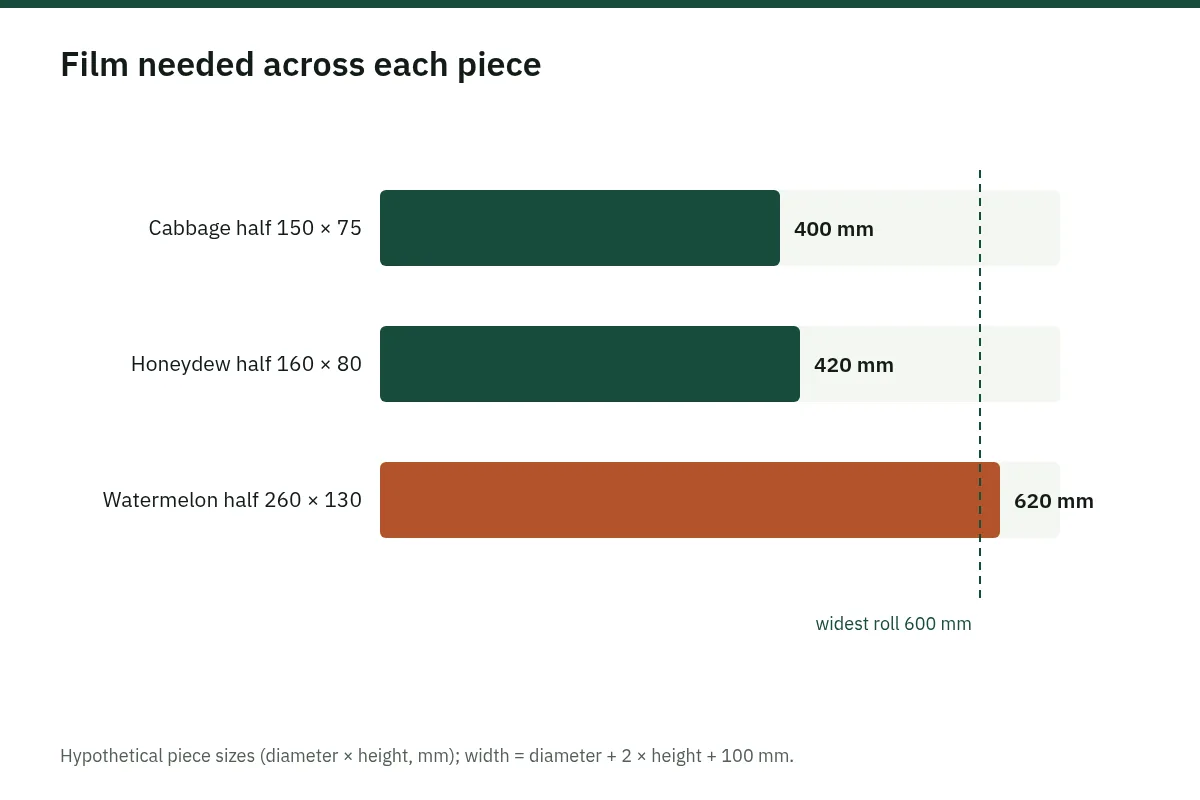
For a piece wrapped directly, without a tray, the film must cover the cut face and both sides and close underneath. A simple planning rule: film needed across ≈ piece diameter + 2 × piece height + about 100 mm for closing underneath. Measure your typical pieces; the sizes below are examples.
| Piece (hypothetical size) | Film needed | Roll to use |
|---|---|---|
| Cabbage half, 150 mm across, 75 mm high | 150 + 150 + 100 = 400 mm | 400 or 450 mm |
| Honeydew half, 160 mm across, 80 mm high | 160 + 160 + 100 = 420 mm | 450 mm |
| Watermelon half, 260 mm across, 130 mm high | 260 + 260 + 100 = 620 mm | Wider than 600 mm: cut in quarters, or use two crossed sheets |
Our PVC cling film for hand wrapping is made to order in width, thickness and roll length. Our commercial cling film rolls are listed in 300, 350, 400 and 450 mm widths, and our PVC fresh wrap in 300, 450 and 600 mm.
Worked example (hypothetical)
A hypothetical supermarket cuts honeydew, cantaloupe and cabbage into halves and watermelon into halves and quarters. Every piece except the watermelon half fits a 450 mm roll. For watermelon halves, staff lay one sheet from the 450 mm roll across the cut face, then a second sheet at right angles. The second sheet closes the sides the first one could not reach. Each crossed pack uses two pulls of film, so the store decides to sell watermelon as quarters on trays during the week and as halves only at weekends, when they sell fastest. It stocks a single 450 mm width for the whole cut-fruit section.
What film cannot do
- It does not replace refrigeration. A wrapped cut melon left at room temperature is no safer than an unwrapped one.
- It does not make a shelf-life claim. If you print a “use by” time, base it on your own records and your local rules; our article on shelf-life claims explains what evidence that takes.
- It does not stop condensation if packs move between cold and warm areas. Fogging under the film is covered in our haze and condensation guide.
Data sources
Widths and formats are from our hand-wrap film, commercial roll and PVC fresh wrap pages and the product catalog. Produce sizes and the store’s choices are hypothetical. Temperature guidance is from the FDA Food Code 2022 and the FDA produce safety page.
Requesting film for cut produce
Send us the largest pieces you wrap, whether you wrap on trays or directly, your wrapping station, and how many packs you wrap a day. We will confirm a width and send a sample roll.
Custom sizes. Every width, length and thickness here can be adjusted to your specification. Custom specifications have a reasonable minimum order quantity. If your order is below it and you still need a custom size, a small customization fee may apply. We confirm both in the quotation.
Prepared by YIYUAN NEW MATERIALS, a cling film and aluminum foil packaging manufacturer in Shangqiu, China. We supply overseas importers and distributors at factory-direct prices with consistent quality, and we have completed orders with a large number of overseas buyers, many of whom first contacted us through this website or through WhatsApp and other social apps. Updated November 13, 2026.