
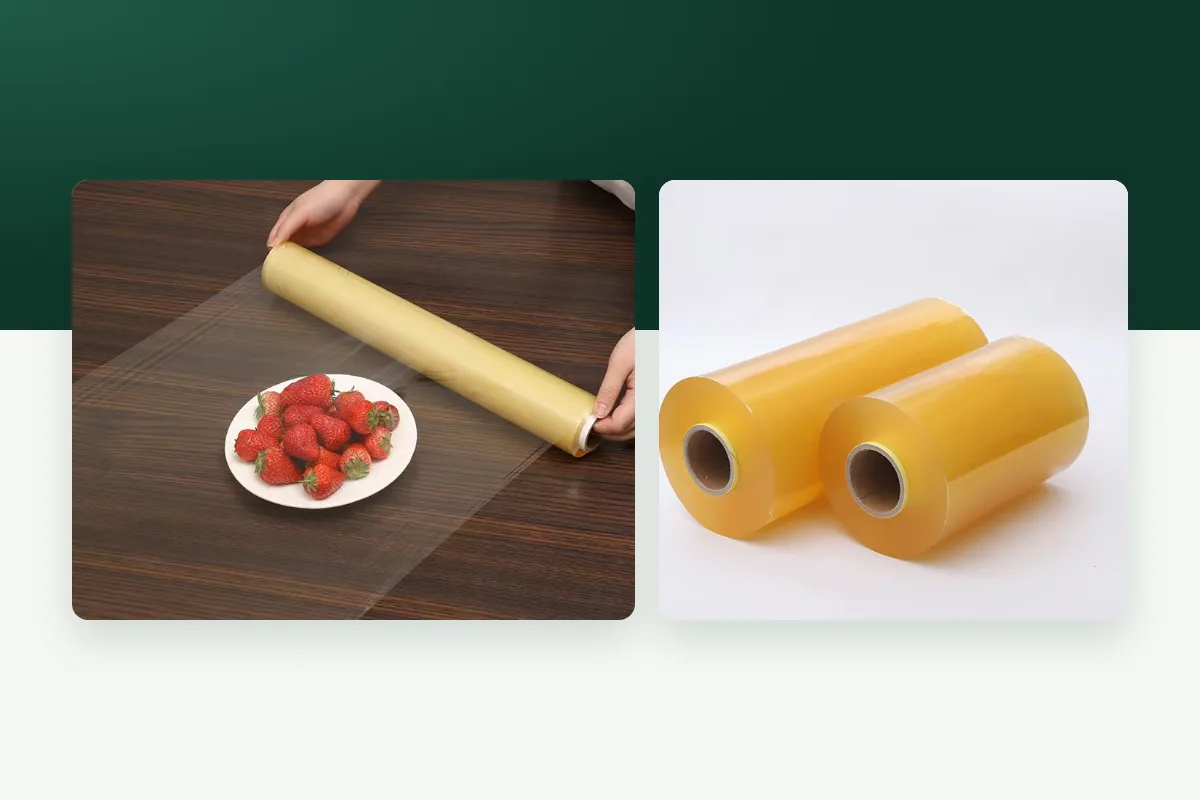
Seafood is the hardest product on a fresh counter to keep neatly wrapped. Packs sit on or near ice, so melt water reaches the folds underneath. Prawn heads, crab legs and fish fins have points that work through thin film during the day. Whole fish are long, so a tray that suits fillets is too short. And seafood smell travels. Wrap seafood on deeper trays with a soaker pad, keep the folded underside off direct melt water, choose the roll width for your longest tray, and test film thickness on spiky product, not on fillets.
Four seafood problems and what fixes each
| Problem | What you see | What to change |
|---|---|---|
| Melt water | Wet underside, film folds open, pack leaks when lifted | Display wrapped packs on a drained tray or liner above the ice, not pressed into it |
| Spines and shells | Pinholes over prawn heads, crab legs, fin rays | Turn sharp parts inward, add a pad over points, or test a thicker film |
| Long whole fish | Film stretched over head and tail, tears at the ends | Longer tray and a wider roll so film reaches the underside at both ends |
| Odour | Customers notice fish smell near other products | Wrap fully, keep seafood packs in their own section, replace packs whose film has opened |
Wrapping does not replace temperature control. The FDA’s guide to selecting and serving fresh and frozen seafood safely tells shoppers to buy fish that is refrigerated or displayed on a thick bed of fresh ice. Your film choice should work with that display, not against it.
Roll width for whole fish
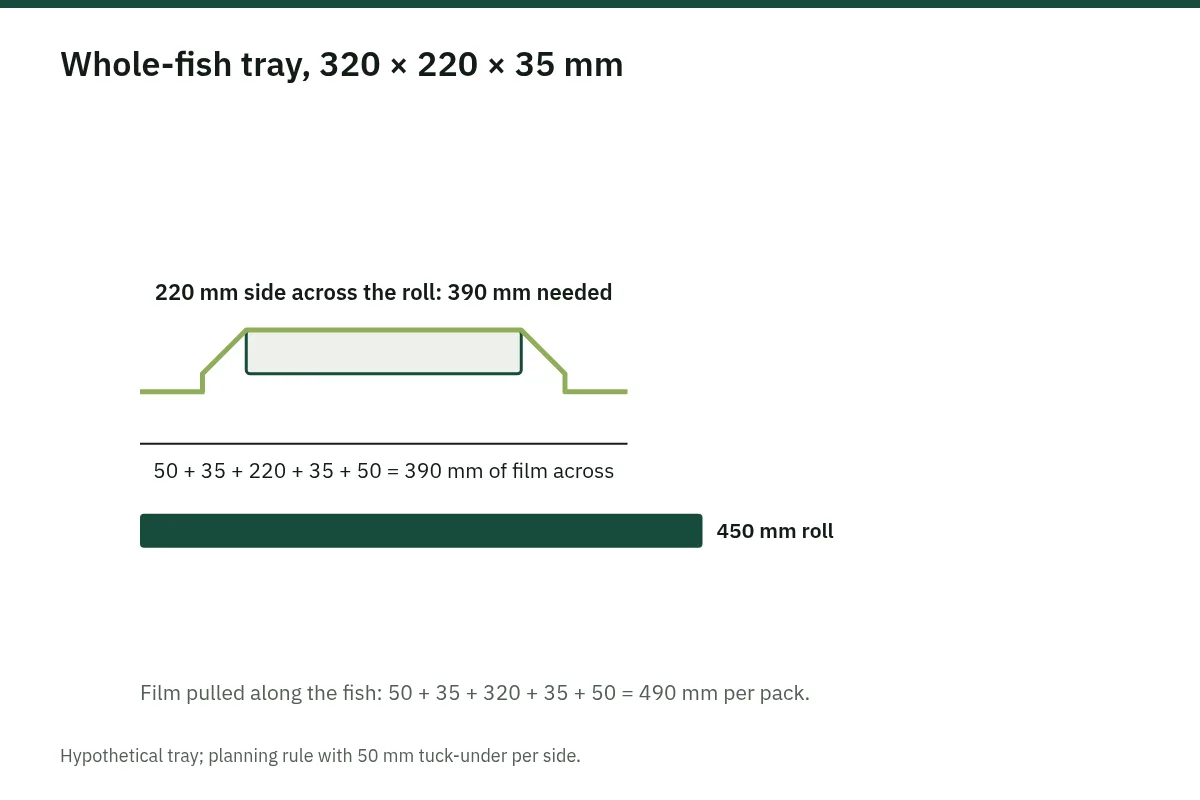
Use the same planning rule as for any hand-wrapped tray: roll width ≈ tray side across the roll + 2 × tray height + 2 × tuck-under allowance, with about 50 mm per side as a starting allowance. For seafood, lay the tray so its shorter side runs across the roll, and pull the film along the length of the fish. That keeps the stretch on the long direction, where the film can follow the shape.
Our PVC fresh wrap is supplied as 300 mm × 300 m (24 rolls per carton), 450 mm × 500 m (6 rolls per carton) and 600 mm × 1000 m (6 rolls per carton). The commercial cling film roll adds 350 and 400 mm widths. Very large platters and whole salmon may need the 600 mm roll; see our article on when the 600 mm roll makes sense.
Worked example (hypothetical)
A hypothetical fish counter wraps whole sea bream on trays measuring 320 × 220 mm and 35 mm deep.
- Width needed, 220 mm side across the roll: 220 + 2 × 35 + 2 × 50 = 390 mm. Both the 400 mm commercial roll and the 450 mm fresh wrap cover it; the counter picks 450 mm to leave room for larger fish.
- Film pulled per pack, along the 320 mm length: 320 + 70 + 100 = 490 mm.
- Packs per 450 mm × 500 m roll: 500,000 ÷ 490 ≈ 1,020 before waste, or about 918 with a 10% allowance for restarts and torn film.
At 120 fish packs a day, one roll lasts about a week, and a carton of six rolls lasts about six weeks.
A spike test before you choose thickness
Fillets tell you little about film strength. The products that fail are head-on prawns, crab clusters and whole fish with stiff fins. Before approving a film, run a simple test on your own counter:
- Wrap ten packs of your spikiest product with each film you are comparing, for example 10 and 12 micron.
- Display them as usual for four hours.
- Count packs with a visible hole, an opened fold or water inside the film.
- Repeat on a second day before deciding.
Our listed thickness range is 8–12 micron for both roll types. If the thicker film costs more per metre but saves rewrapping and returned packs, it can still be the cheaper choice. Our guide to 8, 10 or 12 micron film shows how to compare them.
Odour: what film can and cannot do
A fully closed pack keeps liquid and most smell inside. A pack with an opened corner does not. We do not claim our film is an odour barrier, so do not plan on film alone to stop smells from spreading. Separate seafood from other fresh products in the display and replace any pack whose film has lifted. If customers complain of an odour in the film itself, the checklist in our article on cling film odour complaints helps separate film from product.
Data sources
Widths, lengths, carton counts and the 8–12 micron range come from our PVC fresh wrap and commercial cling film roll pages and the product catalog. Fish size and daily volume in the worked example are hypothetical. Display guidance is from the FDA’s seafood safety page.
Requesting film for a seafood counter
Send us your tray sizes and depths, the products you wrap (fillets, whole fish, prawns, shellfish), hand or machine wrapping, and how many packs you wrap a day. We will suggest a width and send two thicknesses to test.
Custom sizes. Every width, length and thickness here can be adjusted to your specification. Custom specifications have a reasonable minimum order quantity. If your order is below it and you still need a custom size, a small customization fee may apply. We confirm both in the quotation.
Prepared by YIYUAN NEW MATERIALS, a cling film and aluminum foil packaging manufacturer in Shangqiu, China. We supply overseas importers and distributors at factory-direct prices with consistent quality, and we have completed orders with a large number of overseas buyers, many of whom first contacted us through this website or through WhatsApp and other social apps. Updated November 9, 2026.