
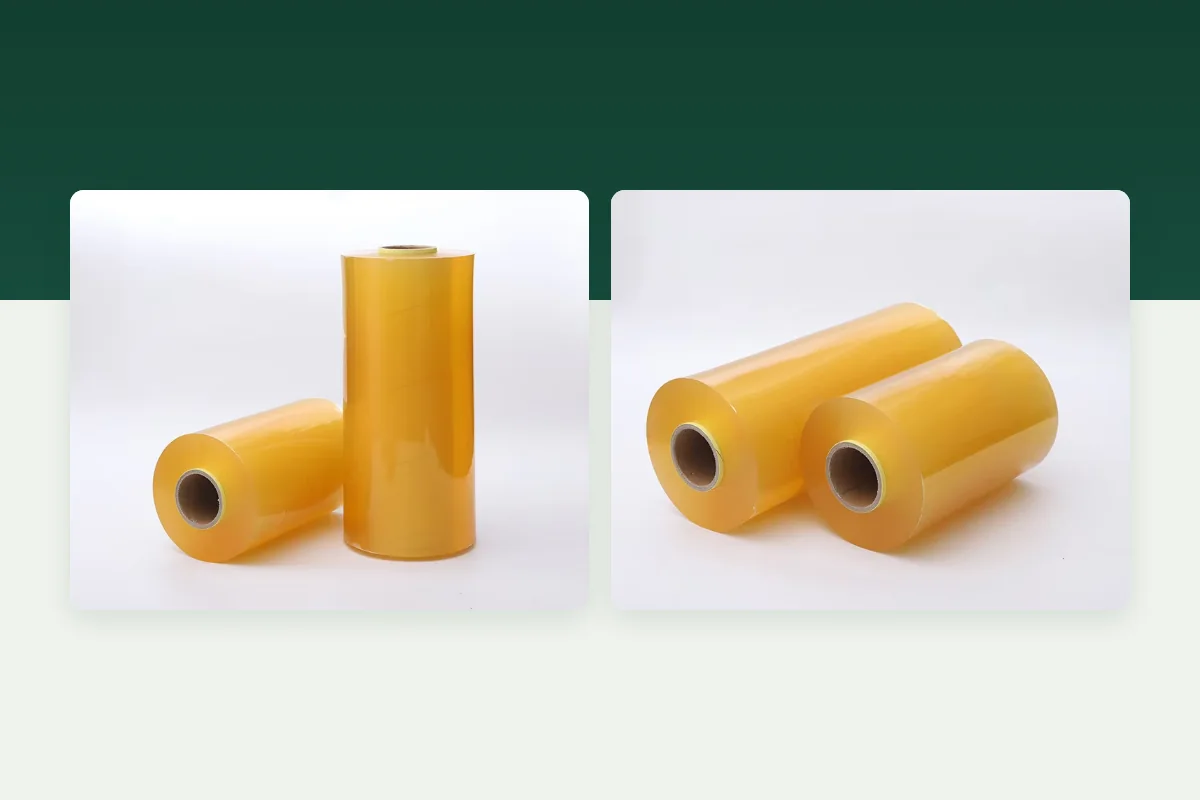
A 600 mm wide, 1,000 m PVC fresh wrap roll makes sense in one situation: your trays or pans are too wide for a 450 mm roll to cover in one pull, and you wrap enough of them to justify a heavy roll and a wide dispenser. Bakery half-sheet pans, Gastronorm 1/1 pans covered lengthwise and large meat or fish trays are the usual reasons. If most of what you wrap is smaller, a 450 mm roll is easier to handle and wastes less.
The figures below are for our PVC fresh wrap film, which lists a 600 mm × 1,000 m size at 10–15 µm, packed 6 rolls per carton.
When 450 mm is not enough
The test is simple: the film must cover the width of the pan plus enough on each side to seal over the rim or tuck under.
| Pan or tray | Dimension the film must span | 450 mm roll | 600 mm roll |
|---|---|---|---|
| Gastronorm 1/1, film across the short side | 325 mm | Fits, 62 mm spare each side | Wider than needed |
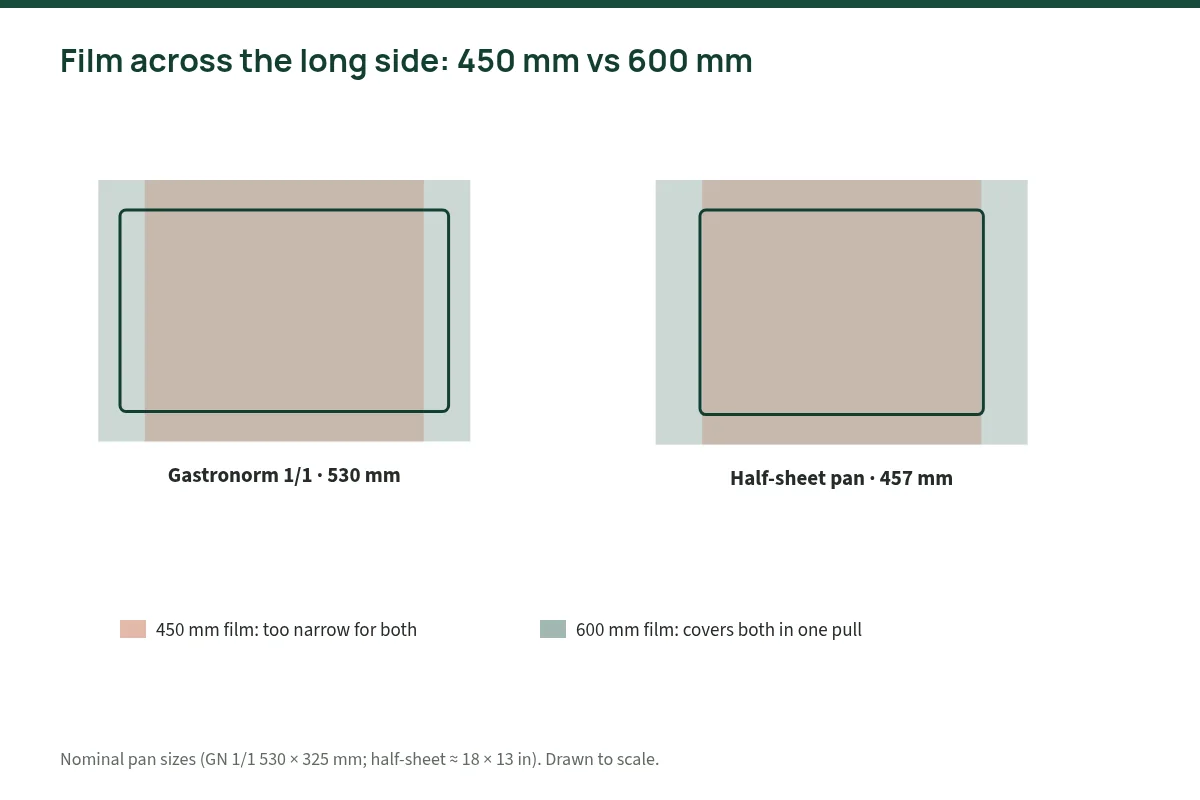
| Gastronorm 1/1, film across the long side | 530 mm | Too narrow | Fits, 35 mm spare each side |
| US half-sheet pan (18 × 13 in), film across the long side | 457 mm | Too narrow | Fits, about 71 mm spare each side |
| US half-sheet pan, film across the short side | 330 mm | Fits | Wider than needed |
Spare film is (roll width − pan dimension) ÷ 2, rounded. Pan sizes are nominal: Gastronorm 1/1 is 530 × 325 mm; a half-sheet pan is about 18 × 13 in (457 × 330 mm). Measure your own pans, rims included.
If you can always run the film across the short side, you rarely need 600 mm. The wide roll earns its place where the station layout, the pan or the product forces the film across the long side, or where film must also drape down deep sides. For narrower choices, see 300 mm vs 450 mm rolls.
What a 1,000 m roll weighs
A wide, long roll is heavy, and staff will be lifting it onto a dispenser. You can estimate the film weight from area, thickness and density:
Film weight (kg) = width (m) × length (m) × thickness (m) × density (kg/m³)
The roll has 0.6 × 1,000 = 600 m² of film. Plasticised PVC film density depends on the formulation. For illustration we use a range of 1.25–1.35 g/cm³ (1,250–1,350 kg/m³); ask your supplier for the actual figure.
| Thickness | Film weight at 1.25 g/cm³ | At 1.30 g/cm³ | At 1.35 g/cm³ |
|---|---|---|---|
| 10 µm | 7.50 kg | 7.80 kg | 8.10 kg |
| 12 µm | 9.00 kg | 9.36 kg | 9.72 kg |
| 15 µm | 11.25 kg | 11.70 kg | 12.15 kg |
Add the core on top of that. A carton of six rolls therefore holds roughly 45–73 kg of film alone. That is above what many workplaces allow one person to lift. Check the carton gross weight with your supplier, plan to unpack at the point of use, and check your local manual handling rules. Our guide to verifying roll length and net film weight uses the same formula to check deliveries.
Will it fit your dispenser?
Two dimensions decide whether the roll fits: the width the dispenser accepts and the roll’s outside diameter. Outside diameter depends on the core and on how tightly the film is wound. A geometric estimate, which ignores air between layers, is:
Outside diameter = √(core OD² + 4 × length × thickness ÷ π)
With an assumed 76 mm core outside diameter, 1,000 m of 10 µm film gives about 136 mm, and 15 µm gives about 158 mm. With a 90 mm core, the figures are about 144 mm and 165 mm. Real rolls come out slightly larger. Ask your supplier for the core size and measured roll diameter. Then use our roll diameter calculator article and core and dispenser compatibility checks against your equipment.
Don’t overlook the cutter. Cutting 600 mm by hand on a narrow blade is slow and gives ragged edges. A wide roll needs a full-width cutter bar or slide cutter.
Worked example (hypothetical)
Picture a hypothetical central bakery that covers about 200 half-sheet pans of pastries a day before they go to the walk-in. Staff currently use a 450 mm roll. Because the film can’t span the 457 mm side, they pull two overlapping strips per pan along the long side, and the overlap often opens.
With a 600 mm roll, one pull covers the pan with about 71 mm to spare each side. If each pan needs a 0.6 m pull, that is 200 × 0.6 = 120 m of film a day. A 1,000 m roll lasts about 1,000 ÷ 120 ≈ 8.3 working days. Under the old method, two strips of 0.6 m used 1.2 m of roll length per pan. At the same daily volume, that was 240 m a day, though some of that film went into the overlap.
The bakery trials the 600 mm roll on one station for a week. Pans are now covered in one movement and the overlap failures stop. The trade-offs are a heavier roll and a new dispenser with a full-width slide cutter for that station. It keeps 450 mm rolls everywhere else.
Product details and evidence
Our PVC fresh wrap lists 300 mm × 300 m and 450 mm × 500 m sizes at 8–12 µm, and 600 mm × 1,000 m at 10–15 µm, all 6 rolls per carton except the 300 mm (24 rolls per carton). Applications include fresh produce, deli counters, meat and fish, and bakery. Our PVC large roll cling film is made to order for width, length and core. The published PVC inspection report covers a 350 mm × 0.01 mm sample. Confirm with us whether a 600 mm roll at your chosen thickness uses the same formulation.
What to send with your enquiry
Contact YIYUAN with the pan or tray sizes you need to cover, the dispenser model and the maximum roll diameter and weight it accepts. Include the core size you use, your daily pan count and the thickness you want to trial. We will confirm the roll diameter, core and carton weight before you order.
Prepared by YIYUAN NEW MATERIALS. Updated November 1, 2026. Weight and diameter figures are estimates from stated assumptions, not measured roll data. The worked example is hypothetical.