
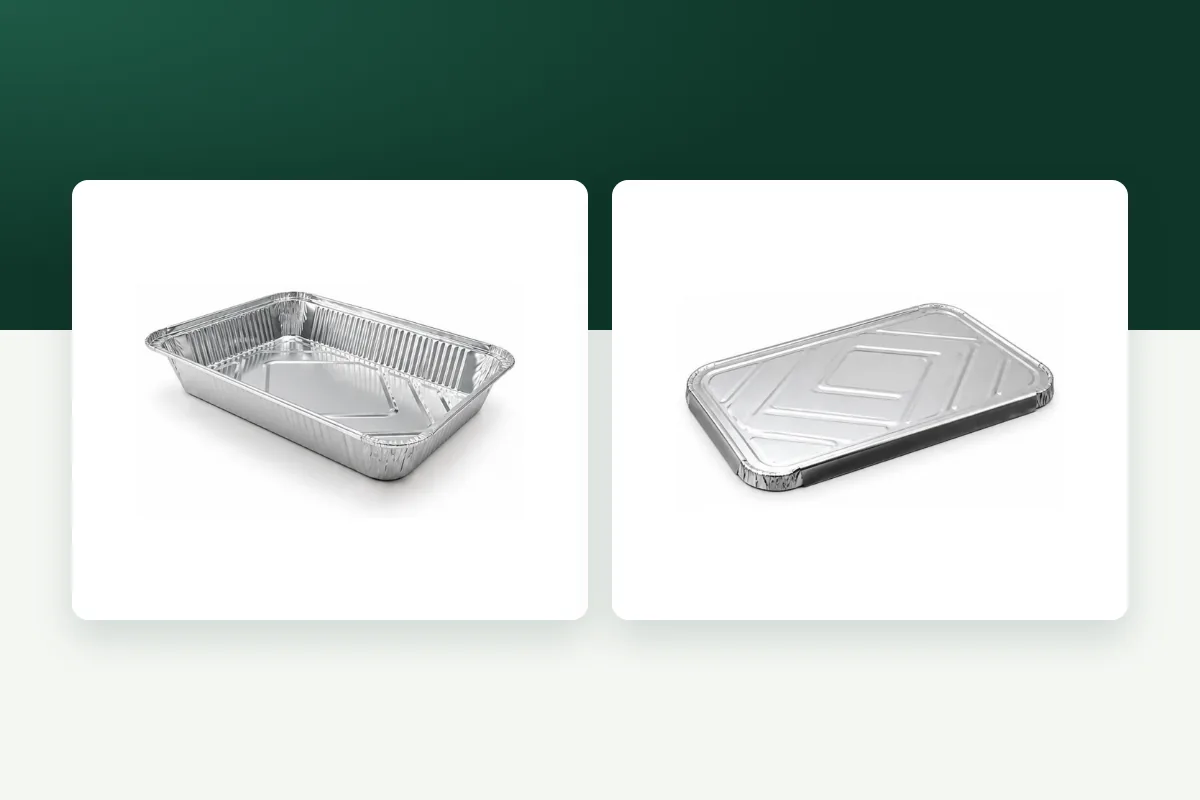
Frozen ready-meal producers choose aluminum foil trays because the same tray goes from filling line to freezer to the customer’s oven. Choosing well comes down to four checks: leave headspace, because water expands as it freezes; close the tray so cold air cannot dry the surface; make sure frozen packs can be stacked without crushing the rims; and print only reheating instructions you have tested yourself. Our family-size 320 and 370 trays have matching foil lids in the catalog. For single-portion trays, the lid or seal has to be chosen and tested separately.
Headspace: plan for expansion
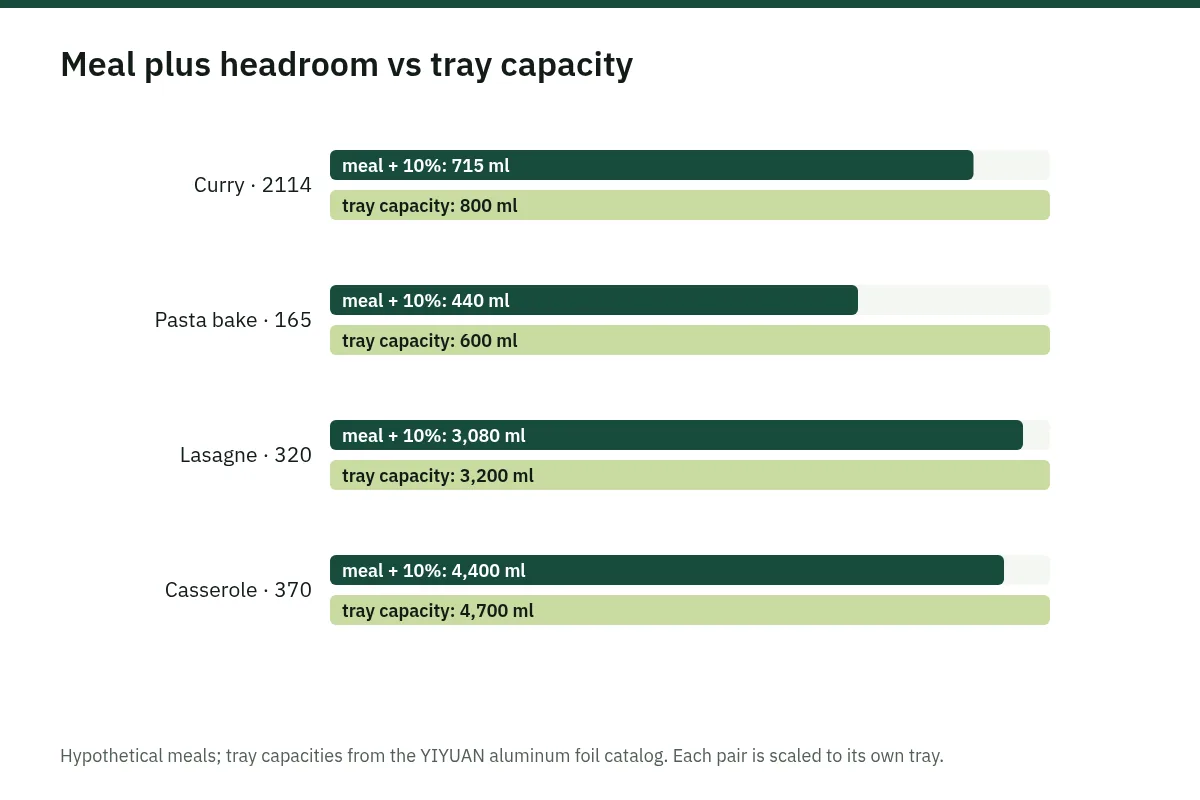
Ice is less dense than water, about 0.917 g/cm³ against 1.0, so water expands by roughly 9% when it freezes. A meal is not pure water, so it expands less, but sauces, soups and wet rice dishes expand enough to push a lid off a tray that was filled to the brim. Allow at least 10% between the meal volume and the tray capacity, and more for liquid dishes.
| Meal | Meal volume + 10% | Example tray | Tray capacity |
|---|---|---|---|
| Single portion, rice and curry | 650 ml → 715 ml | 2114, 210 × 140 × 43 mm | 800 ml |
| Single portion, pasta bake | 400 ml → 440 ml | 165 (1613), 165 × 130 × 45 mm | 600 ml |
| Family lasagne | 2,800 ml → 3,080 ml | 320, 320 × 265 × 60 mm | 3,200 ml |
| Family casserole | 4,000 ml → 4,400 ml | 370, 370 × 270 × 70 mm | 4,700 ml |
The 450 ml 175 (1711) tray would hold the 400 ml pasta bake with only 50 ml to spare, which is too tight for a frozen product. For the full range of single-portion sizes, see our foil container size guide.
Closing the tray
A frozen meal that is not sealed loses moisture from its surface over time, leaving dry, discoloured patches. The cold air in a freezer is very dry, and any gap lets it reach the food.
- Family trays. The 320 lid (320 × 265 mm) and 370 lid (370 × 270 mm) match the top sizes of the 320 and 370 trays. Trays and lids both pack 100 to a carton, so they can be ordered one for one.
- Single-portion trays. The catalog lists no lids for these sizes. Producers commonly use board lids crimped onto the rim or heat-sealed lidding film; ask us what is available for your tray, and test the closure after freezing, not only after filling.
- Extra protection. Overwrapping the closed tray in cling film adds a second barrier for long freezer storage. Our article on wrapping food for the freezer covers the method.
Stacking frozen packs
Frozen meals are packed into outer cartons and stacked on pallets in cold stores. The meal itself is rigid once frozen, but the tray rim and lid are not. Test a full outer carton of frozen packs under the stacking height you expect: check for bent rims, lids that have lifted at the corners and trays that have dented where they touch. Packing frozen meals tightly, with no movement inside the carton, prevents most damage.
Reheating instructions are yours to validate
The U.S. Department of Agriculture explains that food kept constantly frozen at −18°C (0°F) stays safe, though its quality declines over long storage; see Freezing and Food Safety. Reheating is a different matter. The time and temperature printed on your pack must bring your meal to the temperature your market’s food safety rules require, and only testing your meal in your tray proves that. We supply the tray; we do not supply reheating claims.
- Oven: the usual instruction for foil trays. Test with the lid on and off, from frozen, and measure the core temperature at the thickest point.
- Microwave: we do not state that our foil trays are suitable for microwave use. If you want to print microwave instructions, base them on tests with your specific tray, meal and lid, and on the guidance in your market.
- Acidic or salty meals: tomato-based and heavily salted dishes are a particular case for aluminum; read our guide to aluminum foil with acidic or salty foods.
Worked example (hypothetical)
A hypothetical producer launches two lines: a 650 ml curry in the 2114 tray and a 2.8 L family lasagne in the 320 tray with its matching lid. It plans 3,000 lasagnes a month for a year. That is 36,000 trays and 36,000 lids, 360 cartons of each. Before the full order, it orders samples and freezes 20 lasagnes. It stacks them six cartons high for a week, then reheats five from frozen in a domestic oven while logging core temperatures. Only the time that reliably reached its target temperature goes on the label.
Data sources
Tray and lid dimensions, capacities and packing are from the product pages linked above and the aluminum foil catalog, which confirms thickness and alloy with the quotation and lists lids only for the 320, 370 and φ183 round sizes. Frozen storage guidance is from USDA FSIS. Meals, volumes and the test plan in the worked example are hypothetical.
Requesting trays for frozen meals
Send us your meal volumes, the trays you are considering, how you plan to close them, oven or other reheating, and your annual volume. We can send trays and lids for freezing and reheating trials.
Custom sizes. Every size and pack count here can be adjusted to your specification. Custom specifications have a reasonable minimum order quantity. If your order is below it and you still need a custom size, a small customization fee may apply. We confirm both in the quotation.
Prepared by YIYUAN NEW MATERIALS, a cling film and aluminum foil packaging manufacturer in Shangqiu, China. We supply overseas importers and distributors at factory-direct prices with consistent quality, and we have completed orders with a large number of overseas buyers, many of whom first contacted us through this website or through WhatsApp and other social apps. Updated November 20, 2026.