
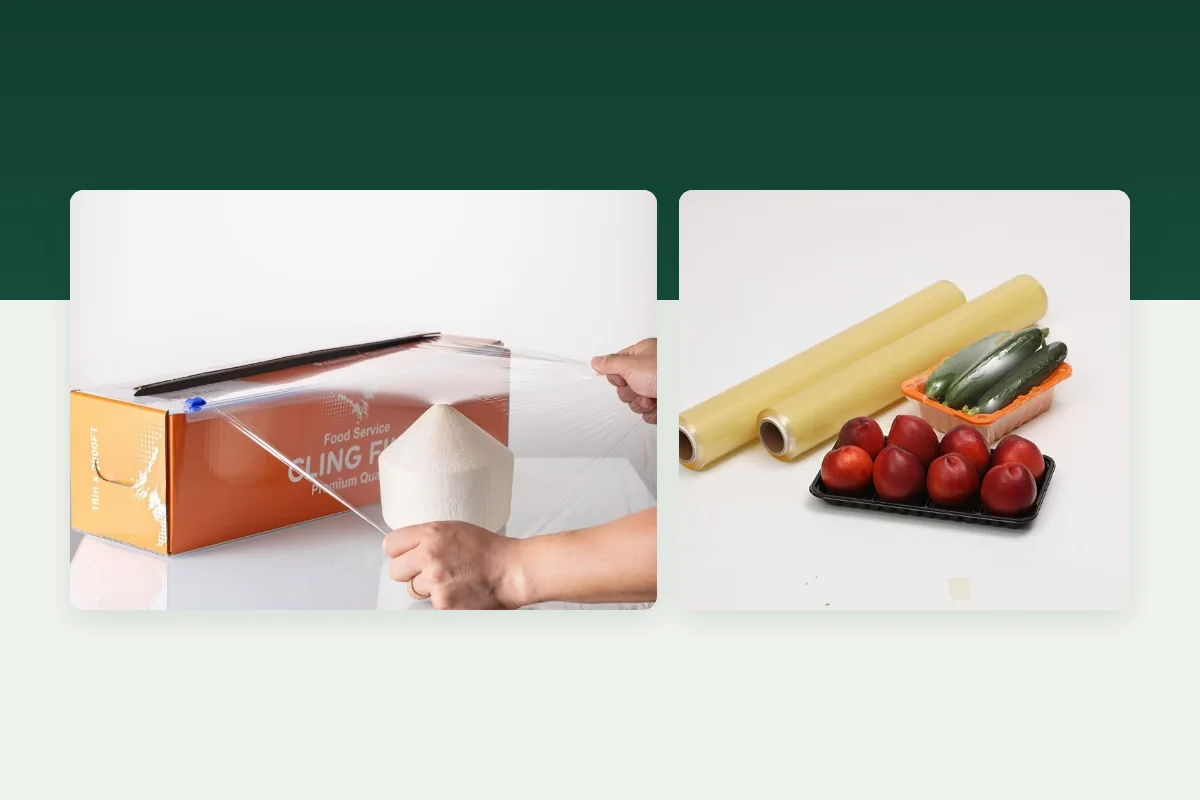
To wrap a sandwich in cling film for a grab-and-go chiller, pull enough film to go around the sandwich with a generous overlap. Wrap it tightly with the seam underneath, fold the ends under, and put the label on a flat area of film where it will stay put. Many cafés then cut the wrapped sandwich in half through the film, so the halves stay together and the filling faces the customer. Behind the counter, three numbers matter: how much film each sandwich uses, how quickly a roll runs out, and what the label has to say. That last one is a legal question in some markets.
A wrapping method staff can repeat
- Pull the film. On a cutter-box roll, pull out a length roughly three times the sandwich’s width. The exact length is worked out below.
- Centre the sandwich. Set it on the film, cut side down if it is already halved.
- Wrap across. Bring the near edge over the top, then roll the sandwich over so the film wraps around it. Keep it snug, but not so tight that it squashes soft bread.
- Fold the ends. Fold each open end under like a parcel and press it flat against the base.
- Cut if needed. With a sharp knife, cut through film and sandwich in one stroke. The film holds the halves together.
- Label. Put the label on the top or side, over a single smooth layer of film rather than a fold.
The same method works for wraps and baguette sections. For wraps, twist the ends instead of folding them; for long baguettes, a wider roll helps.
How much film does a sandwich use?
Use the cross-section of the sandwich to estimate the length you need to pull:
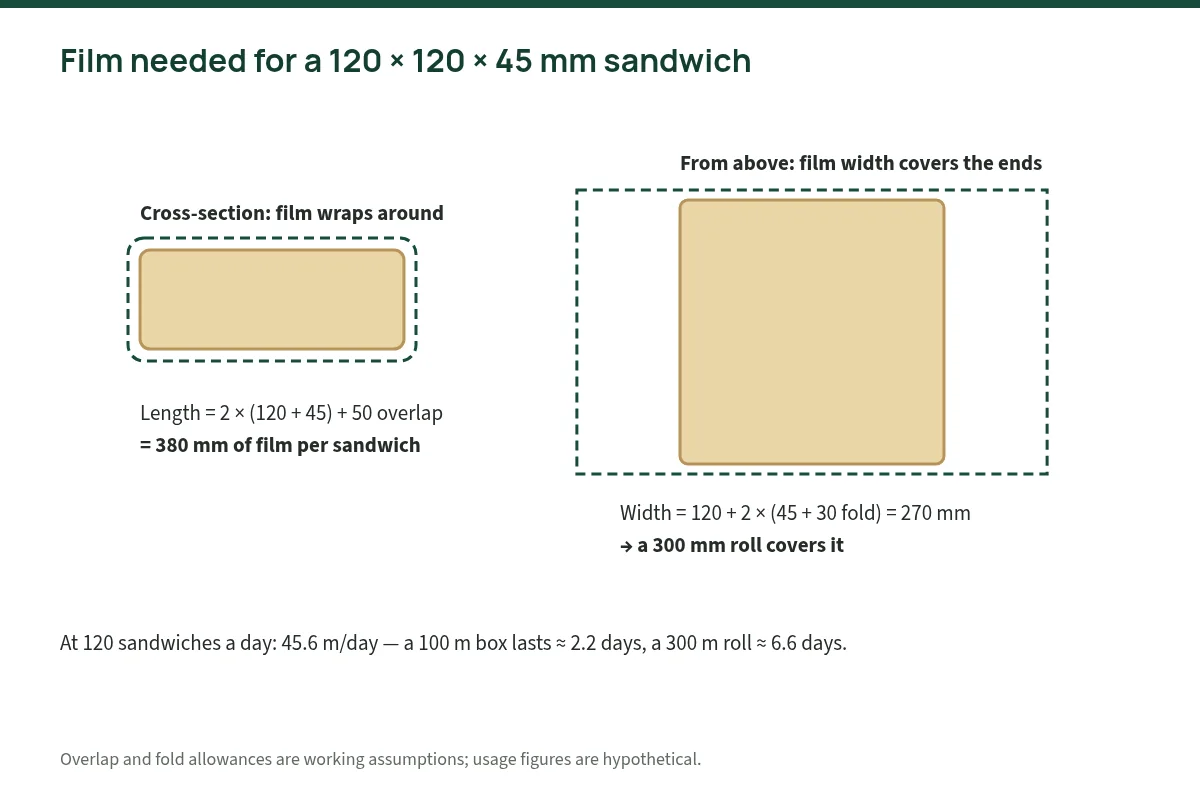
Film length = 2 × (sandwich width + sandwich height) + overlap
Film width needed = sandwich length + 2 × (sandwich height + end fold)
Take a sandwich of 120 × 120 mm bread, 45 mm tall. With a 50 mm overlap and a 30 mm end fold, both working assumptions:
- Length to pull: 2 × (120 + 45) + 50 = 380 mm.
- Width needed: 120 + 2 × (45 + 30) = 270 mm, so a 300 mm roll covers it.
A baguette section of 200 mm needs 200 + 150 = 350 mm of width. A 300 mm roll is too narrow unless you wrap the long way. If your counter makes both, see the trade-offs in 300 mm vs 450 mm rolls.
Worked example (hypothetical)
Picture a hypothetical café that wraps 120 sandwiches each morning, using about 0.38 m of film each. Figures are illustrative.
- Daily use: 120 × 0.38 = 45.6 m.
- A 300 mm × 100 m cutter box lasts about 100 ÷ 45.6 ≈ 2.2 days.
- A 300 mm × 300 m roll lasts about 300 ÷ 45.6 ≈ 6.6 days.
Changing a roll every other day in the middle of the morning rush is a nuisance, so the café moves to a 300 m roll in a cutter box at the main wrapping station. A 100 m box stays as backup on the service counter. That also means buying fewer, larger boxes. Our cutter box vs refill roll article sets out how to compare the cost and labour.
The café also checks waste. Over a week, staff note each time they re-wrap a sandwich, about four a day. That adds roughly 4 × 0.38 ≈ 1.5 m of film a day, small next to the 45.6 m total. The bigger saving came from the longer roll.
Labelling: check what your market requires
A sandwich wrapped on site before the customer chooses it may fall under special labelling rules. In the UK, the Food Standards Agency describes this as prepacked for direct sale (PPDS) food: food packed at the same place it is offered or sold, before the customer selects or orders it. Since 1 October 2021, PPDS food must carry the name of the food and a full ingredients list with the 14 regulated allergens emphasised. A sandwich made and wrapped after the customer orders it is not PPDS (FSA labelling guidance for PPDS food; Scotland has separate guidance from Food Standards Scotland).
Other markets have their own rules. Whatever applies to you, the practical point for the wrap is the same: the label must stay attached and readable through the chiller and the customer’s bag. Test your labels on your film in your chiller, not on a dry desk.
Film choice and limits
- PE or PVC. Both are used for sandwich wrapping. PVC is often chosen for stronger cling, while some markets prefer PE. Trial both on your actual products; see PE vs PVC cling film.
- Fatty fillings. Ireland’s food safety authority notes that some cling film is not suitable for high-fat foods such as cheese and fried meats, and advises checking the manufacturer’s instructions. Our cling film vs foil guide quotes this advice.
- Shelf life. Wrapping doesn’t set a sandwich’s shelf life; the food, its handling and storage temperature do. See shelf-life claims for cling film.
Rolls for café and deli counters
Our commercial cling film rolls include 300 mm × 100 m (8–10 µm, 24 rolls per carton) and 300 mm × 300 m (8–12 µm, 12–24 rolls per carton), with 450 mm options. They are supplied in cutter boxes or as refills, in PE or PVC depending on the market. The product catalog lists the formats. Food-contact documentation depends on the material and specification you order; ask which documents apply to your choice.
Ordering for a café or a chain
Tell YIYUAN how many items you wrap a day, the widest item, and whether you want cutter boxes or refills. Say whether you need PE or PVC, which market you supply, and how many sites you need to stock. We will suggest a roll length that fits your changeover routine.
Prepared by YIYUAN NEW MATERIALS. Updated November 5, 2026. Usage figures are hypothetical. Regulatory references summarise the cited guidance and are not legal advice.