
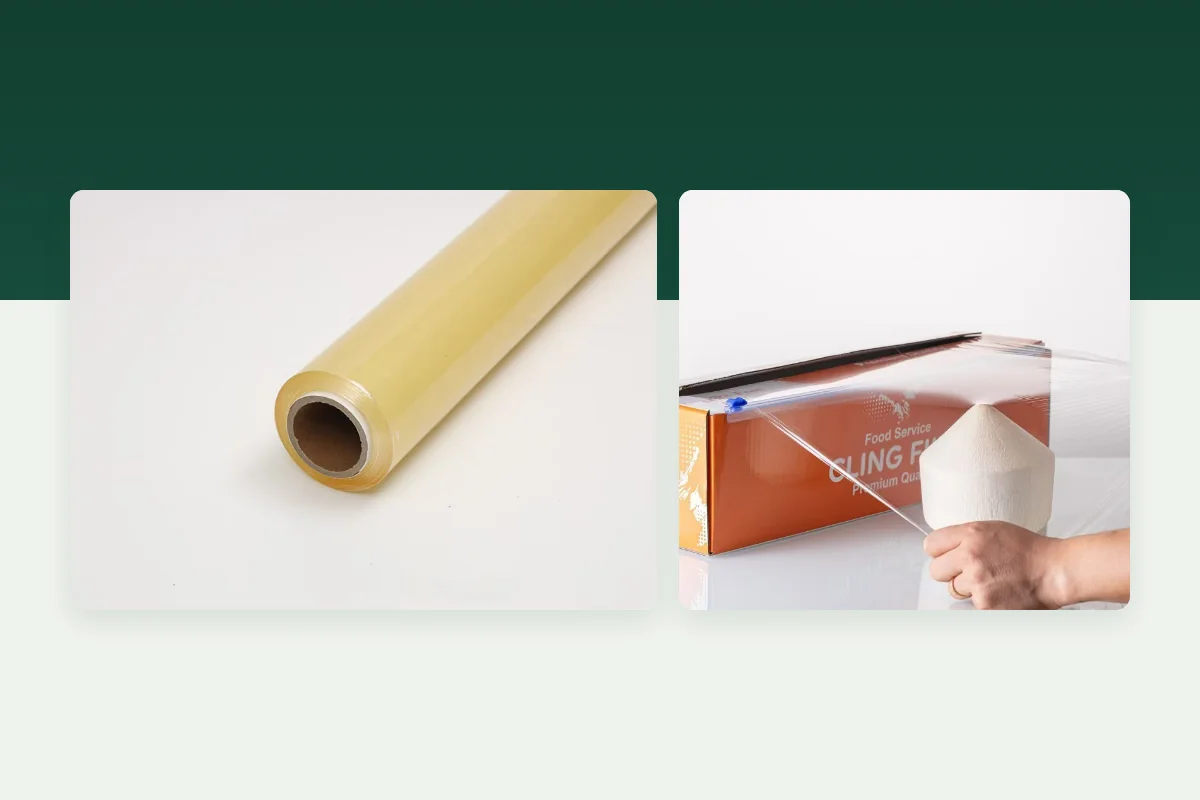
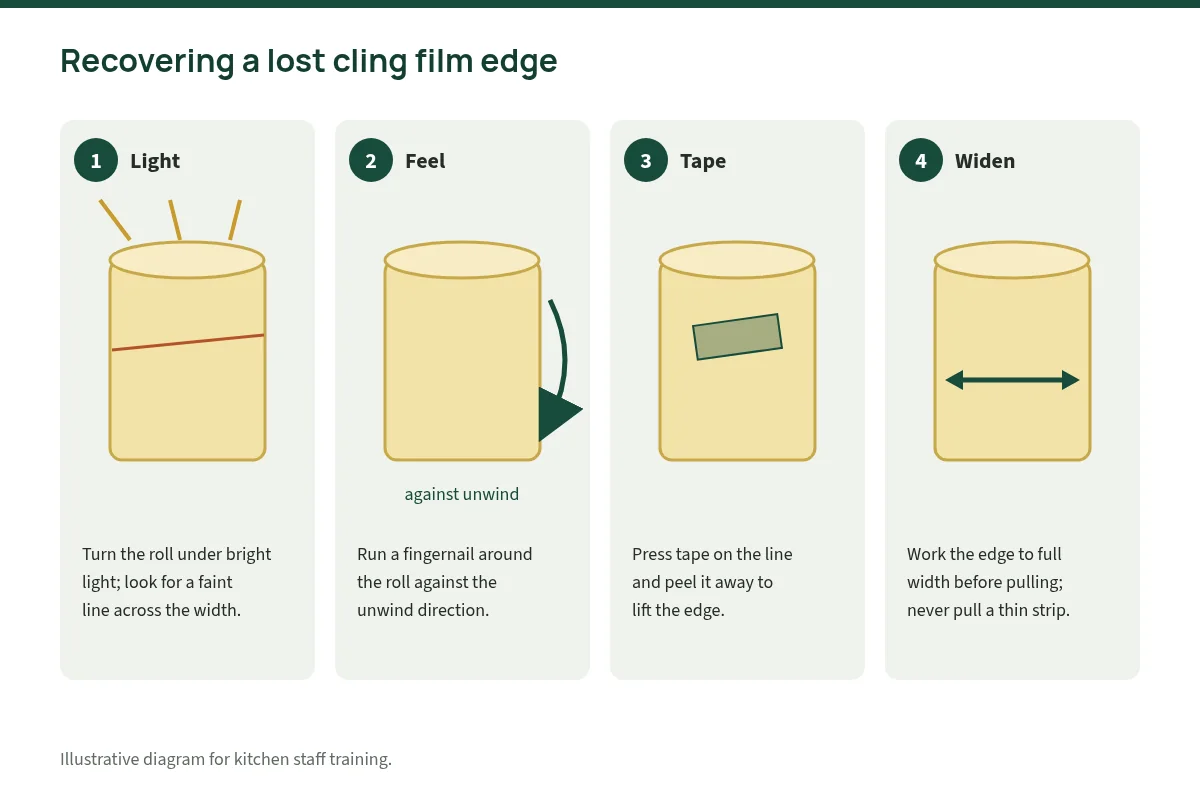
To find a lost cling film edge, hold the roll under a bright light and turn it slowly until you see a faint line across the width. Then press a strip of adhesive tape onto that line and lift. If you can’t see the line, run a fingernail lightly around the roll against the direction it unwinds until the edge catches. Once the edge is up, widen it to the full width of the roll before you pull. That last step is what stops it tearing into a thin strip and disappearing again.
The rest of this article covers why the edge gets lost and how to set up cutter boxes and staff habits so it happens less.
Finding the edge, step by step
- Light first, fingers second. Under good light, the free end usually shows as a slight ridge or a change in sheen running across the roll. Looking costs nothing; scratching at the wrong spot can tear the outer layer.
- Feel against the unwind direction. The free edge trails behind as the roll turns to unwind. Turn the roll the opposite way under a fingernail or the pad of your thumb, and the edge lifts against it.
- Use tape for stubborn rolls. Press a piece of ordinary adhesive tape firmly onto the roll where you think the edge is, then peel it away. Tape grips the top layer harder than the layers grip each other, so it lifts the edge cleanly. Do this with clean hands and tape that stays out of the food area.
- Widen before you pull. If you have only lifted a corner or a narrow strip, don’t pull it. Work it gently across the roll until the full width comes free, then unwind.
- Remove ragged layers. If the outer layer is torn diagonally, unwind and discard it until you reach a clean, full-width layer. Trying to use a torn layer wastes more film than removing it.
Why the edge gets lost
Cling film is made to stick to itself; that is its job. After each cut, the free end springs back and seals onto the roll. Whether you can find it again depends on how the cut was made and where the end ended up.
- Incomplete cuts. If the cut stops halfway, the film tears unevenly. The ragged end sticks to the roll at an angle, which makes it hard to see or lift.
- Letting go too early. If the user releases the film before the cut finishes, the end snaps back across the roll instead of staying on the cutter.
- Open boxes. A cutter box left open lets the end fall back onto the roll.
- Blade problems. A dull or misaligned blade causes partial cuts; our cutter box checklist covers blade position and roll fit.
- Roll condition. If layers stick so firmly that the edge tears every time, the issue may be the roll rather than the user. Heat during storage or excessive winding tension can increase blocking; see our article on unwind force and blocking.
Set up the cutter box so the edge stays put
A cutter box is designed to keep the free end ready. It only works if it is used the way it was designed:
- Pull, then cut in one movement. Pull out the length you need. Keep the film taut and draw it across the blade in one steady movement, holding it until the cut is complete.
- Leave the tail on the lid. On most boxes the lid closes over the film after cutting. The tail then rests on the lid or cutter edge, not back on the roll.
- Close the box between uses. It protects both the edge and the film.
- Consider a slide cutter. A slide cutter runs along a guide and cuts the full width consistently, which reduces ragged ends. Our comparison of metal blade, slide cutter and plastic cutter boxes covers the trade-offs.
For rolls used without a box, a small habit helps: after each cut, fold the last centimetre or so back on itself to make a tab. A folded tab does not seal flat against the roll, so the next user can see it and grab it.
Worked example (hypothetical)
Picture a hypothetical restaurant kitchen with six prep stations, each using a 300 mm cling film roll in a cutter box. During a busy week, the head chef notices staff losing the film end and has a supervisor tally it for two days. The tally averages four lost edges per station per day.
The cost adds up quickly. If each lost edge takes about a minute to recover, that is 6 × 4 = 24 minutes of staff time a day. If each recovery also wastes about one metre of film, that is 24 metres a day. At that rate, a 100 m roll’s worth of film is discarded every 100 ÷ 24 ≈ 4.2 days. These rates are assumptions to show the arithmetic, not measured figures; the point is that a small habit becomes a visible cost when you count it.
The chef makes three changes. The cutter box lids are checked and two boxes with damaged blades are replaced. Staff get a one-minute demonstration of the pull-and-cut technique. And a small card goes up at each station. A follow-up tally a week later shows fewer losses. The chef keeps the card and the tally, which also helps when deciding whether a different box is worth trying.
A training card for prep stations
| Do | Avoid |
|---|---|
| Pull out what you need, keep it taut, cut in one movement | Stopping halfway through the cut |
| Hold the film until the cut is complete | Letting go before the blade finishes |
| Close the lid so the tail rests on it | Leaving the box open |
| Lift a lost edge with tape, then widen it to full width | Pulling a narrow strip |
| Report a blade that tears instead of cuts | Working around a damaged box |
Choosing the format
We supply commercial cling film rolls in cutter boxes, as refill rolls or in shrink-wrapped and private-label packs. Widths are 300–450 mm and lengths 100–500 m, typically 8–12 µm. PVC catering film in cutter boxes is made to order for width, thickness and length. For a busy kitchen, the box matters as much as the film. When you ask for samples, test the box on your busiest station before approving it. Format details are in our product catalog.
When it’s the product, not the habit
If staff technique is good and edges still tear or vanish, send us a description, a photo of the roll and box, and the batch or carton label. Contact YIYUAN with the roll size, box type and what happens when it fails. Our guide to cling film that tears or won’t stick explains what information helps separate a product problem from a use problem.
Prepared by YIYUAN NEW MATERIALS. Updated October 28, 2026. Handling advice reflects general cutter-box use; the worked example and its figures are hypothetical.