
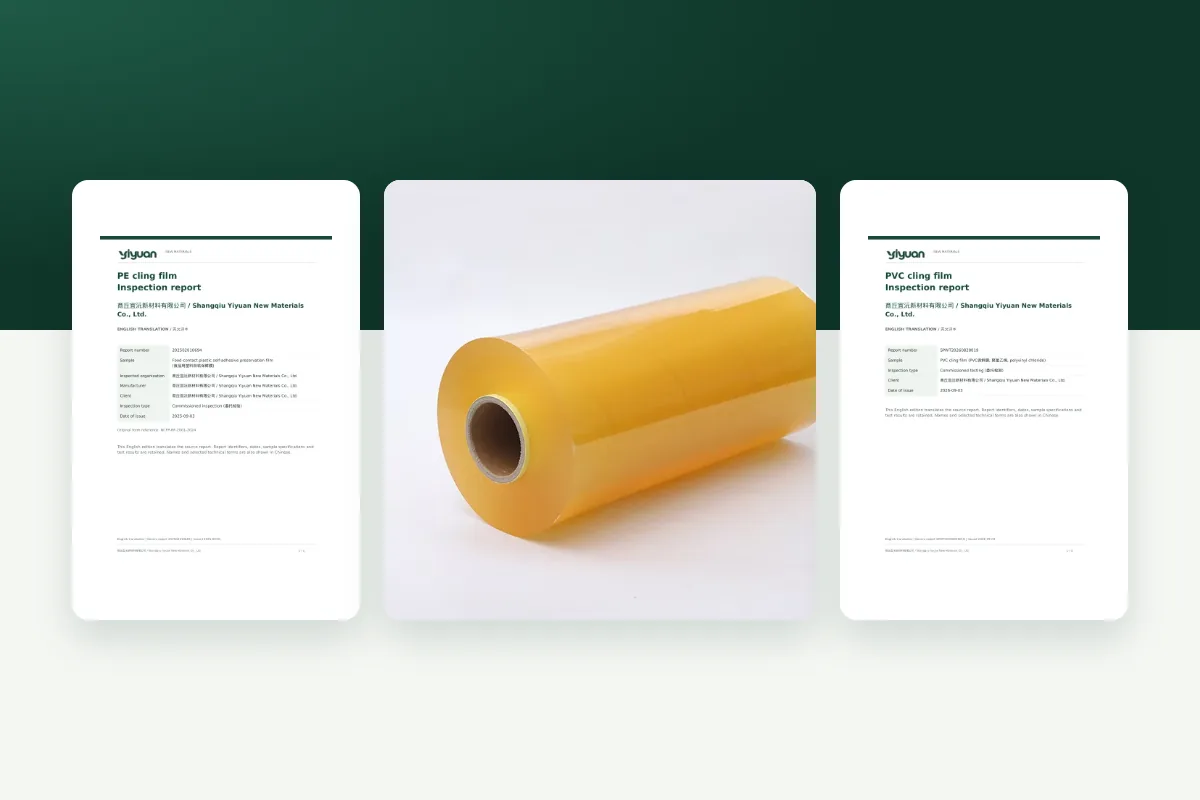
We publish two cling film test reports: one for a PE film sample and one for a PVC film sample, both tested against China’s food-contact plastics standard, GB 4806.7-2023. Both samples passed all seven items. Laid side by side, the two reports show lower overall migration for the PE sample, but that comparison only goes so far. The reports come from different laboratories, tested different sample sizes a year apart, and in one item even printed a different test liquid. This guide sets them next to each other and explains what a buyer can conclude, what they cannot, and what to ask for when you order.
The two reports at a glance
| PE report | PVC report | |
|---|---|---|
| Report number | 202502010694 | SPWT20260828019 |
| Laboratory | Shangqiu Research Center of Product Quality Inspection and Testing | Shandong Shenghe Zhennuo Testing Service Co., Ltd. |
| Sample | Food-contact self-adhesive film, 400 mm × 0.013 mm, 2 rolls | PVC cling film, 350 mm × 0.01 mm, 1 roll |
| Sample received / issued | 2025-08-22 / 2025-09-03 | 2026-08-28 / 2026-09-03 |
| Standard | GB 4806.7-2023 | GB 4806.7-2023 |
| Conclusion | All tested items comply | Tested items comply |
The results side by side
| Item | Limit | PE result | PVC result |
|---|---|---|---|
| 1–2. Sensory: appearance and test liquid | No abnormal colour, odour, turbidity or sediment | Complies | Pass |
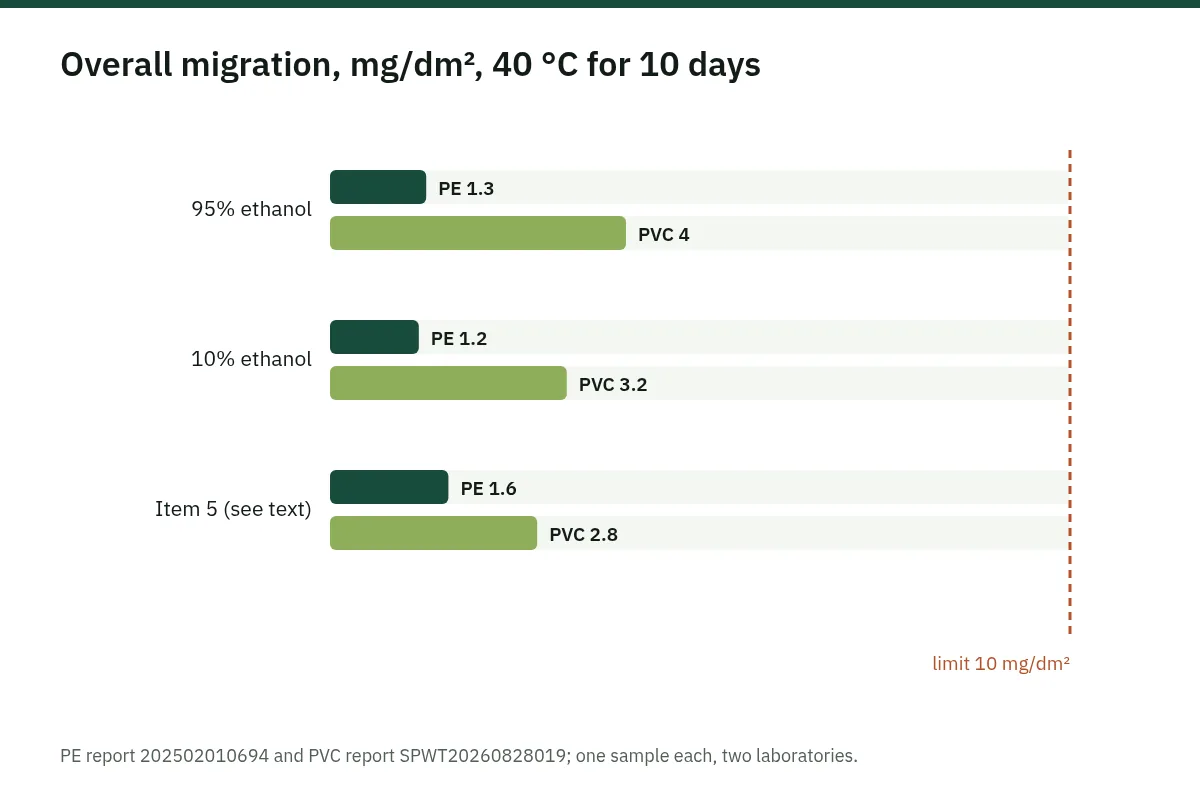
| 3. Overall migration, 95% ethanol, 40°C, 10 days | ≤ 10 mg/dm² | 1.3 | 4.0 |
| 4. Overall migration, 10% ethanol, 40°C, 10 days | ≤ 10 mg/dm² | 1.2 | 3.2 |
| 5. Overall migration, 40°C, 10 days | ≤ 10 mg/dm² | 1.6 (4% acetic acid) | 2.8 (printed as “4% ethanol”) |
| 6. Potassium permanganate consumption, water, 60°C, 2 h | ≤ 10 mg/kg | 1.2 | 2.2 |
| 7. Heavy metals as Pb, 4% acetic acid, 60°C, 2 h | ≤ 1 mg/kg | < 1 | < 1 |
Overall migration measures the total amount of material that moves from the film into a liquid that stands in for food. 95% ethanol stands in for fatty food, 10% ethanol for alcoholic and some other foods, and an acidic liquid for acidic food. Every result in both reports is well inside the limit. Our line-by-line guide to the PVC report explains each item in detail.
What you can conclude
- Both samples met every item tested under the same national standard.
- For these two samples, the PE film showed lower overall migration in the two ethanol tests and lower permanganate consumption.
- Both reports state the sample, laboratory and dates, so you can trace exactly what was tested.
What you cannot conclude
- That PE film is “safer” than PVC film in general. These are single samples from two laboratories a year apart. Both are compliant; the lower number is not a ranking of materials.
- That item 5 compares like with like. The PE report names 4% acetic acid; the PVC source report prints “4% ethanol” for the same item. If the acidic-food result matters to your market, ask for it to be clarified or retested.
- That your order is covered. Each report says results apply to the tested sample only. The PE sample was 13 μm thick, slightly above the 8–12 μm range listed for our commercial rolls; a 10 μm order is a different product specification.
- That additives were assessed. Neither report includes specific migration tests for plasticizers, which are the main document question buyers raise about PVC film. See our article on PVC plasticizer and phthalate questions.
- That the film meets other markets’ rules. GB 4806.7 is China’s standard. U.S. or EU buyers need evidence for their own requirements; see our U.S. and EU document workflow.
Worked example (hypothetical)
A hypothetical importer is bidding to supply PVC film, 450 mm × 10 μm, to a supermarket group, which has asked for “a recent test report”. The importer has the PVC report above, for a 350 mm × 10 μm sample. Width is unlikely to change the material’s test result, but the buyer’s quality team may still ask why the report does not match the tender item. The importer asks us for three things before submitting: confirmation that the tender film uses the same formulation as the tested sample, a clarification of the item 5 test liquid, and a quotation for testing the exact tender SKU if the group requires it. It also asks the supermarket which market’s food-contact rules apply, because a Chinese GB report may need to be supplemented.
Data sources
All report data are from the English translations of PE report 202502010694 and PVC report SPWT20260828019, including the translation note on item 5. The commercial thickness range is from our product page. The tender in the worked example is hypothetical.
Asking for documents that fit your order
Tell us the material, width, thickness and market of the film you plan to order, and what documents your customer requires. We will tell you which existing report relates to it and what further testing would cover your exact specification.
Custom specifications. Width, thickness, length and packing can be adjusted to your specification. Custom specifications have a reasonable minimum order quantity. If your order is below it and you still need a custom size, a small customization fee may apply. We confirm both in the quotation.
Prepared by YIYUAN NEW MATERIALS, a cling film and aluminum foil packaging manufacturer in Shangqiu, China. We supply overseas importers and distributors at factory-direct prices with consistent quality, and we have completed orders with a large number of overseas buyers, many of whom first contacted us through this website or through WhatsApp and other social apps. Updated November 19, 2026.