
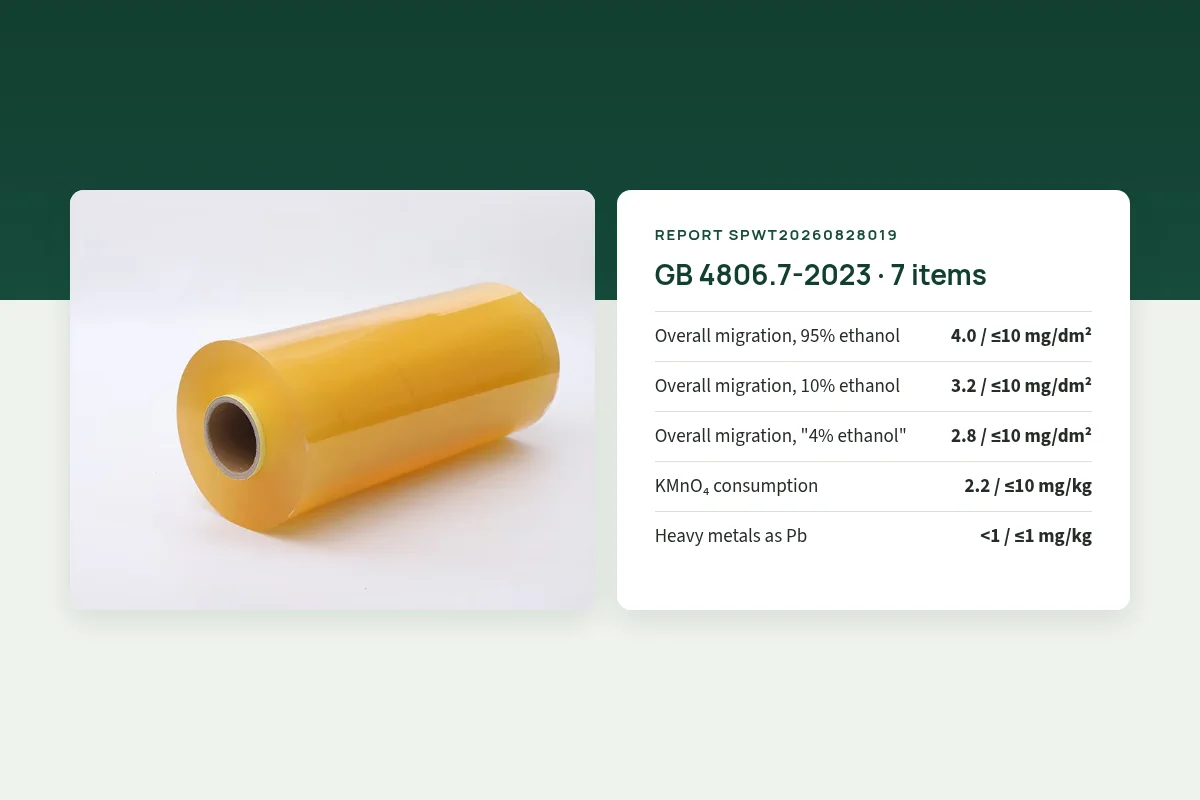
A PVC cling film test report answers one narrow question: did the submitted sample meet the listed requirements under the listed test conditions? This article goes line by line through a real report, our PVC cling film inspection report SPWT20260828019. It explains what each result means and where the report’s evidence stops.
We publish the English translation of the report so buyers can check every figure below. If you are new to reading reports in general, start with how to read a cling film test report before ordering. This piece is the worked version.
The first page: who tested what, and how the sample got there
| Field | What the report says | Why it matters |
|---|---|---|
| Laboratory | Shandong Shenghe Zhennuo Testing Service Co., Ltd. | The issuer you would contact to verify the report |
| Inspection type | Commissioned testing (委托检测) | We sent the sample in; the laboratory did not draw it from a production lot |
| Sample | PVC cling film, 1 roll, intact | One roll is the whole evidence base |
| Specification | 350 mm × 0.01 mm per roll | Width and thickness of the tested sample only |
| Production date / batch | “/” (no entry) | The report cannot be tied to a specific production lot |
| Received / tested / issued | 2026-08-28 / 2026-08-28 to 2026-09-03 / 2026-09-03 | Dates to quote when a customer asks how recent the evidence is |
| Assessment standard | GB 4806.7-2023 | China’s national food safety standard for food-contact plastic materials and articles |
The “commissioned testing” line deserves attention. The report’s own notices state that, for client-submitted samples, the laboratory is responsible only for the tested sample. It is not responsible for the sample information the client supplied. That is normal for this kind of report. It still means the report shows what this roll did, not what every roll from the factory will do.
The seven results, one at a time
| No. | Item and condition | Requirement | Result |
|---|---|---|---|
| 1 | Sensory properties | Normal colour; no abnormal odour or unclean matter | Pass |
| 2 | Immersion liquid (after migration testing) | No turbidity, sediment or abnormal odour | Pass |
| 3 | Overall migration, 95% ethanol, 40 °C, 10 days | ≤ 10 mg/dm² | 4.0 mg/dm² |
| 4 | Overall migration, 10% ethanol, 40 °C, 10 days | ≤ 10 mg/dm² | 3.2 mg/dm² |
| 5 | Overall migration, “4% ethanol” as printed, 40 °C, 10 days | ≤ 10 mg/dm² | 2.8 mg/dm² |
| 6 | Potassium permanganate consumption, distilled water, 60 °C, 2 h | ≤ 10 mg/kg | 2.2 mg/kg |
| 7 | Heavy metals (as Pb), 4% acetic acid, 60 °C, 2 h | ≤ 1 mg/kg | < 1 mg/kg |
Items 1 and 2: sensory checks
These are visual and odour checks on the film, and on the test liquid after it has been in contact with the film. They catch gross problems such as discolouration, cloudiness or smell. A pass here is a basic hygiene check. It says nothing about whether the film will cling, tear cleanly or keep its clarity on a cold tray.
Items 3–5: overall migration
Overall migration measures the total amount of material that leaves the film and enters a test liquid. It does not identify which substances moved, only the total, in milligrams per square decimetre of film.
The test liquids are called food simulants. Under China’s general migration-testing rules, GB 31604.1-2023, they stand in for food types. Water-based ethanol solutions and dilute acid represent aqueous and acidic foods. Some chemical solvents, 95% ethanol among them, may substitute for oily food simulants. Testing in three simulants means the film was checked against more than one type of food.
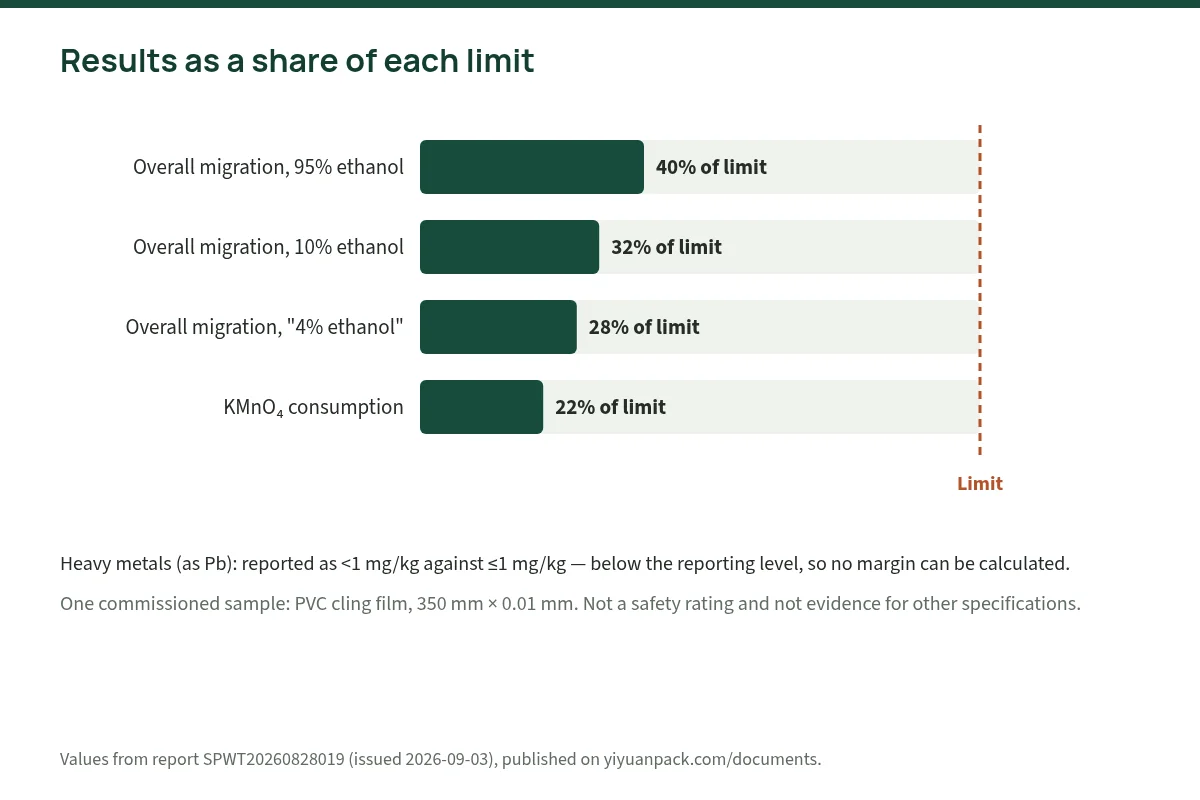
All three results are below the 10 mg/dm² limit. Expressed as a share of the limit, they are 40%, 32% and 28%. That margin is useful context. It is not a safety rating, and it does not carry over to a different formulation or thickness.
A note on item 5. The source report prints this simulant as “4%乙醇” (4% ethanol). Our English translation keeps that wording, as its terminology note explains. In Chinese migration testing, the usual acidic simulant is 4% acetic acid, which is the liquid used in item 7. If your customer or auditor reviews this line, ask the laboratory to confirm which simulant was used. Do not reinterpret the figure yourself. We prefer to point this out than have a reviewer find it first.
Item 6: potassium permanganate consumption
This test exposes the film to distilled water at 60 °C for two hours. It then measures how much potassium permanganate the water consumes. The figure is an indirect indicator of oxidisable organic substances released into water. The result of 2.2 mg/kg is well under the 10 mg/kg requirement.
Item 7: heavy metals as lead
Here the test liquid is 4% acetic acid at 60 °C for two hours, and the result is reported as “< 1 mg/kg” against a limit of “≤ 1 mg/kg”. In plain terms, the result was below the level the method reports. You cannot calculate a margin from it the way you can for items 3–6, and you should not quote it as “zero”.
What this report does not tell you
A buyer who understands the limits of a report is in a stronger position than one who simply files it. This report does not establish:
- Other specifications. The sample was 350 mm × 0.01 mm. A different width is usually the same film slit differently, so it is less of a concern. A different thickness or formulation is a different product and needs its own evidence.
- Specific substances. No item measures the migration of individual substances, such as particular plasticisers, or residual vinyl chloride monomer. If your market or customer requires those results, ask for them explicitly. Our PVC plasticiser document questions list what to request.
- Compliance in another market. GB 4806.7-2023 is a Chinese national standard. A European buyer will usually need a declaration of compliance under the EU plastics regulation. A US buyer will look at FDA food-contact rules. See US and EU document requests for cling film.
- Heating instructions. The temperatures in the table are standardised test conditions. They are not a microwave or oven instruction for end users. Any use claim on a box needs its own evidence, as explained in matching cling film use claims to food, time and temperature.
- Performance. Cling, stretch, tear behaviour and clarity are not part of a GB 4806.7 food-contact test.
- Production consistency. With no batch recorded, the report cannot show that later lots match the sample. That is the job of your incoming inspection and your supplier’s change control.
Worked example (hypothetical)
Consider a hypothetical importer who wants to list a 300 mm × 300 m PVC catering roll and a 450 mm × 500 m roll. Both are proposed at 10 µm in the same PVC formulation as the tested sample. The importer’s customer asks, “Is this film tested?”
An honest answer has three parts. First, a 350 mm × 0.01 mm sample of the PVC film was tested to GB 4806.7-2023 and passed the seven listed items (report SPWT20260828019). Second, the two proposed rolls differ in width and length, and the supplier will state in writing whether the formulation and thickness are identical to the tested sample. Third, if the destination is the EU, a declaration of compliance for that market will follow, and it is a separate document. That answer takes longer to write than “yes, certified”. It is also the answer that holds up when an auditor reads the report.
Products and documents referenced
The report covers a sample of our PVC cling film. Related products include PVC fresh wrap film, PVC catering cutter-box film and PVC large rolls. For PE film, a separate PE inspection report (202502010694) covers a 400 mm × 0.013 mm PE sample. The two reports cover different materials and samples, so we do not compare their figures as if they were the same product. All four public documents are listed on our documents page.
Asking for evidence that fits your order
When you contact YIYUAN about PVC film, tell us the width, length, thickness and box format you plan to order. Tell us the destination market and any substance-specific results your customer requires. We will tell you which existing documents apply to that specification, and what new testing would be needed for anything they do not cover.
Prepared by YIYUAN NEW MATERIALS. Updated October 24, 2026. Results are quoted from report SPWT20260828019; the worked example is hypothetical. A test report on one sample is not a certification of all production.