
Poultry trays are harder to overwrap than most fresh food for three reasons: they leak, they have sharp edges, and they stay wet. Purge (the pink drip that collects under chicken) wets the tray rim so the film cannot cling. Wing tips and cut drumstick bones push up into the film and can puncture it in the display case. And a tray that leaks in the shopping basket is the one complaint a meat department cannot afford. Choose a roll width that leaves enough film to tuck well under the tray, keep the rim dry, and approve the film thickness on your own bone-in packs, not on a flat test tray.
What makes poultry different from red meat and deli trays
Our guide to cling film for meat and deli trays covers cold display in general. Poultry adds problems of its own:
| Problem | Where it shows up | What to change |
|---|---|---|
| Purge on the rim | Film lifts at the corners, pack is not sealed underneath | Absorbent pad under the product; wipe or keep the rim dry before wrapping |
| Bone ends and wing tips | Small holes or tears over drumsticks, thighs, wings | Place bone ends down or toward the centre; test a thicker film |
| Product higher than the tray | Film stretched tight over a whole bird or stacked pieces | Deeper tray or wider roll so the film is not overstretched |
| Cold, wet hands and station | Film sticks to itself before it reaches the tray | Keep the cutter and plate dry; use a high-cling PVC film |
Choose the roll width from the tray, not from habit
On a hand-wrap station, the roll width covers one dimension of the tray and the length you pull covers the other. The film has to climb both sides of the tray and fold underneath. A useful planning rule:
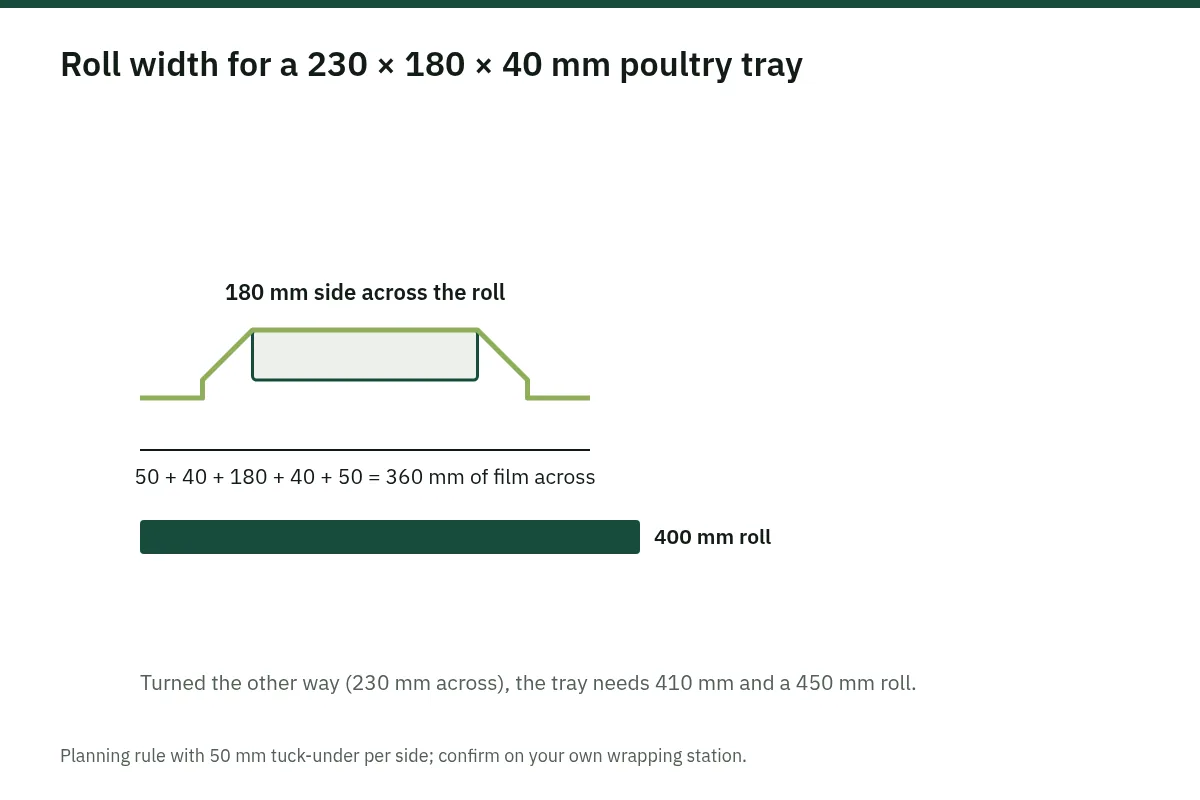
Roll width needed ≈ tray side across the roll + 2 × tray height + 2 × tuck-under allowance.
Use about 50 mm per side as a starting tuck-under allowance, then confirm it on your station. Which side of the tray you lay across the roll changes the answer, as the example below shows. Our commercial cling film roll is listed in 300, 350, 400 and 450 mm widths, and our PVC fresh wrap in 300, 450 and 600 mm. For the wrapping method itself, see how to hand-wrap a fresh food tray.
Worked example (hypothetical)
A hypothetical supermarket packs chicken thighs on a tray measuring 230 × 180 mm and 40 mm deep.
- 180 mm side across the roll: 180 + 2 × 40 + 2 × 50 = 360 mm. A 400 mm roll covers it with room to spare.
- 230 mm side across the roll: 230 + 80 + 100 = 410 mm. That needs the 450 mm roll.
The store chooses 400 mm and wraps with the 180 mm side across. The film pulled for each pack covers the other direction: 230 + 80 + 100 = 410 mm. A 300 m roll then gives 300,000 ÷ 410 ≈ 731 packs before waste. Allowing 10% for restarts and torn pieces, the store plans on about 658 packs per roll. If it wraps 200 chicken packs a day, one roll lasts a little over three days.
Thickness: test on bone-in packs
Our listed range for commercial rolls is 8–12 micron. A thinner film is cheaper per metre, but poultry is where thin film shows its limits. Ask for samples at two thicknesses, for example 10 and 12 micron, and wrap the packs that cause trouble: drumsticks, wings and whole legs. Hold them in the display case for a normal day and count holes and lifted corners. Our article on 8, 10 or 12 micron cling film explains how to compare the cost of each.
Keep the pack cold and closed
Cling film does not keep chicken safe; temperature does. The FDA Food Code, a model code widely adopted by U.S. state and local agencies, sets cold holding for foods like raw poultry at 5°C (41°F) or below. What the film can do is keep the pack sealed so purge stays inside it and does not reach other products. A pack whose film has lifted at one corner is no longer sealed underneath, so check corners at the end of the shift, not only after wrapping.
PVC or PE for poultry?
Most hand-wrap stations use PVC film because it clings and stretches well around wet, uneven packs. We supply both PE and PVC cling film. If your market or customers prefer PE, test it on your wettest packs before switching, as described in our changeover validation guide.
Data sources
Widths, lengths and the 8–12 micron range come from our commercial cling film roll and PVC fresh wrap product pages and the product catalog. The tray size and daily volume in the worked example are hypothetical. Cold-holding temperature is from the FDA Food Code 2022.
Requesting film for poultry trays
Send us your tray sizes and depths, the cuts you pack (whole legs, wings, fillets), whether you wrap by hand or machine, and your daily pack count. We will suggest a width and two thicknesses to sample.
Custom sizes. Every width, length and thickness here can be adjusted to your specification. Custom specifications have a reasonable minimum order quantity. If your order is below it and you still need a custom size, a small customization fee may apply. We confirm both in the quotation.
Prepared by YIYUAN NEW MATERIALS, a cling film and aluminum foil packaging manufacturer in Shangqiu, China. We supply overseas importers and distributors at factory-direct prices with consistent quality, and we have completed orders with a large number of overseas buyers, many of whom first contacted us through this website or through WhatsApp and other social apps. Updated November 7, 2026.