
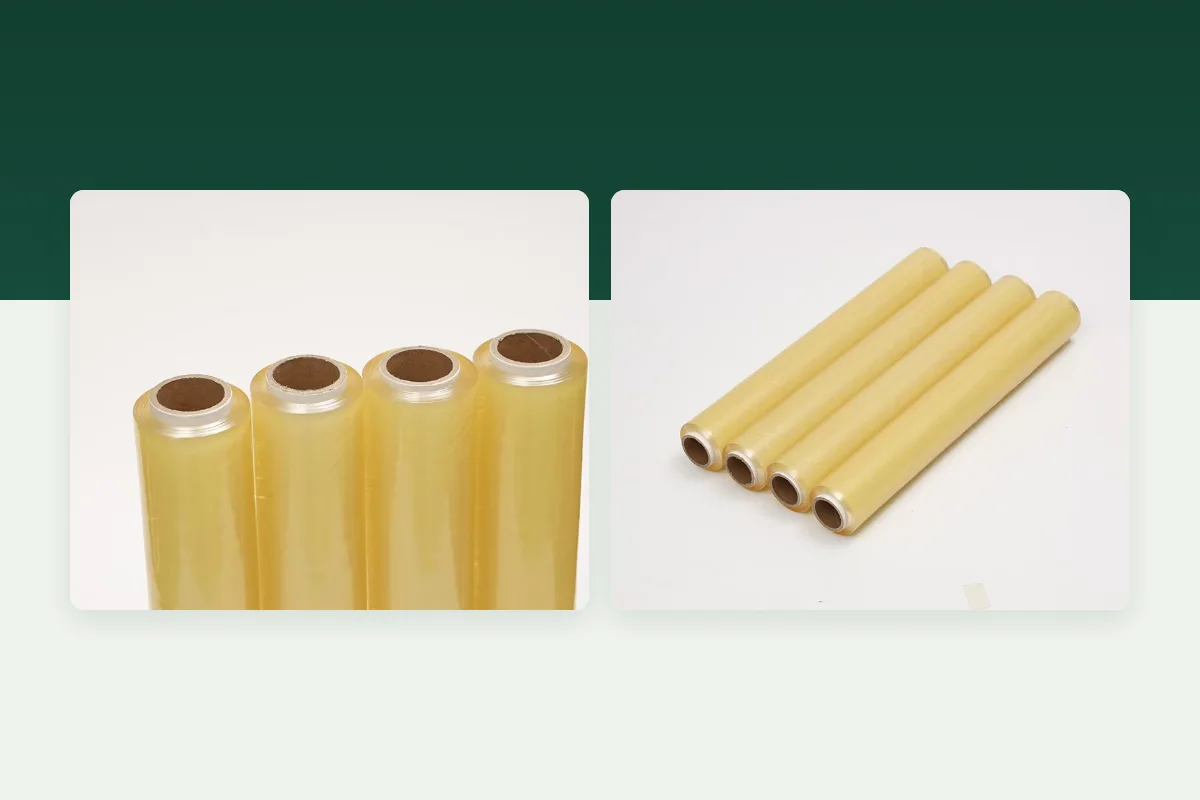
A household cling film range sells best when shoppers can tell its products apart at a glance. In practice that means two or three sizes that differ in a way the shopper understands, usually length, sometimes width. Price per metre should fall as the roll gets longer, and refills should demonstrably fit the dispenser box they replace. Most retail ranges that confuse shoppers have the opposite problem: several near-identical rolls, unit prices that don’t add up, and refills that only fit last year’s box.
This guide is for supermarket buyers, private-label managers and distributors building a household range around PVC household refill rolls.
Start with what the shopper is choosing
At the shelf, a shopper decides between three things:
- Box or refill. A first purchase needs a dispenser box with a cutter. After that, a refill is cheaper and uses less packaging, provided it fits.
- How much. Shoppers see length on the pack. Most households don’t know whether they need 30 m or 60 m; they know whether the last roll ran out quickly.
- Width. A standard width covers most bowls and plates. A wide roll is for large platters and roasting trays. Fewer shoppers need it, so it works as a single option rather than a full set.
A range that maps to those three choices keeps the shelf readable. For a wider view of SKU planning, see our distributor SKU guide.
Make the unit price tell a sensible story
Shoppers increasingly compare unit prices, and in some markets the shelf label must show one. In the EU, the price indication directive defines the unit price as the final price for one kilogram, one litre, one metre, one square metre or one cubic metre of the product, or another unit customarily used in that member state (Directive 98/6/EC, Article 2). How your market applies this to film varies, so check locally. Either way, plan your prices so the unit price makes sense.
Two rules keep it coherent:
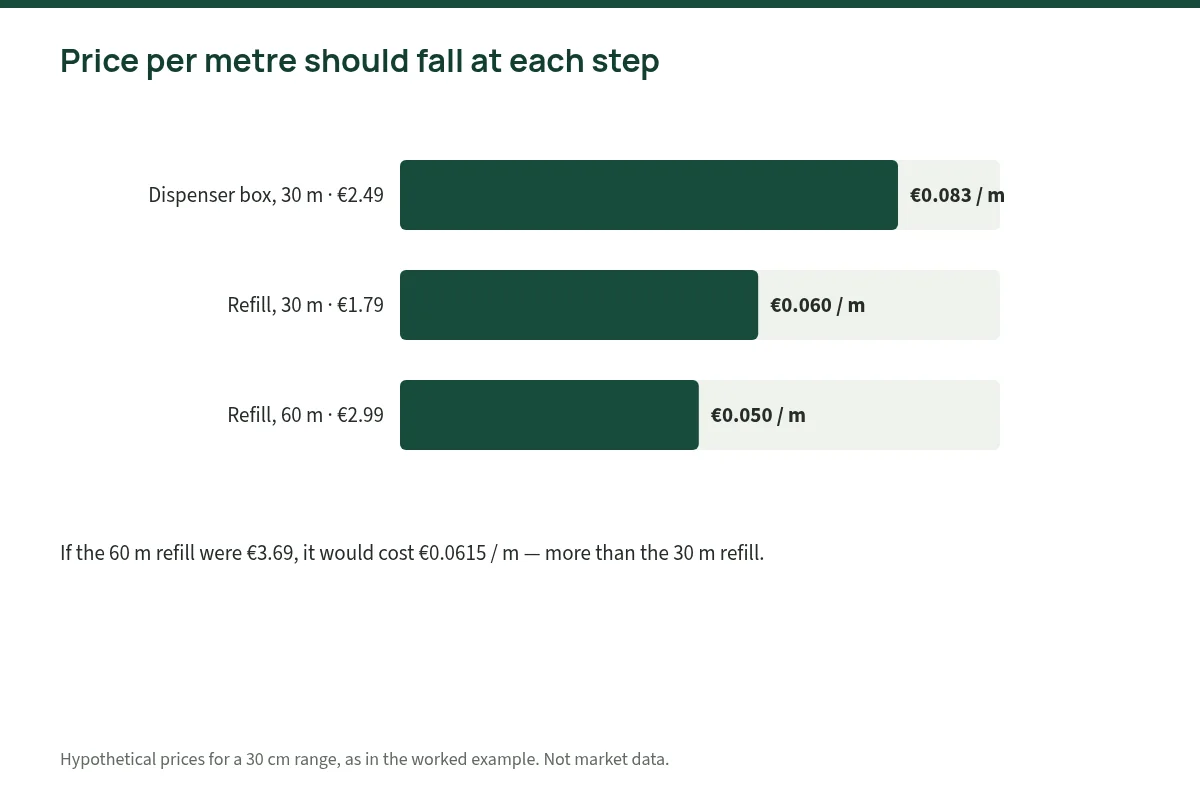
- A refill should cost less per metre than the same length in a box. Otherwise there is no reason to refill.
- A longer refill should cost less per metre than a shorter one. It rewards the regular buyer and keeps the long roll from looking like a trap.
Worked example (hypothetical)
Consider a hypothetical regional supermarket planning a three-item private-label range in a 30 cm width. The prices are illustrative, not market data.
| Item | Shelf price | Price per metre | Price per m² (30 cm wide) |
|---|---|---|---|
| Dispenser box, 30 cm × 30 m | €2.49 | €2.49 ÷ 30 = €0.083 | €0.083 ÷ 0.3 = €0.277 |
| Refill, 30 cm × 30 m | €1.79 | €0.060 | €0.199 |
| Refill, 30 cm × 60 m | €2.99 | €0.050 | €0.166 |
Each step down the table is cheaper per metre, so the range follows both rules. Per-metre figures are rounded to three decimals. Now suppose the buyer had priced the 60 m refill at €3.69. That is €0.0615 per metre, slightly more than the 30 m refill. A shopper reading unit prices would see the long roll as worse value. The buyer could not have spotted that from shelf prices alone.
The same supermarket considers adding a 45 cm box. Its customers buy very few large-tray products, so it lists the 45 cm as a single dispenser box without a refill, and reviews it after one season.
Refills must fit the box, every time
A refill that doesn’t fit the dispenser does more damage than a missing product. Define fit in the specification, not just in the sample:
- Roll width against the box’s internal length, with clearance so the roll turns freely.
- Outside diameter of a full roll against the box’s internal height and depth. A longer refill means a larger diameter.
- Core size and strength, so the roll turns smoothly and keeps its shape in transport. See core size and dispenser compatibility.
- Change control. If the box is redesigned or the core changes, every existing refill SKU must be rechecked. Our change control article explains how to make the supplier tell you before it happens.
The 60 m refill in the example above will have a larger diameter than the 30 m one. Check that it fits the 30 m box. If it doesn’t, the box needs enough room for the longest refill you plan to sell.
What the pack should say
- Width × length in the units your market uses, both prominent.
- The material (for example, PVC).
- Use instructions that match the product’s documents, such as guidance on microwave use and fatty foods. Our comparison of cling film and aluminum foil by kitchen task quotes the official advice that this text should follow.
- Which dispenser box the refill fits, with a simple loading diagram.
- A batch or lot code, so complaints can be traced.
- Any disposal or recycling marking required in your market.
Our articles on private-label cling film packaging and box artwork, barcodes and MOQ cover the production side.
About the product
YIYUAN PVC household refill rolls are made to order: width, thickness, roll length and core are set per customer, and rolls can be supplied individually or in retail packs. For markets that prefer PE, our cling film rolls are available in PE or PVC. The PVC inspection report SPWT20260828019 covers a 350 mm × 0.01 mm sample of our PVC film. Confirm with us whether your chosen household specification uses the same formulation, and what documents your destination market requires.
Planning a range with YIYUAN
Send us the widths and lengths you are considering, the dispenser box dimensions (or a sample box), the retail pack format and the label language. Include expected volumes per SKU and the destination market. We can confirm roll diameters for each length so you can check refill fit before artwork is final.
Prepared by YIYUAN NEW MATERIALS. Updated November 3, 2026. Prices in the worked example are hypothetical. Regulatory references are summaries; check the requirements of your market.